Dragon – Wrath

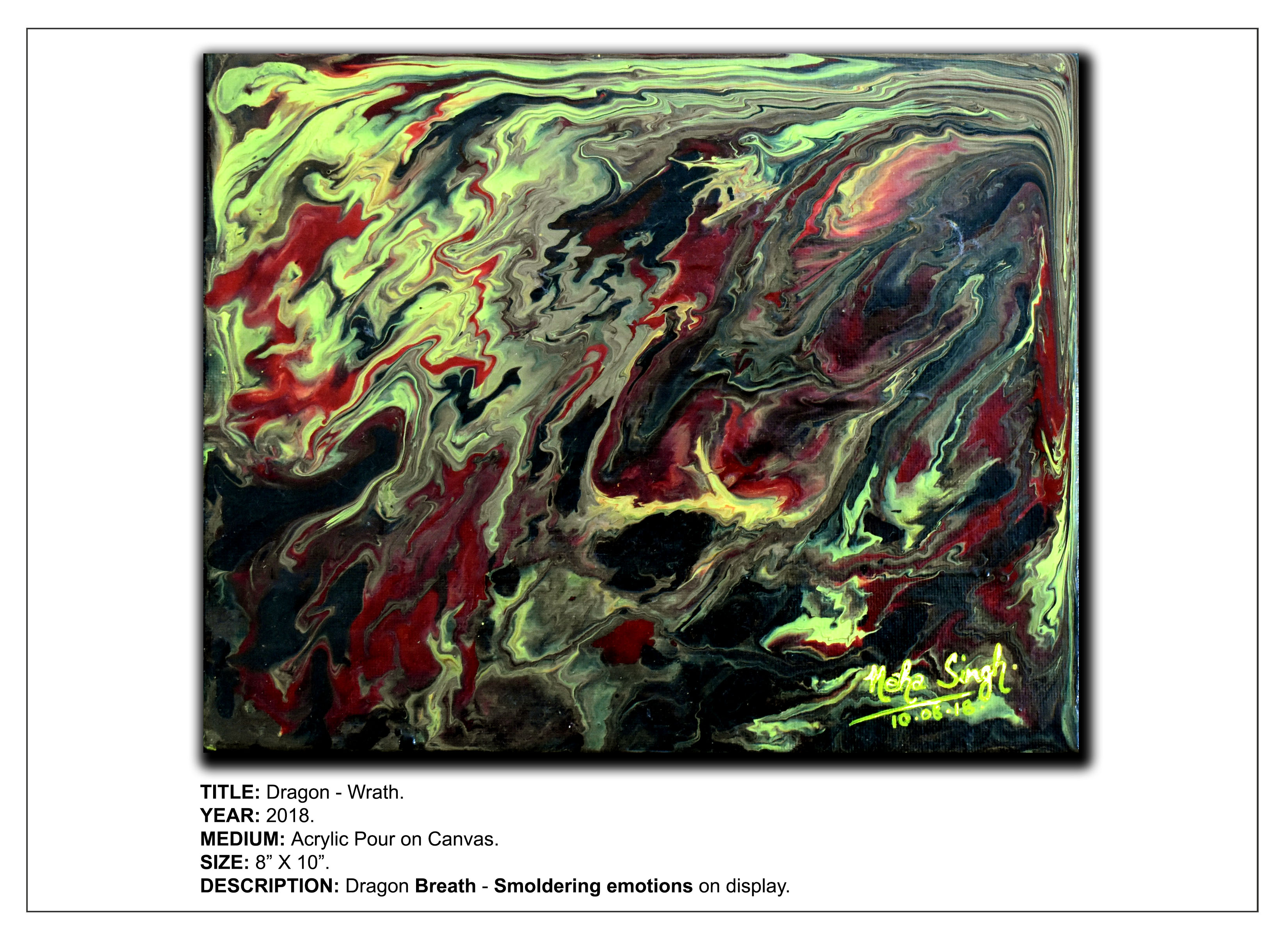
When the dragon breathes fire, all hell breaks loose. The devastating flames expelled from its gullet via its mouth annihilate whatever crosses their path. It is believed that this ruinous blaze can cut through rock like a hot knife cuts through a stick of butter. As the dragon grows, both in age and size, so does its fire power, almost as if the flames churning inside its belly are gradually building up into a blistering inferno.

This searing conflagration is the subject of my next painting, Dragon – Wrath. When the molten broth depicted in my previous artwork has built up to a point where it cannot be contained anymore within its glowing furnace, it rises up the gullet and en route to the mouth, the noxious fumes of a highly inflammable aerosol are released through two orifices. The minute a spark from the fiery cauldron hits this froth, it lights up to create a plume of fire and Kaboom!! It wreaks havoc mercilessly on its helpless victims. The torrential outburst of a livid human mind resembles this smoldering eruption. As the flames of fury build up inside the head, all reasoning and intellect are engulfed by them, and the obnoxious poison that is released, sets free the most dreadful of all emotions…anger. This exasperated and irrational mental state is a ticking time bomb like Drogon, triggered off to explode by the Dragon Queen’s command….DRACARYS!!(Love dragons! Gotta love GOT!!)
The technique I have employed here is the simple Flip Cup, which I have described in detail in one of my earlier posts. In short, it is just a layering of colors mixed with pouring medium and silicone in a single cup, which is flipped quickly in a swift motion onto the canvas and allowed to flow and spread with the help of a little tilting. The addition of silicone is optional, depending on whether you wish to create cells or not. In this case, I chose not to add silicone as I felt cells would give it a more organic look, which I did not want. I have used shades of yellow, red and black to depict the simmering heat, not just of the dragon’s breathe, but also of the violent temper inside a mind mad with rage. While the yellow and red symbolize the fatal nature of the dragon, hence a destructive mentality, the black gives a glimpse of the catastrophic end…when all that is left is smoke, soot and vapor.

Dragon – The Fire Within

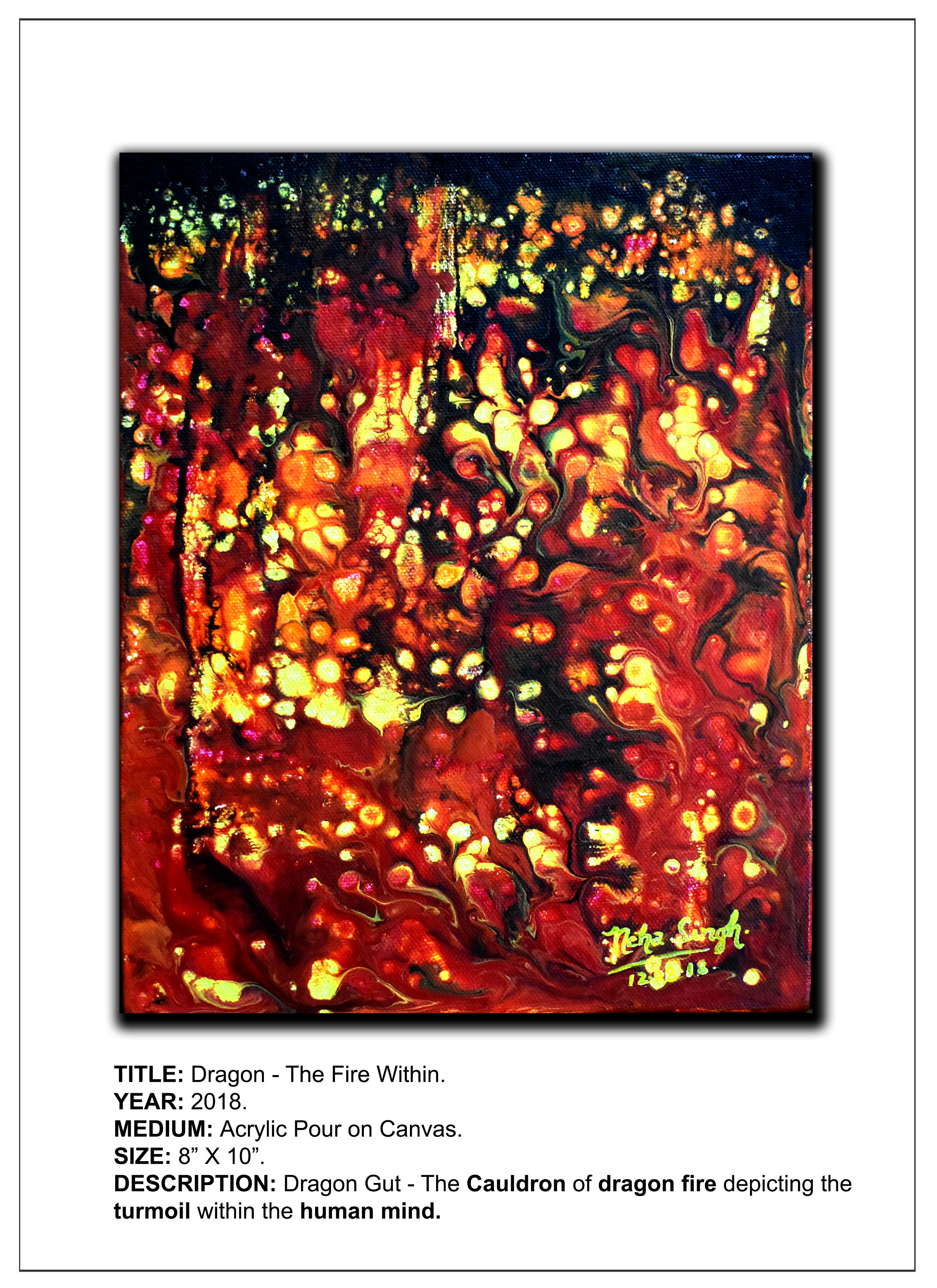
So, the next installment of my Dragon Series is an Acrylic Pour, my very first for that matter. Before I get into the technicalities of the procedure itself, let me run you through the essence of the artwork.

This one is a sequel to “Camouflage” and gets “inside the skin” of the beast, literally and of the human mind, figuratively. Under the impenetrable crust of the scales, a fire blazes within the belly of this colossal creature, simmering in a broth of molten flames. This molten blaze is a metaphor for the turbulent storm raging within the mind of an infuriated human. The tempest continues to brew inside the fiery precipice, churning and seething, threatening to spew forth its impending doom.

I have attempted to depict this smoldering inferno through the Pour and Swipe method of acrylic pouring. The color palette I have used comprises of warm tones of fire, namely yellow, orange and red, with black acting as a contrast. I mixed each color in a 1:1 ration with Liquitex pouring medium and diluted it further with water to get a flowing consistency. Except for the black, I added 2 to 3 drops of silicone to the rest of the colors. The secret to getting cells to form in your pour mainly lies in the stirring. If you want big cells, then a couple of gentle stirs is enough, but, if you want numerous small cells, then give your concoction a nice vigorous mix. Let the mixtures stand for a few minutes for the reaction to take place and air bubbles to pop.

Thereafter, I poured the yellow, orange and red vertically across the canvas and tilted it gently to ensure the entire surface, including the sides were covered with paint. The next step was to pour the black paint horizontally on one end of the canvas. Then, with the help of a swiping tool (you can use almost anything, from an old credit card, a piece of card board to even a price tag card!), I dragged this black paint across vertically from one end of the canvas to the other, so that it went over all the other colors. What happened thereafter was pure magic! Beautiful cells started to form, as the colors overlapped and the silicone reacted with them. One thing I had to look out for was the formation of air bubbles. This problem can be solved with the help of a flame gun. Not only does it pop the bubbles, but also accelerates the formation of cells.

The end result quite resembled red hot molten lava, spewing and bubbling, overflowing with rage and fury, on the verge of breaking out of its slumber. I decided to be a little more adventurous and tipped the canvas a bit more, resulting in the cells also flowing around to form random, convulsing shapes, giving the effect of boiling hot magma. Phew! Boy was I lucky!! This is exactly what I wanted! Acrylic pour really works wonders in the most unexpected ways.    

Confessions of an Acrylic Pour Addict

I love creating art systematically and methodically…I can proudly claim that when it comes to creating an artwork, my patience knows no bounds and I can go to great lengths to incorporate the tinniest detail in my work. I love playing around with my art supplies and always endeavor to produce something new and distinctive. This means frequent trips to art stores which I absolutely love!! Let me loose in one and I am like a little child who has just found his favorite toy!
But hold on! Being methodical doesn’t mean I can’t be messy!! I love experimenting with new techniques and mediums as much as I love bearing my quintessential oil paints onto a blank canvas. It was on one such exploratory journeys that I stumbled upon the fascinating world of ACRYLIC POURING. It felt as if I had walked into a whole new domain of artistry, like a Pandora’s Box with tons of possibilities, through which I could create divine magic on the canvas!! Even though it meant a lot of experimentation, trial and error, muddled up canvases and wasted art material, it was all worth it as it gave me a deeper insight into art and boosted my confidence tremendously as an artist. And hey! As I said before, when creating art, my patience is limitless!
When it comes to acrylic pouring, I have secrets aplenty to share with those who wish to explore this beautiful technique. So I hope these fun and interesting facts inspire you all to create your own magic with acrylic pours.
What is Acrylic Pouring?
Also called paint pouring, fluid art, flow art, liquid art, etc., it is a form of abstract art that uses acrylic paints with a runny (fluid) consistency. This technique can achieve stunning marbleized effects that are totally abstract in nature. They also add glaze to your artwork and smooth out unwanted textures, if any. In order to make acrylic paints runny, a “pouring medium” is added to them. This not only makes the paints flow more smoothly, but also improves their consistency and overall integrity, so that they dry and finish without cracking, separating or fading. Some examples of pouring mediums are Liquitex pouring medium, Floetrol, PVA Glue and GAC800. Apart from Liquitex, I am yet to try the rest.
Besides the marbleized effect, another aspect to acrylic pouring is the creation of “cells”. The best additive to use for this effect is Silicone oil. It works very well with almost all pouring mediums and makes cells with most paints. Some other alternatives for silicone oil are Dimethicone, Treadmill Belt lubricant and Coconut oil. I find silicone oil the most suitable as it creates perfect cells.
So, I hope I have covered the basics of acrylic pouring. Now for some fun facts!
You can make your pour look like an oil painting!
Want your acrylic pour to have the glossy shine that oil paintings have? You can achieve this by using a Coated Pour! This is the classic acrylic pour, where acrylic paint is combined with pouring medium and depending upon the amount of pouring medium used, the flow will be viscous or thin, thereby affecting the overall look of the painting. The paint creates a fluid shape that sits on top of the painting surface. Another version of this method is the Pour and Swipe, where the pouring concoction is poured onto the canvas and then swiped with a swiping tool in a particular direction.
• Watercolor effects!
Like the effect of watercolor paintings, but your heart still lies in acrylic pouring? Well, the good news is, you can achieve both with the Wash Pouring technique! Instead of using the pouring medium, dilute your paint with water in a 1:1 ratio before you perform the pour. The effect will vary depending on what surface you are painting. If it’s glossy, the wash pour will break up into funky shapes and if it’s matte, the paint will soak into the surface, just like watercolors.
• Get dirty!
Ever heard of a Dirty pour? Well, contrary to the name, it’s just a pour that is performed when the colors are mixed together. Just pick the colors you want to use and mix then into your pouring container. As you pour, the paints mix further, thereby creating interesting patterns and designs. You can create more eye-catching patterns by tilting the canvas around.
• Bottoms up!
Nope! It has nothing to do with drinking!! I am talking about another cool technique of acrylic pouring, the Flip cup. It involves putting different colored paints into separate cups along with water or pouring medium, then layering them one on top of the other in one cup and finally flipping it upside down onto your canvas in one swift stroke. Careful not to spill! Thereafter, slowly lift the cup and watch the paint do its magic as you tilt the canvas. So bottoms up!!
• Straight pour
This may sound boring after all the exciting techniques listed above, but trust me, it isn’t, as it produces equally cool effects! Starting with the darkest color and working to the lightest, pour the paints into the centre of the canvas. The colors spread outwards to the edge of the canvas with each layer, creating small or big circles, depending on the amount of paint poured. The end result is totally psychedelic and funky!!

Sounds fun doesn’t it? So delve into this fascinating realm of acrylic painting and take your compositions to a new level! The possibilities with acrylic pouring are endless and each time the same technique will result in a totally different look. Sharing with you all, images of some of my acrylic pour compositions, which are also part of my ongoing Dragon Series. Each one of them is an unforeseeable aspect of the dragon’s personality, hence the human mind. I have experimented with different acrylic pour techniques in each artwork, at the same time, added a personal twist to them. I shall take them up individually when I get to them…. So watch this space for more!

Dragon – Camouflage

Hey all! Sharing a really cool new technique that I came across and used for my next piece of art. It’s called PEEL PAINTING. It’s one of a kind and I had loads of fun trying it out! The best part about this method of painting is that not only is it quick and easy, but also produces, not one, not two but multiple paintings, depending on how much paint you have used. It basically involves squeezing paint between two surfaces, then “peeling” them apart to reveal all these intricate and cool textured, veiny lines…and Voila! You have a Peel Painting!! Read on for a more detailed description.

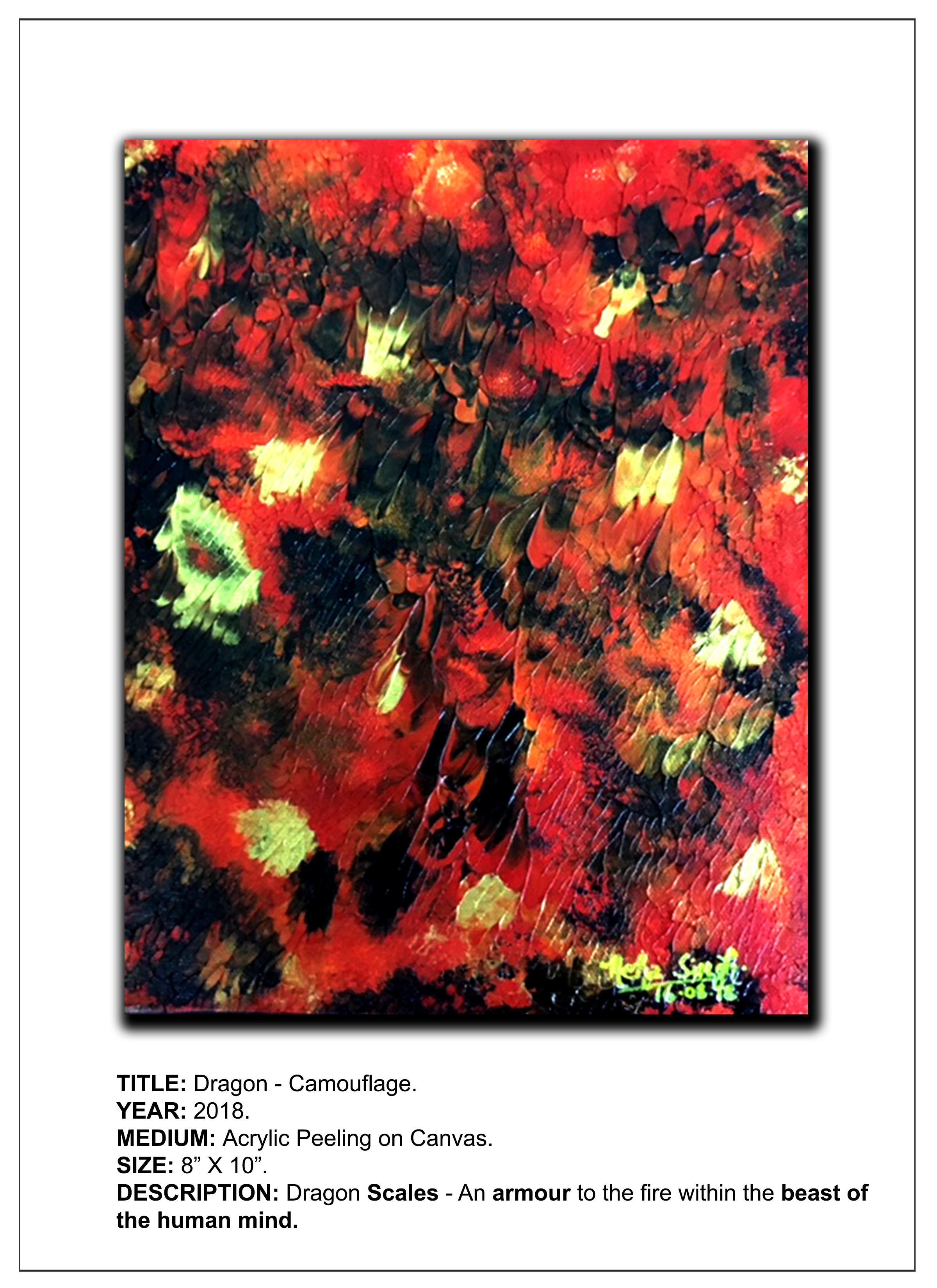
The scales of a dragon are largely impervious to flames, hence serving as protection for the more vulnerable flesh and musculature beneath. As a dragon ages and becomes more ferocious, its scales thicken and harden, providing not just protection, but also camouflage to this beastly predator’s fiery cauldron. The human mind builds around itself, a similar impregnable fortress, which conceals its deepest and darkest emotion, namely, anger. Not only does it attempt to conceal it, but also struggles to contain it within. Just as the scales of the dragon serve as an armour to its burning fury, the mind tries to disguise its frenzy by appearing dispassionate and unaffected, thereby attempting to blend into oblivion.
And now for the fun part! PEEL PAINTING!! I used this awesomely fun technique
to depict the scales of a dragon in this artwork. As the name suggest, it involves peeling! I dropped blobs of paint randomly onto the canvas, (keeping in mind the composition I wanted to achieve, of course), then pressed another canvas or canvas sheet on top. After applying considerable amount of pressure to ensure that the paint had spread evenly all over the canvas, I literally “peeled” off the canvas on top and I am happy to say, I successfully achieved the effect I was aiming for! Not only did the colors merge and blend-in perfectly, but also rose out of the canvas in the form of “peeks”, if I may call them that. I thought they pretty much gave the effect of dragon scales! What say?

The Dragon Within

It is said that dragons are fire transformed into flesh. They emanate so much heat from their bodies that they steam during cold nights, as if sweating fire. Their breath is so hot that the flames they exhale are used by them to cook the meat they consume. They are a burning furnace of hot, molten lava on the inside, sheathed on the outside by an impenetrable crust… The Scales.
So look out for my next artwork, which is an expression of this anatomical attribute of the dragon, hence the superficial veil of the human mind. Keep following for more!!

Dragon-Fury

Hey fellow art lovers! As promised, I am back with my next post!! Come join me as I dissect the dragon, hence the human mind further, digging deeper inside, in search of the innermost receptacle of its darkest emotion…ANGER.

This composition, titled Dragon-Fury, represents the enraged being at its destructive best. It also symbolizes the turbulent state of the human mind, when it is at the peak of its ferocity. The monstrous creature, when in rage, fills its belly with smoldering embers, depicted through luminous hues of yellow and red for the dragon’s abdominal muscles. As the frenzy builds up, the fuming embers ascend the gut and illuminate the gullet of the ferocious creature, as seen in the painting. The storm continues to build inside, until it cannot be held back anymore by the dragon(in other words, the human mind), and inevitably explodes like a volcanic eruption. I have illustrated this wrath in the form of molten flames emerging from the dragon’s mouth. How did I do the flames? Well, that’s where the secret lies! It was a painstakingly slow process of melting wax crayons over the canvas, graduating from yellow to red..but it was worth the effort, as I was quite happy with the end result!

Coming Up Next….

After exploring the physiological nature and the mental psyche of our beloved Saphira, I have attempted to dissect her psychotic rage further and dig deeper into her anatomy. At the same time, I am excavating into the emotional archives of the subconscious human mind, with an endeavour to analyse the metamorphosis of the delirium building up inside it….Coming Soon…The Dragon – Inside Out!

The Wise Dragon

This one portrays Saphira in a solemn state, when she has overcome her savagery to attained peace and serenity. Full of remorse for the devastation she has left behind in her raging frenzy, she has chosen the path of retribution, thereby transforming into a calmer, wiser and more tranquil being. She represents the penitence of the troubled human mind after it has let loose its fury. Once self realisation sets in, it rises over its unbridled emotions to emerge victorious and attains a transcendent state of eternal peace and harmony. The cooler tones of blue rendering this portrait are symbolic of a contented and peaceful entity.

The Furious Dragon

My next composition portrays Saphira, hence the human mind, in a different avatar…strong, yet ferocious and destructive. Like the dragon, when the mind is full of rage, the darkness tends to take over and it wreaks havoc all around it….I have attempted to bring out this fury in the eyes of Saphira through her menacing glance, waiting, watching and threatening to breath out the smoldering embers of devastation onto all that dare to cross her path…just like an enraged mind threatening to erupt.

Red Dragon

The Dragon…this legendary, mythical being, capable of breathing fire, caught my fantasy at first sight. It is believed that they are telepathic creatures and can “imprint” on humans soon after hatching, thereby bonding telepathically with them. That is exactly what the majestic Saphira did when I first set my eyes on an image of her…It was love at first sight and inspiration galore for the artist in me!
As an attempt to delve further into her psyche, I decided to explore her intrinsic nature…the raging fury within. Soon enough, I realised how similar she is to the temperamental human mind and Lo and behold! My first muse was born!! So the Red Dragon is not just a portrait of Saphira but also a metaphor for the turbulent human mind. I have tried to depict this through a bright palette with warm tones of yellow, orange and red…the varying shades of fiery anger.