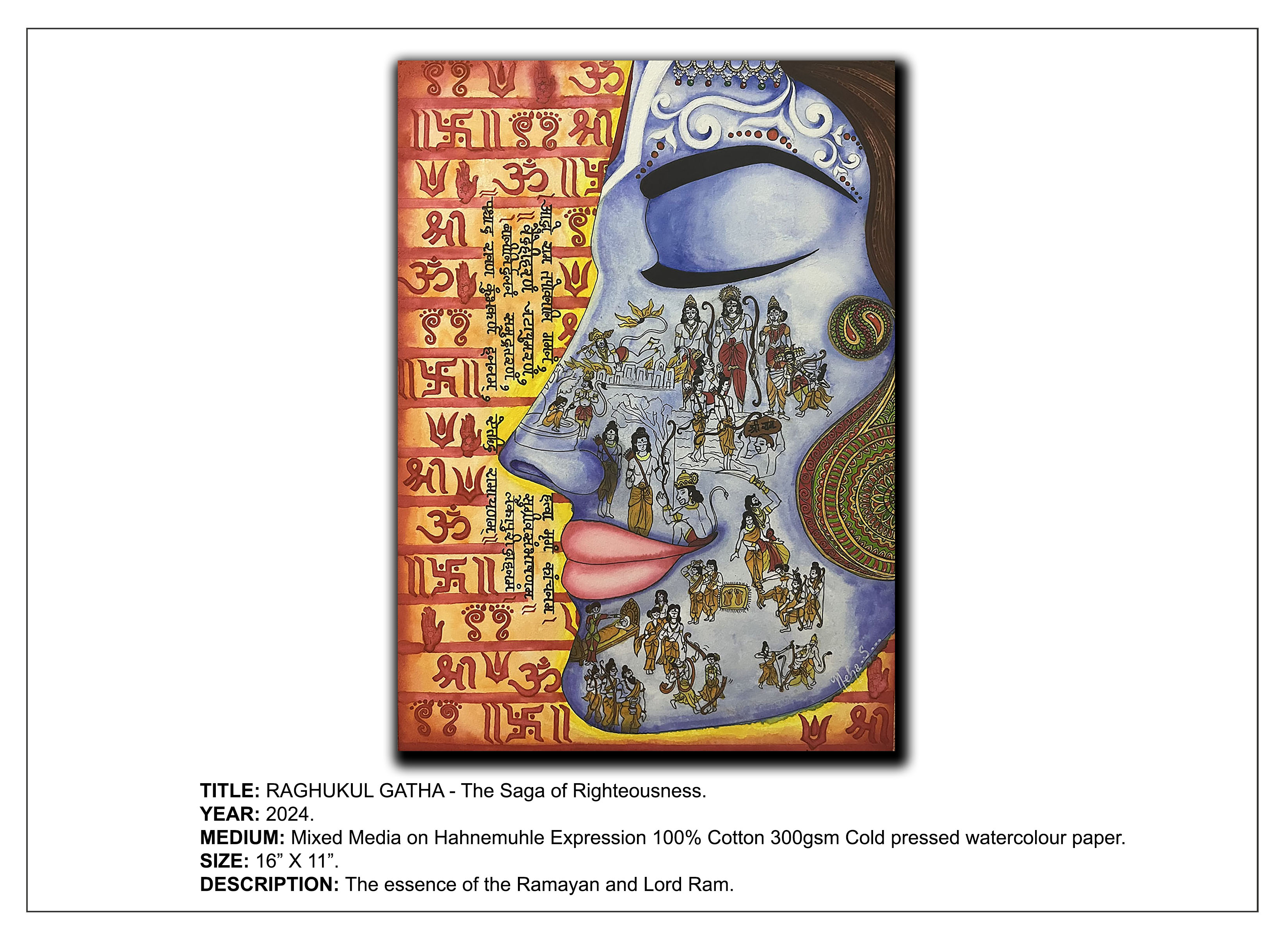


Descending once more into the depths of The Art Dungeon, I have unearthed yet another divine creation, titled Raghukul Gatha. And this one? Oh, this one is truly special.
For this is not merely a painting, but a treasured work of devotion, a sacred tapestry of faith and a timeless memory. Every stroke, every colour and every symbol come together to form something that feels less like a painting and more like a journey through an epic etched into the very soul of Indian tradition.
Raghukul Gatha is a tribute to Lord Ram and the timeless epic of the Ramayan, a story that has endured across generations as an eternal testament to virtue over vice, love over loss, courage over adversity, and devotion over despair.
Within the serene blue face of Lord Ram, lies the entire narrative of the Ramayan. His face becomes the center around which the epic unfolds, with the canvas itself transforming into a visual chronicle of his journey. This composition of cosmic calm vividly encapsulates pivotal moments from the epic: Lord Ram’s exile from Ayodhya, Lakshman’s unwavering loyalty, Sita’s abduction, Hanuman’s extraordinary leap across the ocean, his countless acts of courage and service, the monumental construction of the Ram Setu, and the thunderous battlefields of Lanka, culminating in the ultimate triumph over Ravan.
Yet, beneath the grandeur of these events lies something quieter and perhaps even more profound.
At the heart of the painting stands Lord Ram, embodying righteousness, compassion, duty and steadfastness. Beside him is Sita, a symbol of purity, strength and resilience, that shine through the trials she endures, while Lakshman represents the profound devotion of a brother whose loyalty never falters.
Surrounding the face are sacred symbols, resonating with vibrations of “Shri,” “Om” and the “Divine Footsteps,” each echoing Ram’s spiritual journey from Ayodhya to Lanka and beyond. These motifs transform the canvas into more than the depiction of a story. They become markers along a spiritual pilgrimage.
And then there is the background, where the “Shloki Ramayan” finds its place. It is a Sanskrit verse that distils the vast narrative of the epic into a few sacred lines. Almost hidden within the greater composition, it serves as a quiet reminder that beneath every battle, every separation, every sacrifice and every triumph, lies a deeper spiritual journey.
This visual narrative of the Ramayan invites the viewer to reflect on the eternal values of courage, sacrifice, and the victory of good over evil, reminding us that even in the face of immense trials, righteousness, compassion and the light of virtue will always prevail over darkness.
That, perhaps, is what makes Raghukul Gatha so deeply compelling. It does not simply recount the Ramayan. It invites us to step into it.
To see courage not merely as strength, but as the willingness to endure. To see devotion not merely as loyalty, but as selfless service. To see righteousness not as an easy path, but as one worth walking even when the road is difficult. Raghukul Gatha is therefore not simply a painting of Lord Ram. It is a visual journey through an epic, a celebration of devotion and a meditation on dharma.
Above all, it is a tribute to a story that has travelled through centuries and continues to live on, not only in scriptures and verses, but in art, memory, faith, and the hearts of those who continue to tell it.

