Exploring Beyond Panchamukha – What Does it Mean to You?

My artwork depicting the Panchamukha Hanuman is a powerful manifestation of divine courage, protection, wisdom and the triumph of good over darkness. Through the five faces of Hanuman, Narasimha, Garuda, Varaha and Hayagriva, it brings out devotion, strength, protection, resilience, balance and knowledge in one formidable divine form.

Created through delicate graphite work, textured layers of watercolour and intricate fine-liner detailing, each face was carefully developed to retain its individual symbolism while becoming part of a unified composition.

The background, woven with verses from the Hanuman Chalisa, adds a deeply devotional dimension to the artwork, transforming the painting from a portrayal of mythology into an exploration of how diverse qualities can coexist within one divine force. What began as intricate lines on paper gradually evolved, layer by layer, into a luminous expression of Panchamukha Hanuman’s spiritual power.

Perhaps what fascinates me most about Panchamukha is that its symbolism can be interpreted differently by each of us.

To one person, these five faces may represent five forms of protection. To another, they may symbolise five qualities we need to cultivate within ourselves—courage, wisdom, resilience, devotion and the ability to overcome adversity.

And perhaps that is what makes sacred art so meaningful. A painting may have its roots in an ancient story, but the emotions it evokes can be deeply personal and contemporary.

What does Panchamukha Hanuman represent to you?

Which of the five faces speaks to you most strongly—and what quality or emotion do you see reflected in it?
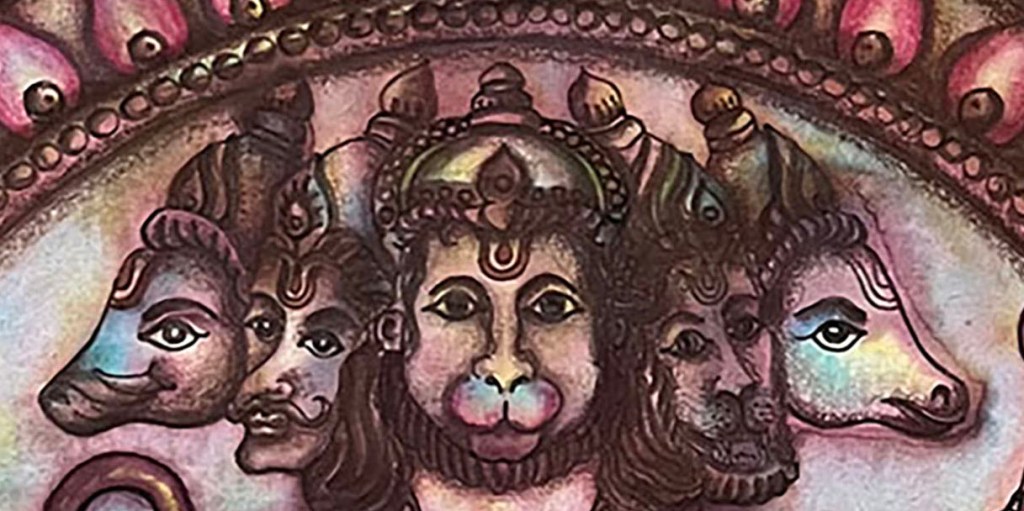
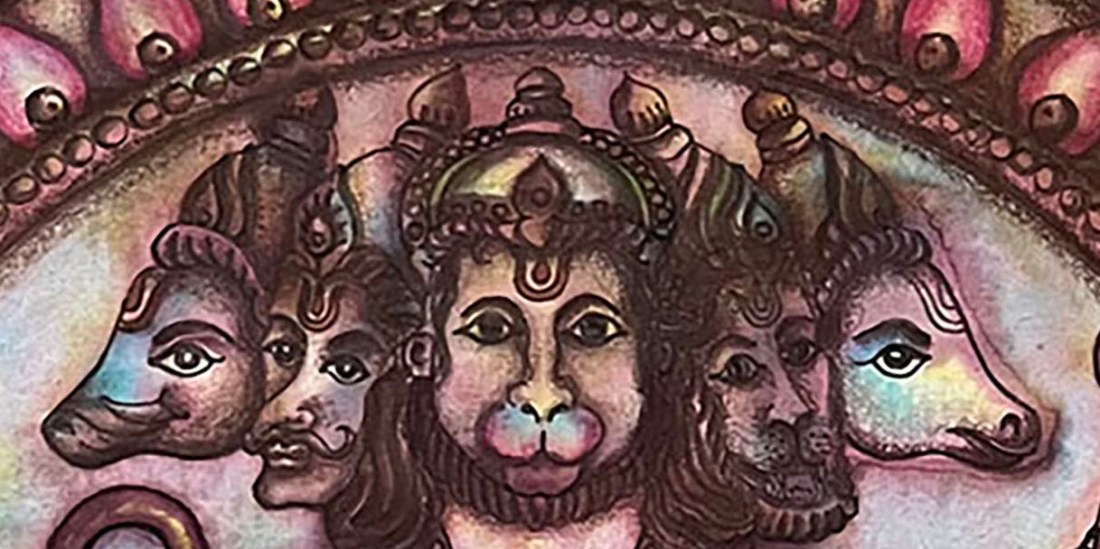
The Five Faces (From Left to Right) – Varaha (The Boar incarnation), Garuda (The Mighty Eagle), Hanuman (The Original Monkey-Faced Form), Narasimha (The Lion-Faced Incarnation of Lord Vishnu) and Hayagriva (The Horse-Headed Form of Lord Vishnu).

If you’ve been following my journey through the previous two posts on this artwork, you already know the story that inspired Panchamukha and the creative journey that brought it to life. But for those discovering this painting for the first time, I’ve gathered the links below to the earlier posts—so you can step back into the story, uncover the inspiration, and then share with me what Panchamukha means to you and how its five faces speak to your own interpretation of this powerful divine form:

I would love to hear your interpretation. Leave a comment below and share what you see in Panchamukha. And if this artwork resonates with you, share this post with someone who might find their own meaning within its five faces.

Because sometimes, art does not simply tell us a story.

It invites us to find ourselves within it.
A Tryst with the Divine

Hey folks! Now that I am through with the Dragon Series, let me introduce you to the next couple of paintings, the subject being, Divinity. For this set of artworks, I have attempted to capture the essence of the Buddha onto my canvas.

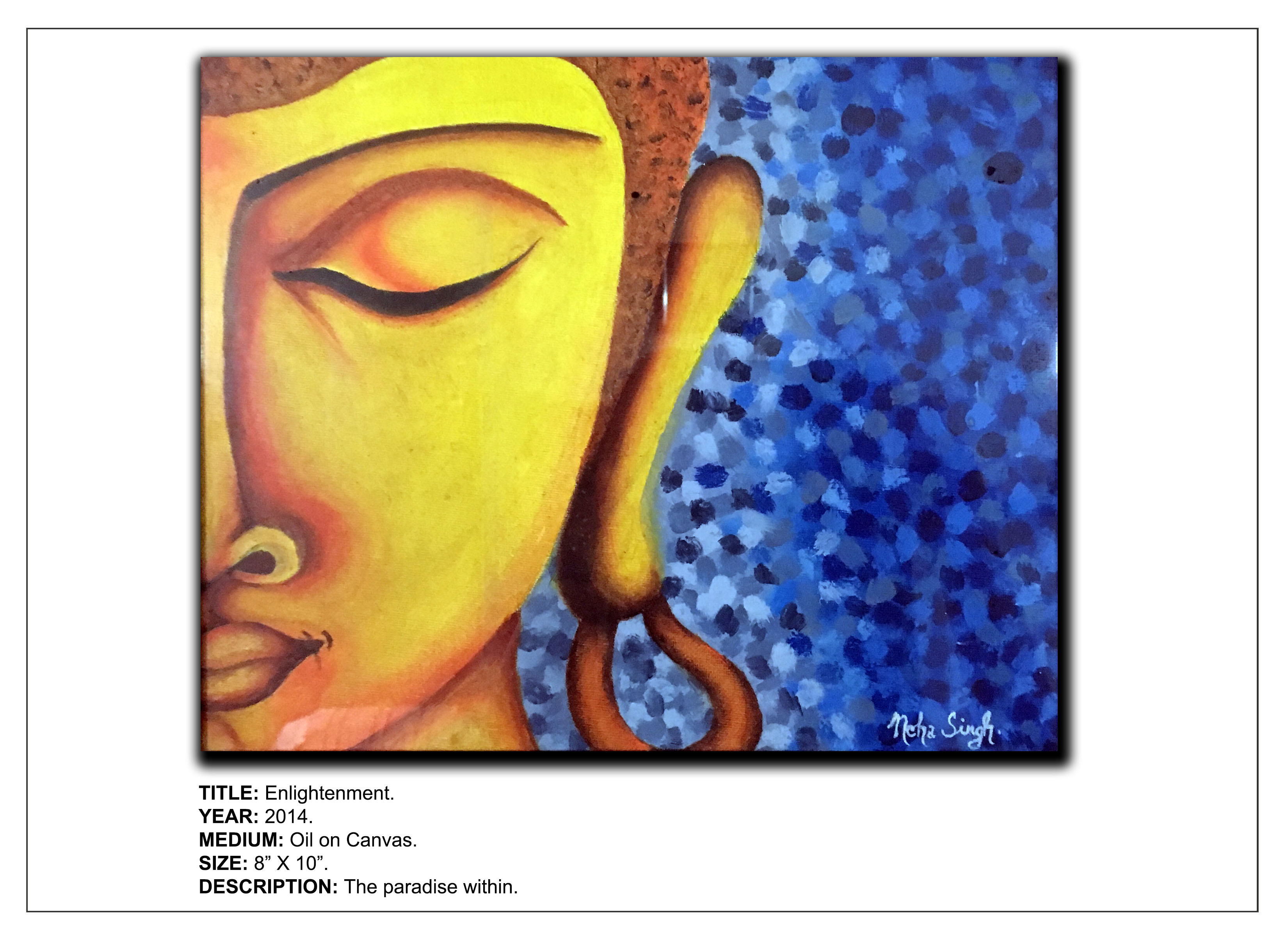
Enlightenment

The first painting, titled “Enlightenment”, is a portrait of the Buddha. The word Buddha is not a name, but a title, which means the enlightened one or the awakened one. It is a Sanskrit word that means “a person who is awake”. What a Buddha is awake to, is the true nature of reality. When the Buddha passes into the peace of Nirvana, it is like a transformed state of existence.

This perfect state of existence, where knowledge or wisdom co-exists with compassion, is called Enlightenment. Knowledge here does not means worldly knowledge of things around us, but a true understanding of reality and the intrinsic nature of things surrounding us. Enlightenment is so much beyond the realm of outside ordinary experience that it cannot be described, but only be realized and felt within ourselves. If I were to put it in words, it would be a paradise within us.

I call this painting a partial portrait, wherein I have painted only half of the face of the Buddha, representing that true reality He sees upon attaining Nirvana. Once enlightened, He is oblivious to all external influences, thus the other half, which symbolizes a superficial exterior, ceases to exist.

The medium I have used for this portrait is oil paints. However, I have been a tad bit adventurous with the background of this artwork! I am greatly inspired by the palette knife technique of my all time favorite artist, Leonid Afremov. He is a Russian–Israeli modern impressionist, who works mainly with a palette knife and oils. Using his unique knife painting technique, he dabs paint onto the canvas in relatively thick and small strokes, creating paintings that seem to be a burst of countless bright colors.

Using a palette knife to paint is very different from a brush. A brush bends and flexes as you move it. The palette knife is a more rigid tool. It can be used to carefully add a straight line or toss on a huge blob of paint. While Leonid possesses his own signature style, I have attempted to reproduce similar effects using a brush instead of a palette knife in my painting. Also, instead of using several colors (like Leonid does), I have used different tones of blue to create an Ombre effect as part of the background of this artwork. Ombré (literally “shaded” in French) is the gradual blending of one color or hue into another, usually moving tints and shades from light to dark.


Sounds Greek and Latin to you? I shall attempt to “enlighten” you all in detail on these terms some other time. For now, it’s Adios till my next post!!