Featured

Bija – The Sounds of the Chakras

Greetings from The Art Dungeon! Today’s post brings a new artwork for all my followers and subscribers. This one is called “Bija – The Sounds of the Chakras” and is the eighth edition in my ongoing “Buddha Sutra” Series.
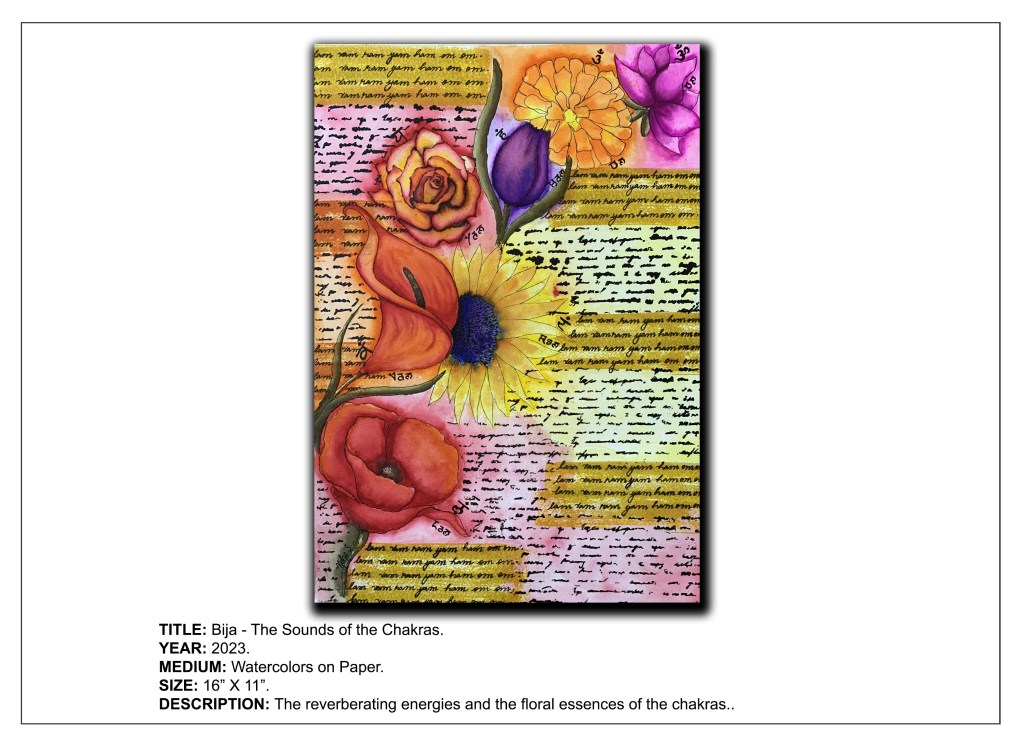
This painting is a portrayal of the 7 “Bija mantras,” one corresponding to each of the 7 “chakras” or energy centers in the human body. The word “Bija” in Sanskrit literally means seed and is used metaphorically for the origin or starting point of all creation. In Buddhism, the term “Bija mantras” is used for mystical “seed syllables” contained within mantras. These are one syllable sounds which have no literal meaning, but connect to spiritual principles or energies. It is believed that these seeds could stimulate physical, emotional, and spiritual growth and metamorphosis.

The 7 Bija mantras, which have been hand-printed in the artwork, when chanted while meditating, help in awakening their corresponding chakras and balancing their energies. The 7 chakras themselves have been illustrated by their respective floral essences. The mantras and the flowers for the respective chakras are:

Muladhara (Root Chakra) – LAM; Poppy flower.

Svadisthana (Sacral Chakra) – VAM; Calla Lily.

Manipura (Solar Plexus Chakra) – RAM; Sunflower.

Anahata (Heart Chakra) – YAM; Rose.

Visuddha (Throat Chakra) – HAM; Tulip.

Ajna (Third Eye Chakra) – OM; Marigold.

Sahasrara (Crown Chakra) – OM; Lotus.

Each chakra is connected symbolically to their respective flowers, either due to the colour of the flower in direct correspondence to the colour of the chakra itself or by the structure of the flower in relation to the role and purpose of the chakra. In other words, while the color of the flower depicted in the artwork may not match that of its corresponding chakra, it will still be connected to it in terms of its characteristics relative to the chakra.

 It is said that the Bija mantras, when said out loud, activate the dormant power of the associated chakras and resonate with their energy, which purifies and harmonizes the body and mind, thus connecting us to cosmic energies, strengthening our spiritual powers and bringing on a state of awareness.  

Featured

“Moksha” – The Moral Compass

Hey all! I know I have been MIA for quite some time but I’m back now with a new post about my most recent artwork. This too has been long overdue, as I allowed procrastination to get the better of me, but finally, I have succeeded in completing it!

In one of my previous posts, I had talked about how a book can become the source of inspiration for my art, in particular the third book of the Ram Chandra Series – Raavan: Enemy of Aryavarta, by the Indian author Amish Tripathi. This work of fiction chronicles the life of Ravan and portrays him as an artist among other things. One of the excerpts from the book describes a painting made by him that is not only a character sketch of himself but also a logically befitting description of the concept of “dharma” or the “righteous path”. (Click on the following link to read this post – https://theartdungeon.blog/2021/06/06/inspiration-calling/).

The beautiful artwork created by Ravan and described in this excerpt was not just a vivid description of Ravan’s psyche, but also a profound portrayal of his struggle to attain the right direction through the “moral compass” called dharma.

This one-of-a-kind piece of art became my muse purely because of the distinctive way in which it brings out the true essence of Ravan. I was so enamored by his narrative that I couldn’t wait to interpret it in my own way and create my very own version onto my canvas. Finally, I managed to do that and here I present to you, my acrylic painting titled “Moksha”.

In the book, Ravan describes a painting created by him that depicts his struggle to attain enlightenment. I have attempted to depict his mental turmoil and his desperate attempts to scale the wall of the Nine emotions or the Navrasas that hold him down. The ten heads in my artwork correspond to the ten heads of Ravan himself. Out of these, 9 represent the Navrasas, one for each emotion, whereas the tenth head is the state of spiritual awakening that Ravan is striving to achieve.

I have further attempted to add on to the concept by depicting the 7 chakras or the main energy centers that control our body. My endeavor is to reaffirm that one can only transcend the wall of emotions by opening up all the chakras, allowing energy to flow freely, thereby harmonizing the body, mind as well as the spirit.  It is only this equilibrium that can help one attain physical, emotional and spiritual “moksha” – which was not just the “righteous path” being pursued by Ravan, but also the “dharma” attained by the Buddha.

Hope you all like my approach towards Ravan and his “moksha!”