Featured

Tashi Tagye – The Eight Signs of Auspiciousness

Today’s post brings the final artwork of my Buddha Sutra series which its titled, “Tashi Tagye – The Eight Signs of Auspiciousness.” This watercolor artwork depicts the eight auspicious symbols of Buddhism. These auspicious signs (called “Ashtamangala” in Sanskrit), are termed “Tashi Tagye” in Tibetan and are associated with different parts of the Buddha’s body. They also symbolize auspicious subjects and enlightened qualities.

The Artwork
The Art Process

These symbols, as illustrated in the artwork above and corresponding to the respective body parts of the Buddha as well as the qualities are:

  1. Parasol – This represents the Buddha’s enigmatic head and signifies the many umbrellas, parasols and canopies offered to the Buddha by countless celestial and human kings which were blessed by the Buddha as symbols of protection from suffering, destructive forces and illness. The parasol represents the various aspects of the Buddha’s teachings which give peaceful solace from suffering. The dome of the parasol symbolizes wisdom and the hanging skirt represents compassion. It also represents protection of the practice of dharma.
  2. The Golden Fishes – These represent the Buddha’s compassionate and clairvoyant eyes and symbolize fearlessness and freedom as they have complete freedom of movement in the water, taking on the bold, vast and dangerous oceans fearlessly. Thus, they symbolize the agility and swiftness of the Buddha’s enlightened mind.  They represent the penetrating as well as transcendental wisdom of the Buddha.
  3. The Lotus – This represents the Buddha’s tongue which is free from flaws of speech and is endowed with eloquence and the profound taste of the dharma. Just as the lotus is not sullied by muddy waters but thrives in them, the Buddha also thrives in the imperfect world unaffected by it. Thus, it symbolizes purity, immaculate existence and enlightenment.
  4. The Treasure Vase – This represents the Buddha’s throat, which is considered an infinite treasury of wisdom and enlightenment. It is a reminder of the many positive aspects gained through the practice of the dharma.  It also symbolizes the spiritual qualities of the Buddha as a container of nectar for immortality.
  5. The Wheel Of Dharma – This represents the Buddha’s feet as well as his vast knowledge and understanding of the dharma. It is a metaphor for his spiritual teachings which he used to teach his disciples and subdue negative forces. The 8 spokes of the wheel represent the noble eightfold path. The hub of the wheel symbolizes moral discipline and the rim, meditative concentration. It is believed that an understanding of the cycle of life wheel stop the wheel from turning.
  6. The Victory Banner – This represents the Buddha’s body and symbolizes the victory of positive virtues over negative ones and the invincibility of an enlightened being. It represents Buddha’s victory over the four “maras,” or hindrances in the path of enlightenment. These hindrances are pride, desire, disturbing emotions and the fear of death.  It is a reminder of victory over lust and temptations and represents strength and solidarity in the practice of dharma.
  7. The Conch – This represents the deep, melodious and pervasive voice of the Buddha and symbolizes the sound of the dharma which awakens sentient beings from the slumber of ignorance. It convinces them towards the path of noble and virtuous deeds. It also symbolizes fearlessness and resounding victory and is a call to focus while the teachings of dharma are present.
  8. The Endless Knot – This represents the profound and mystical nature of the Buddha’s heart and mind. Its intertwining structure symbolizes the interdependence and interpenetration of reality and the complex and intricate nature of all phenomena. It indicates the immutable and adamantine state of enlightenment and the infinite connectivity of all things. It is a reminder how the life of all things intertwines, the continuity of harmony and the practice of dharma. It also symbolizes Buddha’s endless vision and compassion.

These 8 auspicious symbols can be drawn individually, in pairs, in fours or as a group of eight. When illustrated a group of eight traditionally, only seven items excluding the treasure vase are drawn as these seven form the shape of the vase. However, my artwork does not follow this norm and depicts all eight as individual entities. They have been enhanced further with their names written in Tibetan script calligraphy as well as prayer flags displaying Buddhist prayers.
Featured

Kilkhor – The Sacred Circle

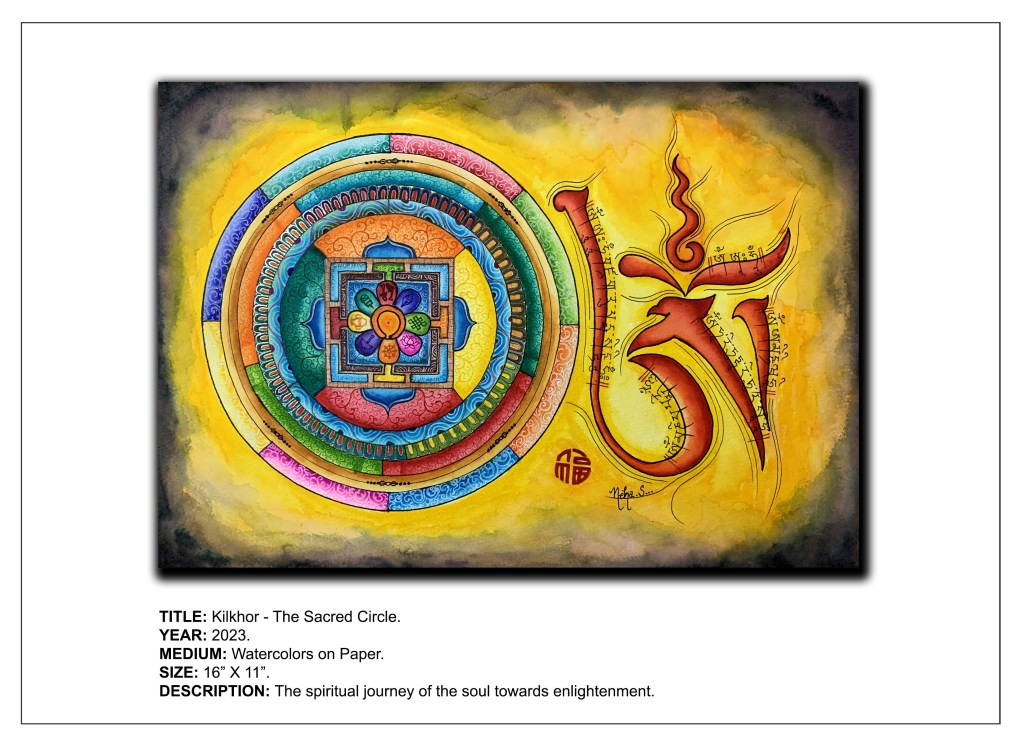
The artwork in today’s post is titled “Kilkhor – The Sacred Circle” and takes inspiration from the Tibetan Mandala and Thangka paintings. The Tibetan word for mandala is “Kilkhor,” which means “center of the circle with exterior walls and surrounding environment.”

The artwork

Mandalas are two- or three-dimensional ritual objects found in Tibetan Buddhist and other religious traditions. They are seen as objects for meditation, assisting in spiritual development. They represent the universe, and all the symbols represent one’s spiritual journey, from birth through life to death, interconnecting all living things. This spiritual journey is portrayed in the mandala through the various layers, starting form the outside to the innermost core, which in turn represents the ultimate destination of every soul – enlightenment.

In this artwork, the mandala that has been illustrated serves as a tool for gaining wisdom and compassion by guiding individuals along the path of enlightenment. It is a cosmic diagram or geometric pattern representing the various layers of worldly vices and weaknesses that one needs to overcome and the virtues that one needs to adopt and practice in order to attain the final goal of Nirvana.  These 8 layers, starting from the outside and moving inwards in concentric circles are:

  • The eight vicissitudes (Outermost/1st layer) – Pleasure, pain, loss, gain, blame, praise, fame and disrepute.
  • The six roots of the mind (2nd layer) – Love, delusion, wisdom, hatred, generosity and greed.
  • The five precepts (3rd layer) – Lust, False/harsh speech, intoxicants, killing and stealing.
  • The five hinderances (4th layer) – Anger, sloth, restlessness, doubt and desire.
  • The three kinds of suffering (5th layer) – Suffering of conditionality, suffering of change and suffering of pain.
  • The four noble truths (6th layer) – The truth of existence of suffering, the cause of suffering, the cessation of suffering and the path leading to the cessation of suffering.
  • The Noble Eightfold Path (7th layer) – Right view, right thought, right speech, right action, right livelihood, right effort, right mindfulness and right concentration. This layer also represents the eight auspicious symbols associated with Buddhism, namely – the conch, endless knot, pair of golden fish, lotus, parasol, vase of jewels, Dharmachakra and victory banner.
  • The Zen Circle (Innermost/8th layer) – This is the circle of enlightenment, the final destination for peace and mindfulness.

Each layer is divided symmetrically into equal portions representing each of the respective qualities or elements associated with it. Traditional motifs employed in Thangka paintings and Tibetan mandalas have been used to illustrate them in different colours. The calligraphic script next to the mandala is a stylized version of the Tibetan alphabet for “Om”, which has been further accentuated with some common Buddhist mantras also in Tibetan script.

This mandala symbolizes every individual’s endeavor to overcome all the worldly attachments (represented in the first five layers), realizing and accepting the four noble truths (represented in the sixth layer) and finally adopting the eight noble virtues (in the seventh layer) through the power of meditation and detachment in order to transcend metaphysically into the pure state of awakening (the eighth and innermost layer).   

Featured

Bija – The Sounds of the Chakras

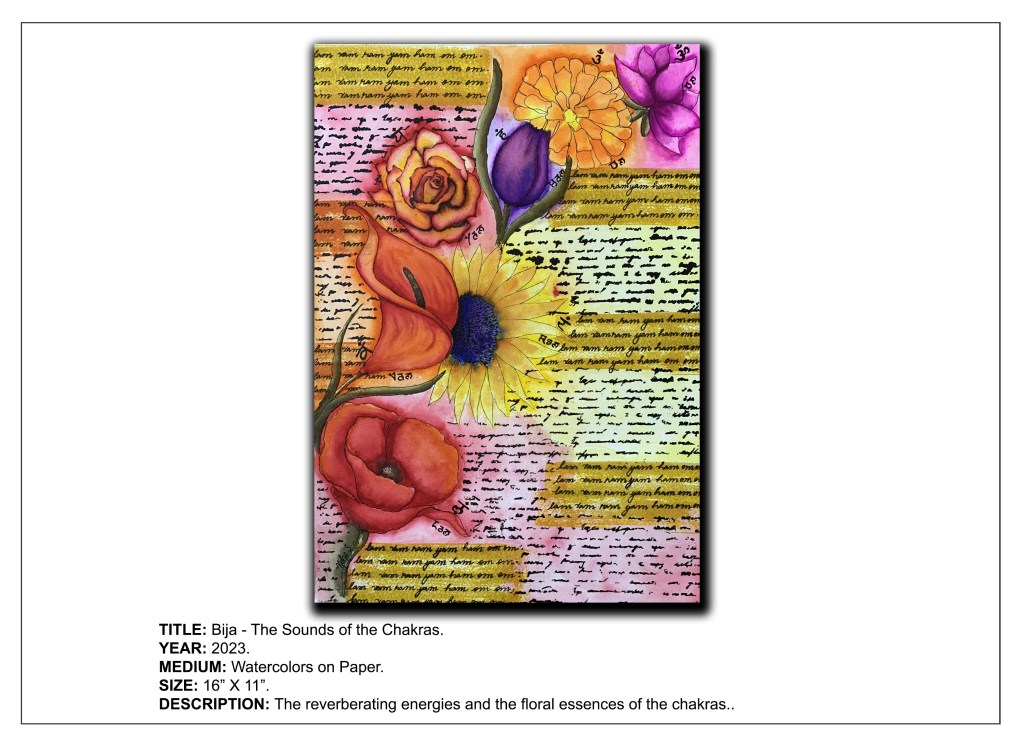
Greetings from The Art Dungeon! Today’s post brings a new artwork for all my followers and subscribers. This one is called “Bija – The Sounds of the Chakras” and is the eighth edition in my ongoing “Buddha Sutra” Series.

This painting is a portrayal of the 7 “Bija mantras,” one corresponding to each of the 7 “chakras” or energy centers in the human body. The word “Bija” in Sanskrit literally means seed and is used metaphorically for the origin or starting point of all creation. In Buddhism, the term “Bija mantras” is used for mystical “seed syllables” contained within mantras. These are one syllable sounds which have no literal meaning, but connect to spiritual principles or energies. It is believed that these seeds could stimulate physical, emotional, and spiritual growth and metamorphosis.

The 7 Bija mantras, which have been hand-printed in the artwork, when chanted while meditating, help in awakening their corresponding chakras and balancing their energies. The 7 chakras themselves have been illustrated by their respective floral essences. The mantras and the flowers for the respective chakras are:

Muladhara (Root Chakra) – LAM; Poppy flower.

Svadisthana (Sacral Chakra) – VAM; Calla Lily.

Manipura (Solar Plexus Chakra) – RAM; Sunflower.

Anahata (Heart Chakra) – YAM; Rose.

Visuddha (Throat Chakra) – HAM; Tulip.

Ajna (Third Eye Chakra) – OM; Marigold.

Sahasrara (Crown Chakra) – OM; Lotus.

Each chakra is connected symbolically to their respective flowers, either due to the colour of the flower in direct correspondence to the colour of the chakra itself or by the structure of the flower in relation to the role and purpose of the chakra. In other words, while the color of the flower depicted in the artwork may not match that of its corresponding chakra, it will still be connected to it in terms of its characteristics relative to the chakra.

 It is said that the Bija mantras, when said out loud, activate the dormant power of the associated chakras and resonate with their energy, which purifies and harmonizes the body and mind, thus connecting us to cosmic energies, strengthening our spiritual powers and bringing on a state of awareness.  

Featured

The Big Reveal!!

Hey fellow art enthusiasts! As promised, here I am with the outcome of the little snippet I shared in last week’s post!! So, are you all ready for the big reveal? Here it is!

This is it!
The final artwork

This watercolor artwork is called Bo Tree – The Emblem of Enlightenment. It is a representation of the Bodhi Tree (Ficus religiosa), under which Siddharth Gautam, who later became known as the Buddha, is said to have attained enlightenment or Buddhahood.

The Bodhi Tree is a principal religious symbol in Buddhism due to its prominence in the Buddha’s discovery of enlightenment, or total peace and happiness in the form of Nirvana, or the greater reality. “Bodhi” means awareness and Bodhi tree means the tree under which Buddha becomes fully aware of the noble truth of the universe.

Essentially the ‘tree of awakening,’ also known as the Bo Tree, in Pali it is known as the “bodhirukkha,” in Sanskrit the “bodhivka” and to botanists as Ficus religiosa. Given its close association with the attainment of Buddhahood, the tree has great symbolic significance.

This tree as depicted in the artwork represents the supreme knowledge acquired by the Buddha during his tireless meditation. It conveys the teachings and sermons he preached and passed on to his disciples and followers. These teachings are illustrated in the artwork in the Pali script and represented as scribbles in the canopy of the tree.  The tree reflects the capacity of every human being to follow in the footsteps of the Buddha in achieving the ultimate spiritual goal by letting go of the finite self through meditation and self-discipline. The heart-shaped leaves of the Bodhi tree symbolize peace and happiness developing in one’s heart during the journey towards Nirvana.

The Bodhi tree is the DNA of Buddha’s teachings, an emblem of peace and a reminder of the eventual prospect of enlightenment that lies within us all.  

Featured

Guess What’s On My Easel?

Hey folks! This week it’s going to be a short and sweet post. Working on a new project, albeit part of my ongoing “Buddha Sutra” series. Here’s a small snippet of what I am working on currently. Take a guess as to what it could be!

Do share what you think it is in the comments section below. Would love to hear your ideas. And yes! Look out for the final artwork which will be up soon!!

Featured

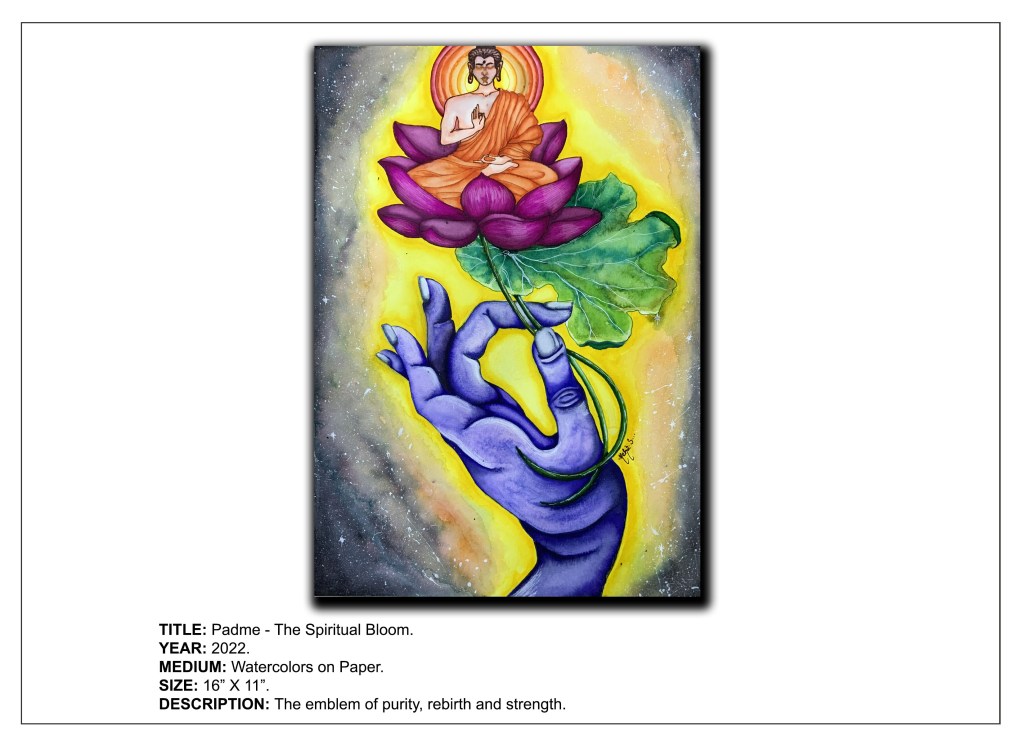
Padme – The Spiritual Bloom

Padme – The Spiritual Bloom

“Just like the lotus we too have the ability to rise from the mud, bloom out of the darkness and radiate into the world.”

The lotus is one of the most revered and sacred symbols of Buddhism. It is this holy symbol that is the subject of today’s artwork tilted, “Padme – The Spiritual Bloom.”

The lotus represents spiritual awakening, purity, and rebirth as the act of emerging from muddy water symbolizes rising above the challenges and adversities of life and moving towards the light of wisdom. It also represents nonattachment, as it is rooted in mud (attachment and desire) but its flowers blossom on long stalks untarnished by the mud below (detachment).

Another important aspect of the lotus is that when it blossoms, it simultaneously plants a seed, representing the Buddhist concept of cause and effect, whereby the flower is symbolic of the cause and the seed-pod the effect.

The lotus serves as a reminder that all beings can attain enlightenment. Just as the blossom rises from the depths of murky ponds and lakes to bloom immaculately above the water’s surface, so can the human mind develop the virtues of the Buddha and transcend desire and attachment to reveal its essentially pure nature. It symbolizes the blooming of the soul from the filth of the physical world, eventually flourishing in the bright sunshine of enlightenment and attaining nirvana.

There are a variety of colors of the lotus associated with Buddhism. The pink lotus is the supreme one and is the true lotus of Buddha. It is for this reason that the Buddha in this artwork is depicted seated on a pink lotus, which indicates His enlightened and divine status.

 All symbolism associated with the lotus points towards finding spiritual meaning in life. We all are like lotus blooms in the universal pond, striving to realize our true potential.

Featured

“Ariya atthangika magga” – The Noble Eightfold Path

“There are no enlightened beings, only enlightened actions.”

Buddhism revolves around the principle of Dharma and encompasses various traditions, beliefs and practices of Lord Buddha. Buddha gave his first sermon in Sarnath to Kaundinya and four other scholars. In Isipatana of Sarnath, he preached about Dhammacakkappavattana Sutta, which includes Four Noble Truths and Noble Eightfold Path.

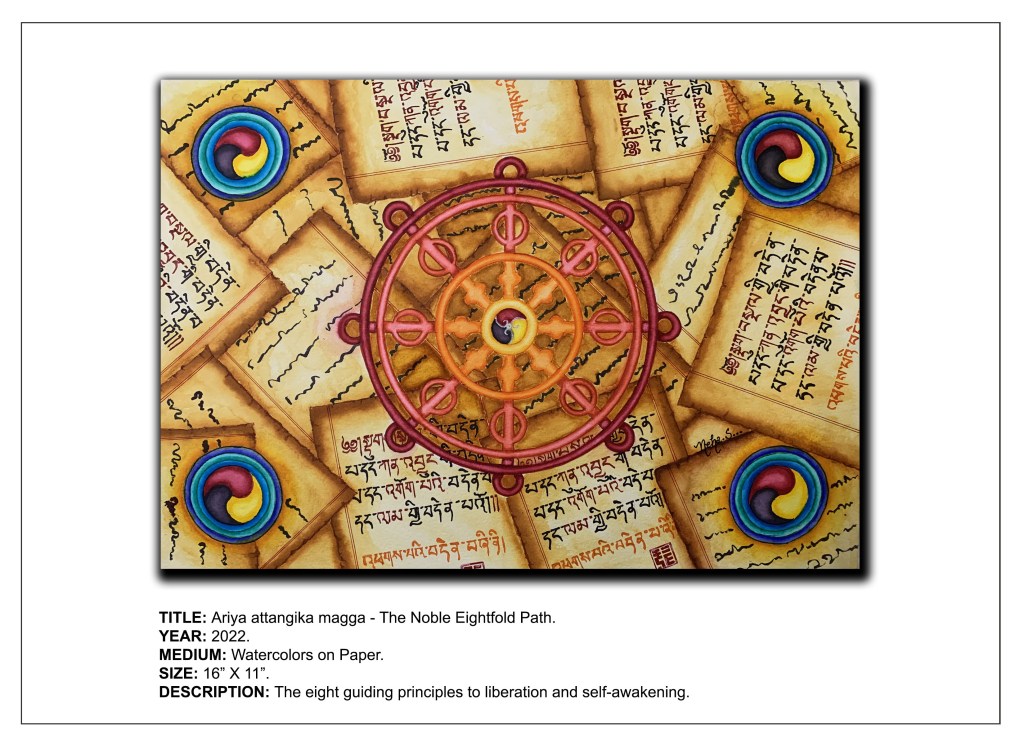
It is these fundamental doctrines of Buddhism that have been displayed in the artwork shown below, the title of the artwork being, “Ariya atthangika magga” – The Noble Eightfold Path. The Noble Eightfold Path is one of the principal teachings of Buddhism and is the fourth truth of the Four Noble Truths and regarded by Buddha as the medium to attain Enlightenment.

This artwork depicts the Noble Eightfold Path through the Dharma Wheel (Dharma Chakra), with its eight spokes representing the eight elements of the path, namely – right view, right resolve, right speech, right conduct, right livelihood, right effort, right mindfulness, and right concentration (or “samadhi”).

The four circles in the corners represent the Four Noble Truths, namely – The existence of suffering, its cause, its cessation and the path leading to its end. The path alluded to in the fourth truth is the Eightfold Path, which ultimately leads to enlightenment or Nirvana. This path is also depicted textually in the form of Tibetan manuscripts in the background of the artwork.

The Noble Eightfold Path is all about ending the suffering of life and achievement of self-awakening.  It enables us to overcome the “I” and attain harmony with the world around us. Being always awake and aware, is fundamental to a good life.

Featured

Panchamahabhuta – The Five Great Elements

AIR moves us

FIRE transforms us

WATER shapes us

EARTH heals us

SPACE awakens us

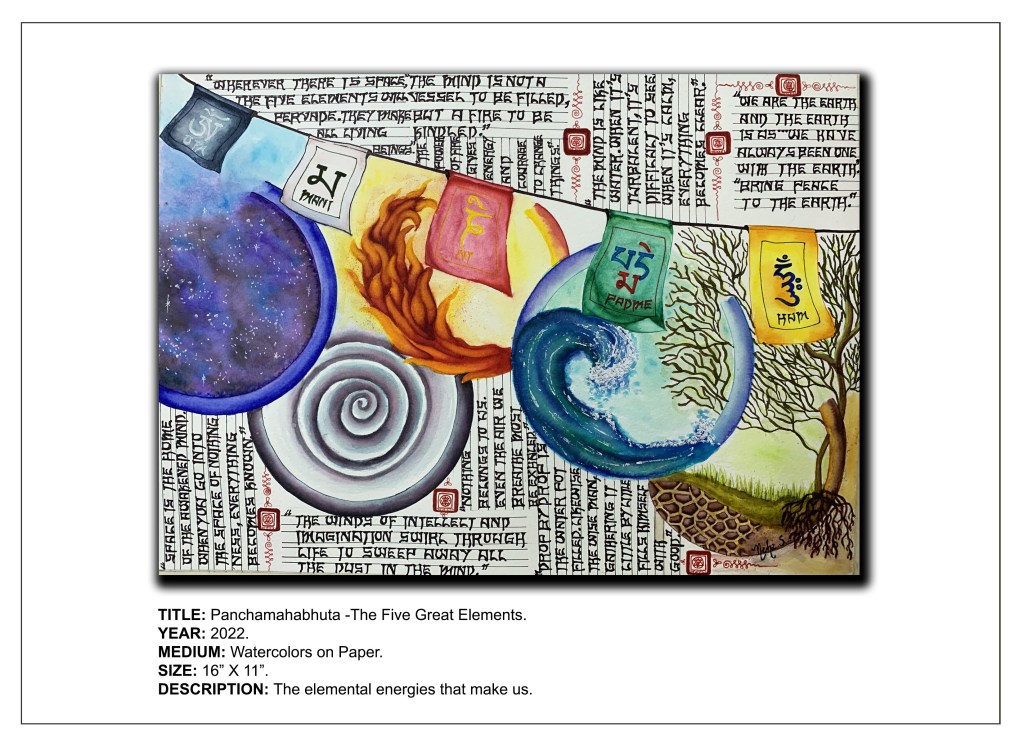
Earth, water, fire, air, and space are the five elemental energies that reside inside each one of us. It is these five elements that form the basis of this week’s watercolor artwork called Panchamahabhuta – The Five Great Elements. As in the title, these five elements are called “Panchamahabhuta” in Sanskrit and compose not only the universe, but the human body and mind.

The artwork

Each element represents a force of nature as well as a potential and quality of the human mind. The mind’s ability to serve as the ground for all experience is the quality of earth; its continuity and adaptability is water; its clarity and capacity to perceive is fire; its continuous movement is air and its unlimited emptiness is space.

These elements have been visually illustrated in the artwork along with corresponding text written in stylized calligraphy. Each element has also been represented as a Sanskrit syllable on prayer flags in synonymous colors.

We can discover our true potential by exploring and navigating through the terrain of these five elements that we are composed of. We can heal ourselves by acknowledging, aligning and connecting with these fundamental energies, thereby leading our lives with wisdom and grace.

Featured

Unalome – The Path of Life

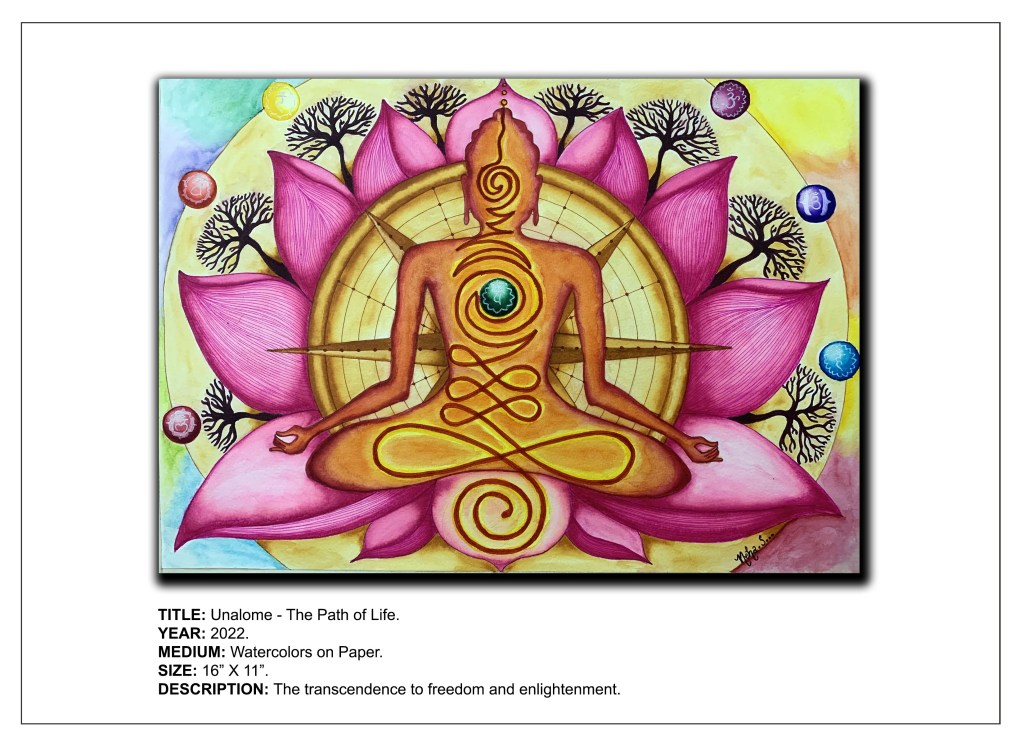
Presenting the next watercolor installment in my “Buddha Sutra” Series – I call this one Unalome – The Path of Life.

Also available on instagam – https://www.instagram.com/p/Ckgd1bdP2lF/

The Unalome is both a Buddhist and a Hindu spiritual symbol. It represents the path to freedom or enlightenment, or in simpler terms, your life’s path. The sign consists of three parts: the spiral, the swirl, and the dots at the end.

The spirals represent the twists and turns in life. With these ups and downs and unexpected encounters, one becomes more and more aware. The spiral represents the state before one spiritually awakens.  After the spiral comes the swirl, which gets smaller and smaller and turns into a straight line. When you are aware of your thoughts, you have more focus and clarity and the road becomes less winding. The straight line is the moment of enlightenment or peace and harmony. When one gets out of the swirl, he or she suddenly see everything very clearly. Like a straight line. The road is pure, that’s where one is free and reaches enlightenment. The dots represent death, or the moment we fade into nothing. They also represent the uncertainty of life.

The lotus flower symbolizes how we can overcome all the obstacles on our journey to enlightenment and flourish. The Buddha is shown seated on a Lotus flower with a compass forming His halo. This symbolizes the path navigated by the compass of meditation towards freedom and enlightenment which can be achieved by harmonizing the 7 chakras depicted in the artwork. The trees represent growth and progress thereafter.

The Buddhist Unalome is a visual metaphor for the journey towards enlightenment. It inspires us to carve out our own path, which is unique to each one of us. Even though the journey as well as the path is uniquely different for each one of us, ultimately, the destination is the same – liberation.

Featured

Buddha Dharma – The Discipline of the Dharma

“A disciplined mind brings happiness.” – Gautam Buddha.

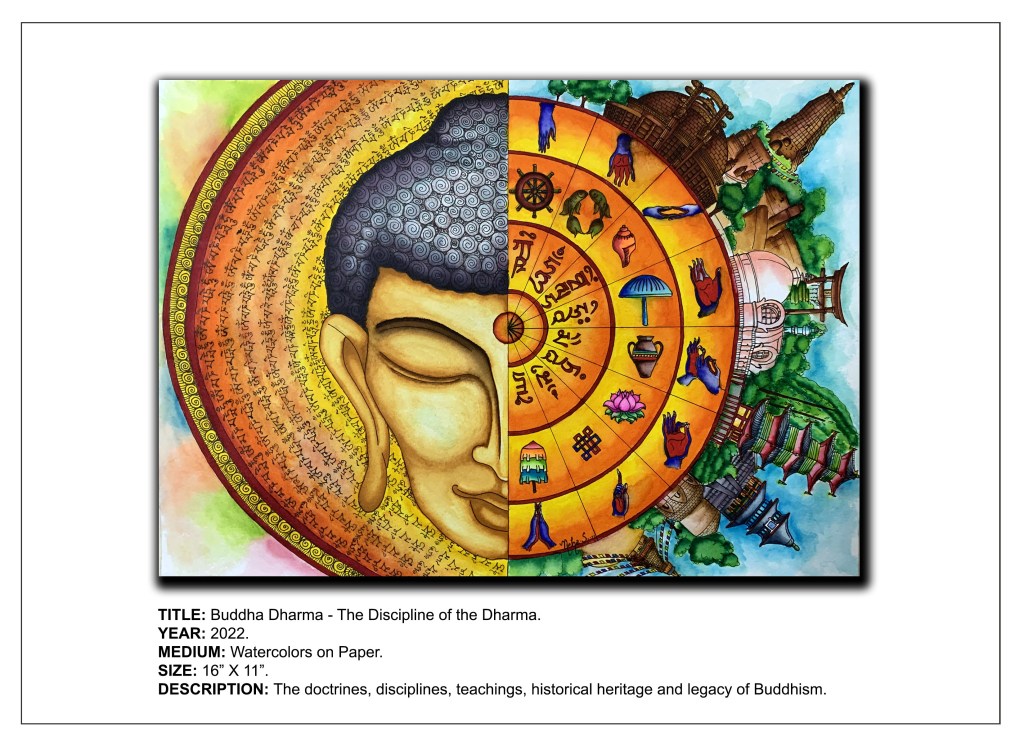
Reviving my blog and my art after a prolonged creative block. Today’s post is about my artwork titled Buddha Dharma – The Discipline of the Buddha, which is a sequel to the story of the Buddha and a continuation of my “Buddha Sutra” Series.  Here’s an image of the artwork I have created:

The making of the artwork – https://www.instagram.com/p/CjaGde-rKXc/

Over his lifetime, the Buddha preached a wide range of teachings that were collectively known as the Dharma or Buddhadharma. This watercolor artwork depicts not only the doctrines, disciplines, and teachings of Dharma but also the historical heritage and legacy associated with it. Dharma has been symbolized in the painting by the powerful Sanskrit mantra – “Om Mani Padme Hum.” This mantra, within which every one of the Buddha’s teachings is believed to reside, has been illustrated in the halo surrounding the Buddha’s face on the left as well as inside the “Dharma Chakra” or Dharma Wheel on the right.  Also depicted within the Dharma wheel is the “Ashtamangala” or the Eight Auspicious Symbols in Buddhism. These symbols, which are also teaching tools, include: the conch, endless knot, pair of golden fish, lotus, parasol, vase of jewels, Dharmachakra and victory banner. The various hand mudras associated with Buddhism have also been depicted within the Dharma Wheel.

The historical heritage of Buddhism has been illustrated in the form of Buddhist monuments of the likes of the Sanchi Stupa, the Mahaparinirvana Temple, the Mahabodhi temple, the Dhamekh Stupa, the Vishwa Shanti Stupa and some other monestaries and temples.

The Buddha’s teachings encompass the nature of the mind, the true nature of reality in the form of the existence and acknowledgement of suffering, the path to ending suffering, and finally the possibility of achieving nirvana through meditation and detachment.