Featured

Tashi Tagye – The Eight Signs of Auspiciousness

Today’s post brings the final artwork of my Buddha Sutra series which its titled, “Tashi Tagye – The Eight Signs of Auspiciousness.” This watercolor artwork depicts the eight auspicious symbols of Buddhism. These auspicious signs (called “Ashtamangala” in Sanskrit), are termed “Tashi Tagye” in Tibetan and are associated with different parts of the Buddha’s body. They also symbolize auspicious subjects and enlightened qualities.

The Artwork
The Art Process

These symbols, as illustrated in the artwork above and corresponding to the respective body parts of the Buddha as well as the qualities are:

  1. Parasol – This represents the Buddha’s enigmatic head and signifies the many umbrellas, parasols and canopies offered to the Buddha by countless celestial and human kings which were blessed by the Buddha as symbols of protection from suffering, destructive forces and illness. The parasol represents the various aspects of the Buddha’s teachings which give peaceful solace from suffering. The dome of the parasol symbolizes wisdom and the hanging skirt represents compassion. It also represents protection of the practice of dharma.
  2. The Golden Fishes – These represent the Buddha’s compassionate and clairvoyant eyes and symbolize fearlessness and freedom as they have complete freedom of movement in the water, taking on the bold, vast and dangerous oceans fearlessly. Thus, they symbolize the agility and swiftness of the Buddha’s enlightened mind.  They represent the penetrating as well as transcendental wisdom of the Buddha.
  3. The Lotus – This represents the Buddha’s tongue which is free from flaws of speech and is endowed with eloquence and the profound taste of the dharma. Just as the lotus is not sullied by muddy waters but thrives in them, the Buddha also thrives in the imperfect world unaffected by it. Thus, it symbolizes purity, immaculate existence and enlightenment.
  4. The Treasure Vase – This represents the Buddha’s throat, which is considered an infinite treasury of wisdom and enlightenment. It is a reminder of the many positive aspects gained through the practice of the dharma.  It also symbolizes the spiritual qualities of the Buddha as a container of nectar for immortality.
  5. The Wheel Of Dharma – This represents the Buddha’s feet as well as his vast knowledge and understanding of the dharma. It is a metaphor for his spiritual teachings which he used to teach his disciples and subdue negative forces. The 8 spokes of the wheel represent the noble eightfold path. The hub of the wheel symbolizes moral discipline and the rim, meditative concentration. It is believed that an understanding of the cycle of life wheel stop the wheel from turning.
  6. The Victory Banner – This represents the Buddha’s body and symbolizes the victory of positive virtues over negative ones and the invincibility of an enlightened being. It represents Buddha’s victory over the four “maras,” or hindrances in the path of enlightenment. These hindrances are pride, desire, disturbing emotions and the fear of death.  It is a reminder of victory over lust and temptations and represents strength and solidarity in the practice of dharma.
  7. The Conch – This represents the deep, melodious and pervasive voice of the Buddha and symbolizes the sound of the dharma which awakens sentient beings from the slumber of ignorance. It convinces them towards the path of noble and virtuous deeds. It also symbolizes fearlessness and resounding victory and is a call to focus while the teachings of dharma are present.
  8. The Endless Knot – This represents the profound and mystical nature of the Buddha’s heart and mind. Its intertwining structure symbolizes the interdependence and interpenetration of reality and the complex and intricate nature of all phenomena. It indicates the immutable and adamantine state of enlightenment and the infinite connectivity of all things. It is a reminder how the life of all things intertwines, the continuity of harmony and the practice of dharma. It also symbolizes Buddha’s endless vision and compassion.

These 8 auspicious symbols can be drawn individually, in pairs, in fours or as a group of eight. When illustrated a group of eight traditionally, only seven items excluding the treasure vase are drawn as these seven form the shape of the vase. However, my artwork does not follow this norm and depicts all eight as individual entities. They have been enhanced further with their names written in Tibetan script calligraphy as well as prayer flags displaying Buddhist prayers.
Featured

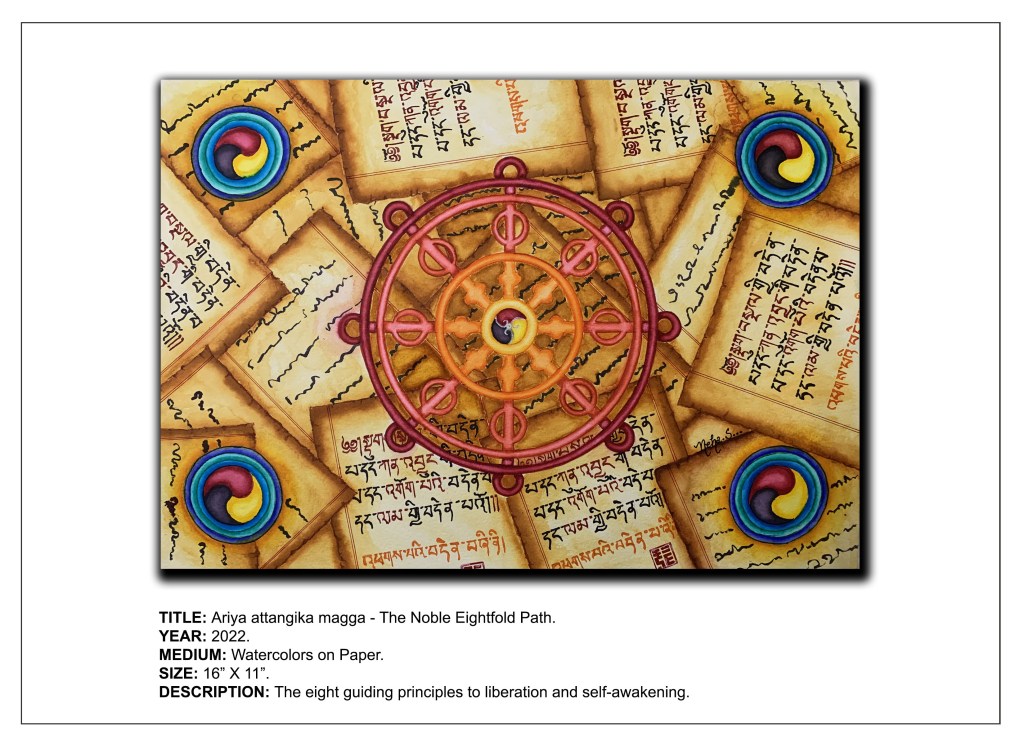
“Ariya atthangika magga” – The Noble Eightfold Path

“There are no enlightened beings, only enlightened actions.”

Buddhism revolves around the principle of Dharma and encompasses various traditions, beliefs and practices of Lord Buddha. Buddha gave his first sermon in Sarnath to Kaundinya and four other scholars. In Isipatana of Sarnath, he preached about Dhammacakkappavattana Sutta, which includes Four Noble Truths and Noble Eightfold Path.

It is these fundamental doctrines of Buddhism that have been displayed in the artwork shown below, the title of the artwork being, “Ariya atthangika magga” – The Noble Eightfold Path. The Noble Eightfold Path is one of the principal teachings of Buddhism and is the fourth truth of the Four Noble Truths and regarded by Buddha as the medium to attain Enlightenment.

This artwork depicts the Noble Eightfold Path through the Dharma Wheel (Dharma Chakra), with its eight spokes representing the eight elements of the path, namely – right view, right resolve, right speech, right conduct, right livelihood, right effort, right mindfulness, and right concentration (or “samadhi”).

The four circles in the corners represent the Four Noble Truths, namely – The existence of suffering, its cause, its cessation and the path leading to its end. The path alluded to in the fourth truth is the Eightfold Path, which ultimately leads to enlightenment or Nirvana. This path is also depicted textually in the form of Tibetan manuscripts in the background of the artwork.

The Noble Eightfold Path is all about ending the suffering of life and achievement of self-awakening.  It enables us to overcome the “I” and attain harmony with the world around us. Being always awake and aware, is fundamental to a good life.

Featured

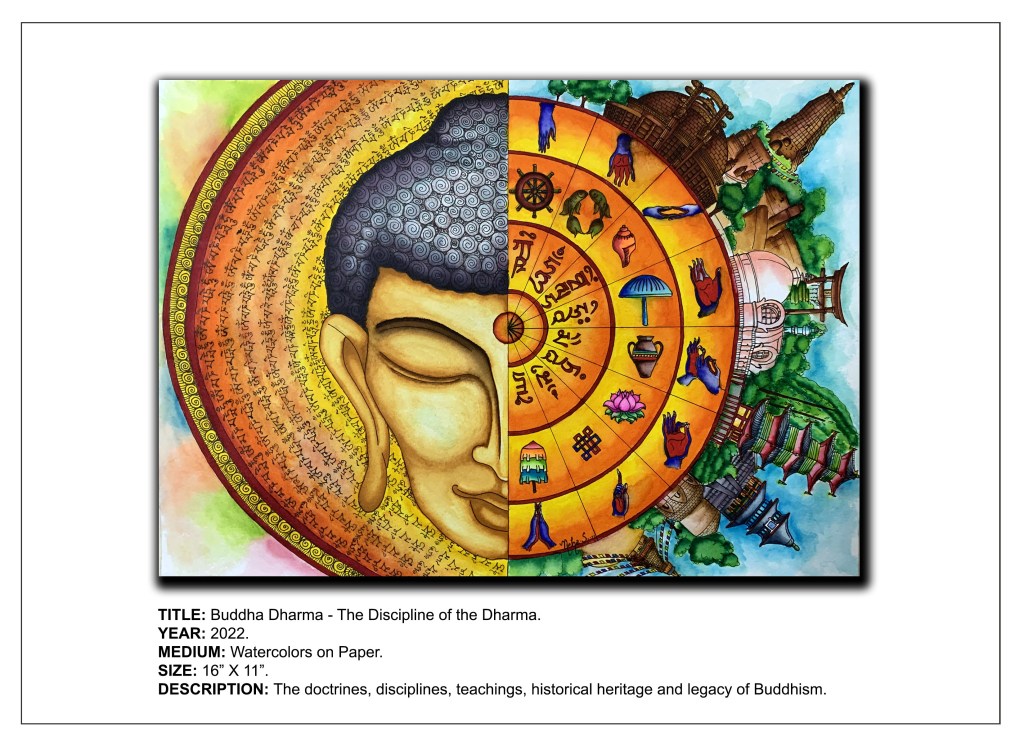
Buddha Dharma – The Discipline of the Dharma

“A disciplined mind brings happiness.” – Gautam Buddha.

Reviving my blog and my art after a prolonged creative block. Today’s post is about my artwork titled Buddha Dharma – The Discipline of the Buddha, which is a sequel to the story of the Buddha and a continuation of my “Buddha Sutra” Series.  Here’s an image of the artwork I have created:

The making of the artwork – https://www.instagram.com/p/CjaGde-rKXc/

Over his lifetime, the Buddha preached a wide range of teachings that were collectively known as the Dharma or Buddhadharma. This watercolor artwork depicts not only the doctrines, disciplines, and teachings of Dharma but also the historical heritage and legacy associated with it. Dharma has been symbolized in the painting by the powerful Sanskrit mantra – “Om Mani Padme Hum.” This mantra, within which every one of the Buddha’s teachings is believed to reside, has been illustrated in the halo surrounding the Buddha’s face on the left as well as inside the “Dharma Chakra” or Dharma Wheel on the right.  Also depicted within the Dharma wheel is the “Ashtamangala” or the Eight Auspicious Symbols in Buddhism. These symbols, which are also teaching tools, include: the conch, endless knot, pair of golden fish, lotus, parasol, vase of jewels, Dharmachakra and victory banner. The various hand mudras associated with Buddhism have also been depicted within the Dharma Wheel.

The historical heritage of Buddhism has been illustrated in the form of Buddhist monuments of the likes of the Sanchi Stupa, the Mahaparinirvana Temple, the Mahabodhi temple, the Dhamekh Stupa, the Vishwa Shanti Stupa and some other monestaries and temples.

The Buddha’s teachings encompass the nature of the mind, the true nature of reality in the form of the existence and acknowledgement of suffering, the path to ending suffering, and finally the possibility of achieving nirvana through meditation and detachment.

Featured

“Moksha” – The Moral Compass

Hey all! I know I have been MIA for quite some time but I’m back now with a new post about my most recent artwork. This too has been long overdue, as I allowed procrastination to get the better of me, but finally, I have succeeded in completing it!

In one of my previous posts, I had talked about how a book can become the source of inspiration for my art, in particular the third book of the Ram Chandra Series – Raavan: Enemy of Aryavarta, by the Indian author Amish Tripathi. This work of fiction chronicles the life of Ravan and portrays him as an artist among other things. One of the excerpts from the book describes a painting made by him that is not only a character sketch of himself but also a logically befitting description of the concept of “dharma” or the “righteous path”. (Click on the following link to read this post – https://theartdungeon.blog/2021/06/06/inspiration-calling/).

The beautiful artwork created by Ravan and described in this excerpt was not just a vivid description of Ravan’s psyche, but also a profound portrayal of his struggle to attain the right direction through the “moral compass” called dharma.

This one-of-a-kind piece of art became my muse purely because of the distinctive way in which it brings out the true essence of Ravan. I was so enamored by his narrative that I couldn’t wait to interpret it in my own way and create my very own version onto my canvas. Finally, I managed to do that and here I present to you, my acrylic painting titled “Moksha”.

In the book, Ravan describes a painting created by him that depicts his struggle to attain enlightenment. I have attempted to depict his mental turmoil and his desperate attempts to scale the wall of the Nine emotions or the Navrasas that hold him down. The ten heads in my artwork correspond to the ten heads of Ravan himself. Out of these, 9 represent the Navrasas, one for each emotion, whereas the tenth head is the state of spiritual awakening that Ravan is striving to achieve.

I have further attempted to add on to the concept by depicting the 7 chakras or the main energy centers that control our body. My endeavor is to reaffirm that one can only transcend the wall of emotions by opening up all the chakras, allowing energy to flow freely, thereby harmonizing the body, mind as well as the spirit.  It is only this equilibrium that can help one attain physical, emotional and spiritual “moksha” – which was not just the “righteous path” being pursued by Ravan, but also the “dharma” attained by the Buddha.

Hope you all like my approach towards Ravan and his “moksha!”