

Every time I venture into the depths of The Art Dungeon, I never quite know what I am going to find. And here I am, opening another little time capsule from my repository of artistic memories.
Some artworks make me stop because I remember exactly why I painted them. Others make me pause because, honestly, I have no idea what possessed me to put those colours together in the first place!
And then there are those rare ones that make me wonder: “How did I forget this?”
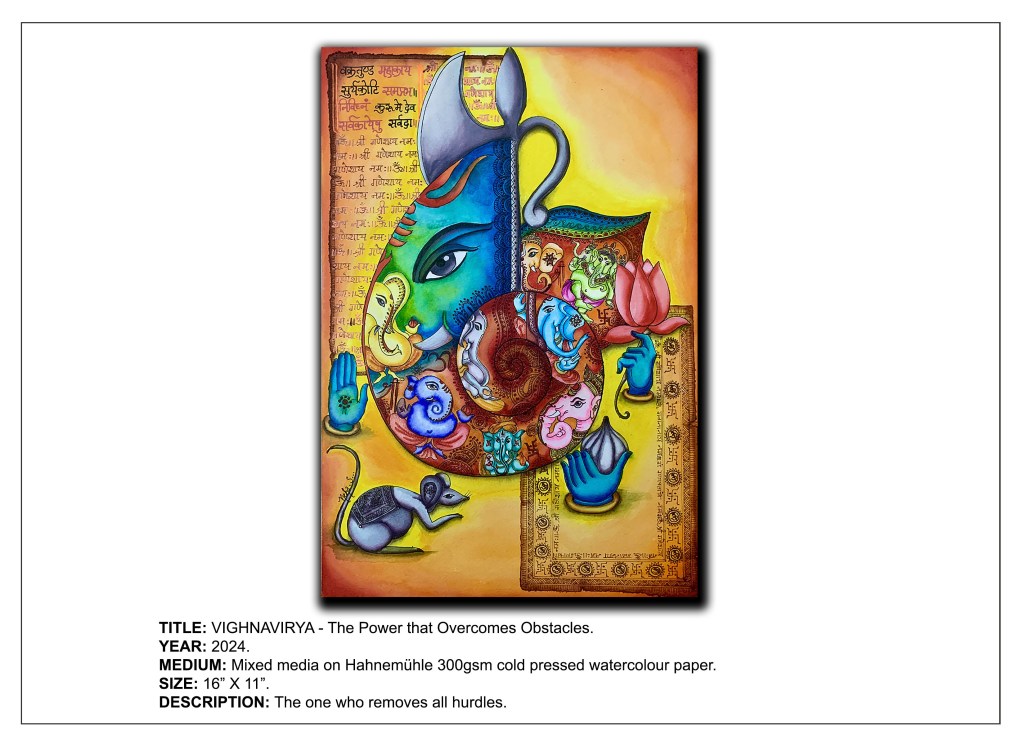
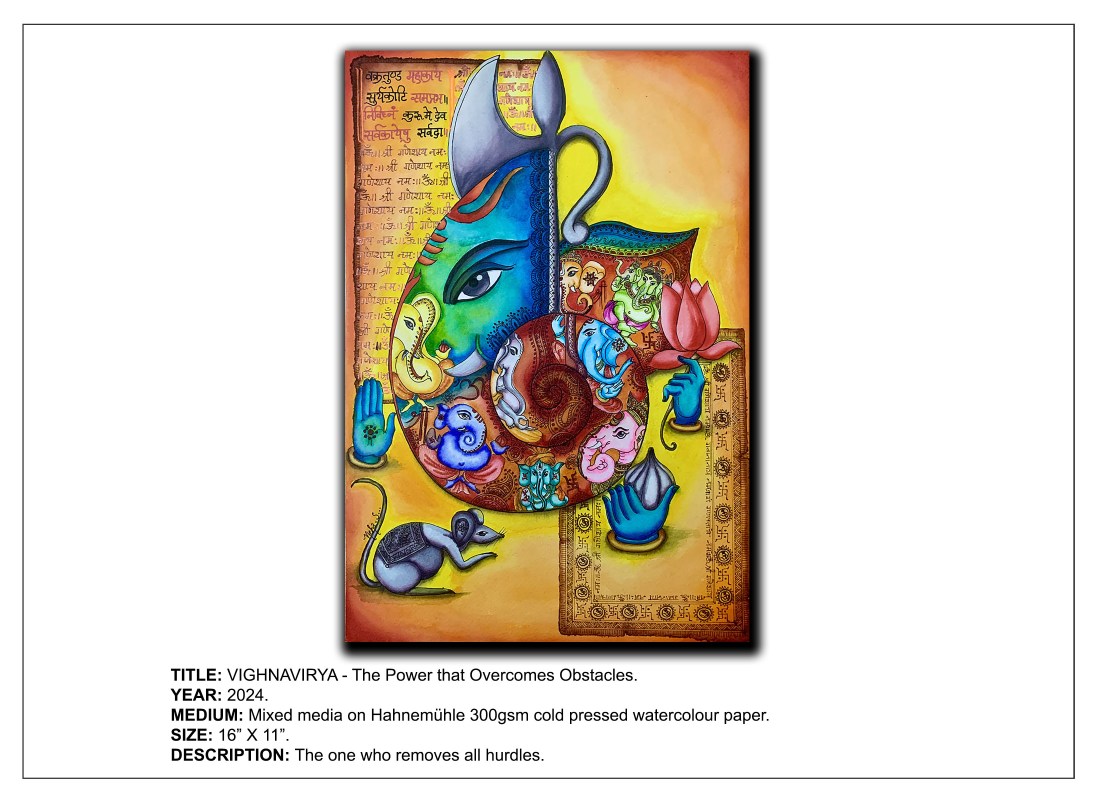
This Ganesha painting was one of them and I called it Vighnavirya, which literally translates to one who possesses the power to defeat obstacles and is used as an epithet for the Lord.
I have always been fascinated by how much meaning can be contained within the seemingly simplest elements of a divine form.
At the centre of this artwork, is the majestic elephant head of Ganesha, surrounded by a kaleidoscope of his various forms and manifestations. The elephant head immediately speaks of wisdom, strength and discernment.
Those enormous ears seem almost exaggerated—and perhaps deliberately so. They seem to whisper: Listen. Listen before you speak. Listen before you react. Listen to the world around you. And perhaps most importantly, listen to that quiet voice within.
Then there is the broken tusk. At first glance, it may seem like an imperfection. But in Ganesha’s story, it becomes a symbol of sacrifice—the willingness to give up something precious for a greater purpose. There is something beautiful about that contradiction. What appears broken becomes sacred. What appears imperfect becomes meaningful. Perhaps that is a lesson worth remembering in our own lives too.
The Stories Hidden in His Hands
Ganesha’s multiple hands hold some of the most recognisable symbols associated with him, and each one adds another chapter to the story.
The lotus rises from the mud yet blooms in exquisite purity. It is a reminder that difficult circumstances need not determine who we become. We can rise above them, just as the lotus rises above the waters that surround it.
The axe represents the cutting away of ignorance, attachment and obstacles. Sometimes progress isn’t about acquiring more.Sometimes it is about having the courage to let go.
And then there is the Modak—that little sweet resting in his palm. Perhaps one of the most delightful of Ganesha’s symbols, the Modak represents the sweetness that comes from discipline, devotion and perseverance. A gentle reminder that the journey may not always be easy, but there is sweetness waiting at the end of it.
The trident brings yet another dimension of divine strength and power.
Together, these objects transform his hands into a visual vocabulary—a collection of lessons on how to navigate life.
When Colour Becomes Emotion
And then, of course, there are the colours. This artwork is anything but shy. It bursts with saffron, red, gold and green, each colour contributing its own energy to the composition.
Saffron evokes spirituality and purity.
Red brings energy, strength and auspiciousness.
Gold speaks of divine radiance, abundance and prosperity.
Green suggests growth, renewal and the richness of life.
Ganesha isn’t only the deity we turn to when something goes wrong.
He is also the deity we welcome when something new is about to begin.
And beginnings deserve colour.
And Then I Found the Mushak
Almost hidden at his feet is one of my favourite details—the little Mushak. It would be easy to overlook him next to the grandeur of Ganesha. But that tiny mouse carries a surprisingly enormous message. The Mushak is associated with desire—the restless, constantly moving mind that wants, seeks, reaches and rarely seems satisfied. And here is Ganesha, magnificent and serene, riding upon it.
The symbolism is wonderfully simple: Master your desires. Don’t let them master you. The contrast between the enormous Ganesha and the tiny Mushak makes the message even more powerful. Perhaps the greatest strength isn’t having no desires. Perhaps it is knowing how to remain in control of them.
When the Background Starts Speaking
As I looked at the artwork again, I noticed the sacred chants and mantras woven into the background. And suddenly, the painting felt different. The words weren’t merely decorative. They seemed to create an invisible rhythm behind the image—a reminder of prayer, faith and invocation. The chants speak to that universal belief that when we call upon Ganesha, we are not merely asking for obstacles to disappear. We are asking for the strength, wisdom and clarity to overcome them. And perhaps that distinction matters. Because sometimes the mountain doesn’t disappear. We simply become strong enough to climb it.
The Deity of Beginnings
There is a reason Ganesha is invoked before new ventures and important beginnings. Beginnings are exciting, but they are rarely predictable. Every new chapter comes with its share of uncertainty, self-doubt and obstacles. And perhaps that is why Ganesha’s symbolism continues to feel so relevant.
His lotus tells us to rise.
His axe tells us to release.
His Modak reminds us that perseverance has its rewards.
His broken tusk reminds us that sacrifice can serve a greater purpose.
His enormous ears remind us to listen.
His Mushak reminds us to master our desires.
And his elephant head reminds us to approach life with wisdom.
Perhaps This Is Why I Found Him Today. So here I am, standing in the middle of The Art Dungeon, rediscovering an artwork I had almost forgotten. And I can’t help wondering whether perhaps I didn’t really find this Ganesha. Perhaps he found me.
After all, isn’t that how art sometimes works? We create something at one point in our lives, leave it behind, and then years later encounter it again—only to realize that its meaning has changed because we have changed. The canvas remains the same. But we don’t. And suddenly, an old artwork can say something entirely new.
Looking at this Ganesha today, I see more than vibrant colours and sacred symbols.
I see a reminder.
That obstacles are inevitable.
That beginnings are uncertain.
That perfection is overrated.
That sometimes we need to let go.
That sometimes we need to listen.
And that faith doesn’t necessarily promise us an obstacle-free path.
It simply gives us the courage to walk the path.
Perhaps that is the little message this forgotten canvas brought back from the depths of The Art Dungeon.
No mountain is too high.
No path is too twisted.
No beginning is too small.
And when the road ahead seems blocked, perhaps all we need to do is pause, listen, find our inner strength—and invoke Ganesha.
Ganpati Bappa Morya!
Another forgotten canvas. Another story rediscovered. Another little piece of The Art Dungeon brought back into the light.