

The artwork in today’s post is titled “Kilkhor – The Sacred Circle” and takes inspiration from the Tibetan Mandala and Thangka paintings. The Tibetan word for mandala is “Kilkhor,” which means “center of the circle with exterior walls and surrounding environment.”
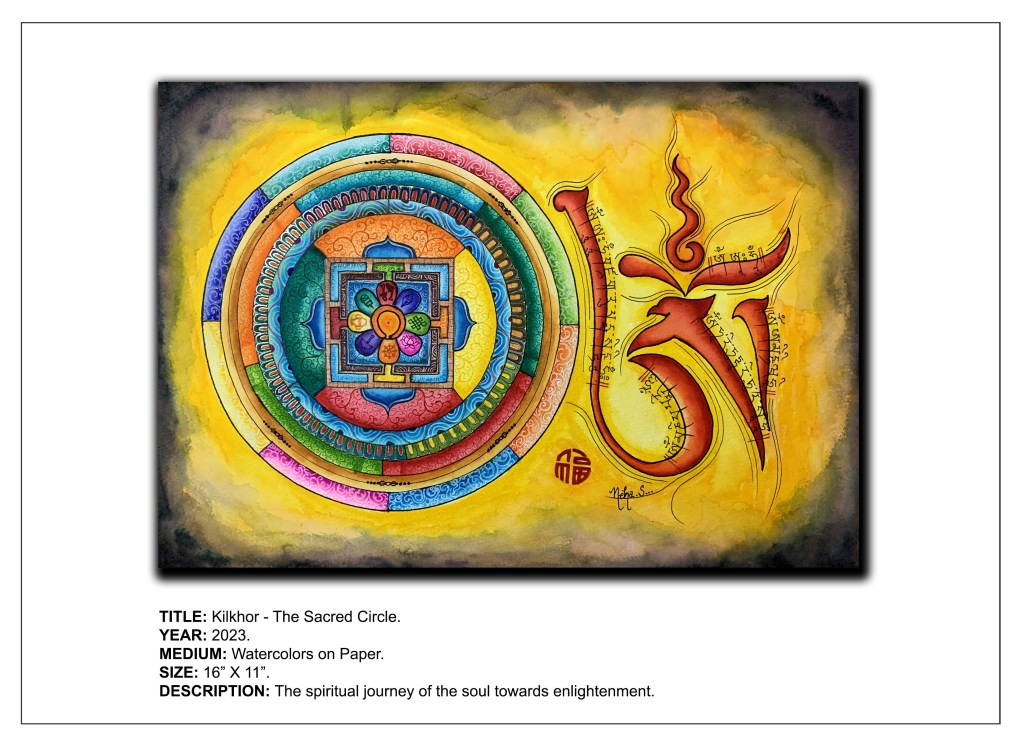
Mandalas are two- or three-dimensional ritual objects found in Tibetan Buddhist and other religious traditions. They are seen as objects for meditation, assisting in spiritual development. They represent the universe, and all the symbols represent one’s spiritual journey, from birth through life to death, interconnecting all living things. This spiritual journey is portrayed in the mandala through the various layers, starting form the outside to the innermost core, which in turn represents the ultimate destination of every soul – enlightenment.
In this artwork, the mandala that has been illustrated serves as a tool for gaining wisdom and compassion by guiding individuals along the path of enlightenment. It is a cosmic diagram or geometric pattern representing the various layers of worldly vices and weaknesses that one needs to overcome and the virtues that one needs to adopt and practice in order to attain the final goal of Nirvana. These 8 layers, starting from the outside and moving inwards in concentric circles are:
- The eight vicissitudes (Outermost/1st layer) – Pleasure, pain, loss, gain, blame, praise, fame and disrepute.
- The six roots of the mind (2nd layer) – Love, delusion, wisdom, hatred, generosity and greed.
- The five precepts (3rd layer) – Lust, False/harsh speech, intoxicants, killing and stealing.
- The five hinderances (4th layer) – Anger, sloth, restlessness, doubt and desire.
- The three kinds of suffering (5th layer) – Suffering of conditionality, suffering of change and suffering of pain.
- The four noble truths (6th layer) – The truth of existence of suffering, the cause of suffering, the cessation of suffering and the path leading to the cessation of suffering.
- The Noble Eightfold Path (7th layer) – Right view, right thought, right speech, right action, right livelihood, right effort, right mindfulness and right concentration. This layer also represents the eight auspicious symbols associated with Buddhism, namely – the conch, endless knot, pair of golden fish, lotus, parasol, vase of jewels, Dharmachakra and victory banner.
- The Zen Circle (Innermost/8th layer) – This is the circle of enlightenment, the final destination for peace and mindfulness.
Each layer is divided symmetrically into equal portions representing each of the respective qualities or elements associated with it. Traditional motifs employed in Thangka paintings and Tibetan mandalas have been used to illustrate them in different colours. The calligraphic script next to the mandala is a stylized version of the Tibetan alphabet for “Om”, which has been further accentuated with some common Buddhist mantras also in Tibetan script.
This mandala symbolizes every individual’s endeavor to overcome all the worldly attachments (represented in the first five layers), realizing and accepting the four noble truths (represented in the sixth layer) and finally adopting the eight noble virtues (in the seventh layer) through the power of meditation and detachment in order to transcend metaphysically into the pure state of awakening (the eighth and innermost layer).
 The Art Dungeon