Featured

Kilkhor – The Sacred Circle

The artwork in today’s post is titled “Kilkhor – The Sacred Circle” and takes inspiration from the Tibetan Mandala and Thangka paintings. The Tibetan word for mandala is “Kilkhor,” which means “center of the circle with exterior walls and surrounding environment.”
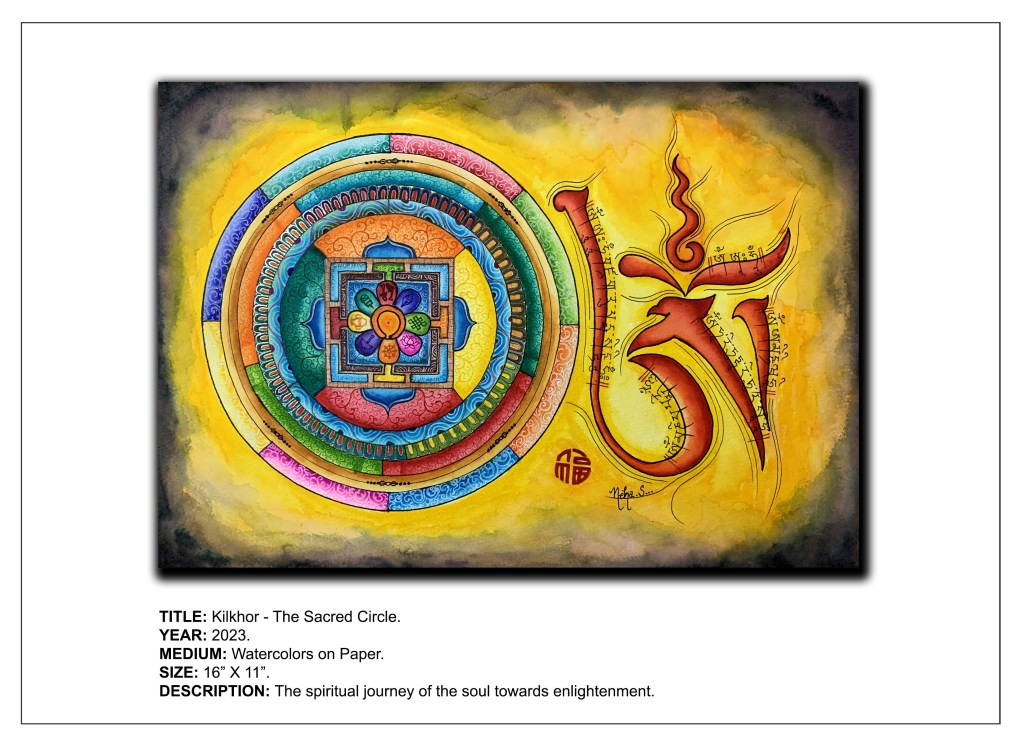
The artwork

Mandalas are two- or three-dimensional ritual objects found in Tibetan Buddhist and other religious traditions. They are seen as objects for meditation, assisting in spiritual development. They represent the universe, and all the symbols represent one’s spiritual journey, from birth through life to death, interconnecting all living things. This spiritual journey is portrayed in the mandala through the various layers, starting form the outside to the innermost core, which in turn represents the ultimate destination of every soul – enlightenment.

In this artwork, the mandala that has been illustrated serves as a tool for gaining wisdom and compassion by guiding individuals along the path of enlightenment. It is a cosmic diagram or geometric pattern representing the various layers of worldly vices and weaknesses that one needs to overcome and the virtues that one needs to adopt and practice in order to attain the final goal of Nirvana.  These 8 layers, starting from the outside and moving inwards in concentric circles are:

  • The eight vicissitudes (Outermost/1st layer) – Pleasure, pain, loss, gain, blame, praise, fame and disrepute.
  • The six roots of the mind (2nd layer) – Love, delusion, wisdom, hatred, generosity and greed.
  • The five precepts (3rd layer) – Lust, False/harsh speech, intoxicants, killing and stealing.
  • The five hinderances (4th layer) – Anger, sloth, restlessness, doubt and desire.
  • The three kinds of suffering (5th layer) – Suffering of conditionality, suffering of change and suffering of pain.
  • The four noble truths (6th layer) – The truth of existence of suffering, the cause of suffering, the cessation of suffering and the path leading to the cessation of suffering.
  • The Noble Eightfold Path (7th layer) – Right view, right thought, right speech, right action, right livelihood, right effort, right mindfulness and right concentration. This layer also represents the eight auspicious symbols associated with Buddhism, namely – the conch, endless knot, pair of golden fish, lotus, parasol, vase of jewels, Dharmachakra and victory banner.
  • The Zen Circle (Innermost/8th layer) – This is the circle of enlightenment, the final destination for peace and mindfulness.

Each layer is divided symmetrically into equal portions representing each of the respective qualities or elements associated with it. Traditional motifs employed in Thangka paintings and Tibetan mandalas have been used to illustrate them in different colours. The calligraphic script next to the mandala is a stylized version of the Tibetan alphabet for “Om”, which has been further accentuated with some common Buddhist mantras also in Tibetan script.

This mandala symbolizes every individual’s endeavor to overcome all the worldly attachments (represented in the first five layers), realizing and accepting the four noble truths (represented in the sixth layer) and finally adopting the eight noble virtues (in the seventh layer) through the power of meditation and detachment in order to transcend metaphysically into the pure state of awakening (the eighth and innermost layer).   

Featured

The Big Reveal!!

Hey fellow art enthusiasts! As promised, here I am with the outcome of the little snippet I shared in last week’s post!! So, are you all ready for the big reveal? Here it is!

This is it!
The final artwork

This watercolor artwork is called Bo Tree – The Emblem of Enlightenment. It is a representation of the Bodhi Tree (Ficus religiosa), under which Siddharth Gautam, who later became known as the Buddha, is said to have attained enlightenment or Buddhahood.

The Bodhi Tree is a principal religious symbol in Buddhism due to its prominence in the Buddha’s discovery of enlightenment, or total peace and happiness in the form of Nirvana, or the greater reality. “Bodhi” means awareness and Bodhi tree means the tree under which Buddha becomes fully aware of the noble truth of the universe.

Essentially the ‘tree of awakening,’ also known as the Bo Tree, in Pali it is known as the “bodhirukkha,” in Sanskrit the “bodhivka” and to botanists as Ficus religiosa. Given its close association with the attainment of Buddhahood, the tree has great symbolic significance.

This tree as depicted in the artwork represents the supreme knowledge acquired by the Buddha during his tireless meditation. It conveys the teachings and sermons he preached and passed on to his disciples and followers. These teachings are illustrated in the artwork in the Pali script and represented as scribbles in the canopy of the tree.  The tree reflects the capacity of every human being to follow in the footsteps of the Buddha in achieving the ultimate spiritual goal by letting go of the finite self through meditation and self-discipline. The heart-shaped leaves of the Bodhi tree symbolize peace and happiness developing in one’s heart during the journey towards Nirvana.

The Bodhi tree is the DNA of Buddha’s teachings, an emblem of peace and a reminder of the eventual prospect of enlightenment that lies within us all.  

Featured

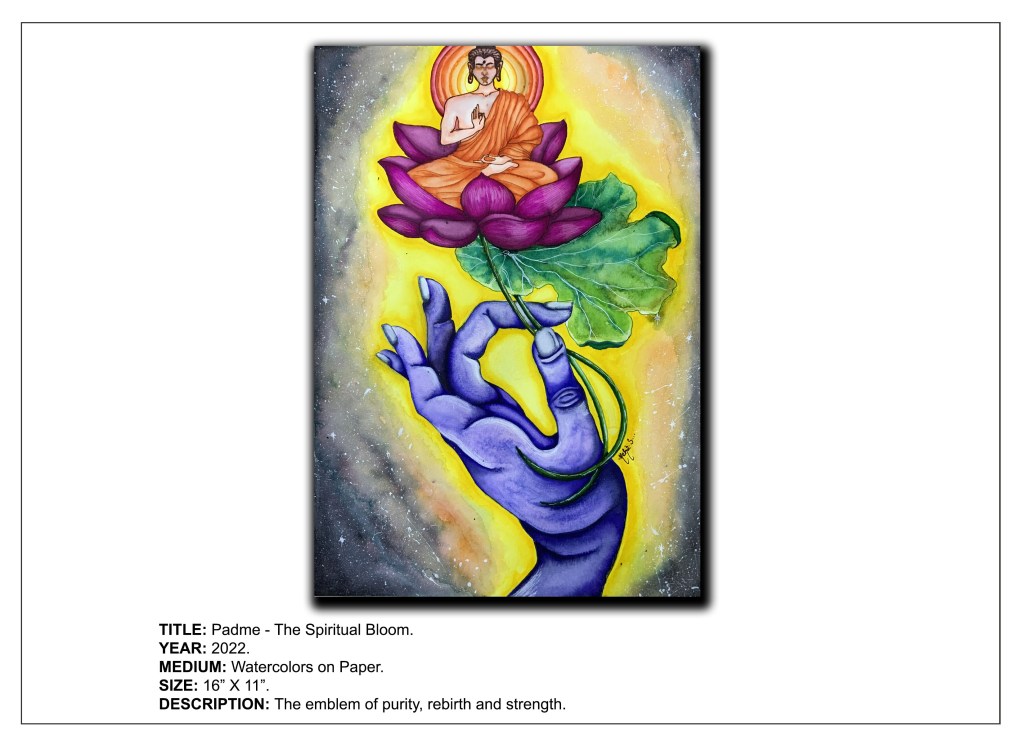
Padme – The Spiritual Bloom

Padme – The Spiritual Bloom

“Just like the lotus we too have the ability to rise from the mud, bloom out of the darkness and radiate into the world.”

The lotus is one of the most revered and sacred symbols of Buddhism. It is this holy symbol that is the subject of today’s artwork tilted, “Padme – The Spiritual Bloom.”

The lotus represents spiritual awakening, purity, and rebirth as the act of emerging from muddy water symbolizes rising above the challenges and adversities of life and moving towards the light of wisdom. It also represents nonattachment, as it is rooted in mud (attachment and desire) but its flowers blossom on long stalks untarnished by the mud below (detachment).

Another important aspect of the lotus is that when it blossoms, it simultaneously plants a seed, representing the Buddhist concept of cause and effect, whereby the flower is symbolic of the cause and the seed-pod the effect.

The lotus serves as a reminder that all beings can attain enlightenment. Just as the blossom rises from the depths of murky ponds and lakes to bloom immaculately above the water’s surface, so can the human mind develop the virtues of the Buddha and transcend desire and attachment to reveal its essentially pure nature. It symbolizes the blooming of the soul from the filth of the physical world, eventually flourishing in the bright sunshine of enlightenment and attaining nirvana.

There are a variety of colors of the lotus associated with Buddhism. The pink lotus is the supreme one and is the true lotus of Buddha. It is for this reason that the Buddha in this artwork is depicted seated on a pink lotus, which indicates His enlightened and divine status.

 All symbolism associated with the lotus points towards finding spiritual meaning in life. We all are like lotus blooms in the universal pond, striving to realize our true potential.

Featured

“Ariya atthangika magga” – The Noble Eightfold Path

“There are no enlightened beings, only enlightened actions.”

Buddhism revolves around the principle of Dharma and encompasses various traditions, beliefs and practices of Lord Buddha. Buddha gave his first sermon in Sarnath to Kaundinya and four other scholars. In Isipatana of Sarnath, he preached about Dhammacakkappavattana Sutta, which includes Four Noble Truths and Noble Eightfold Path.

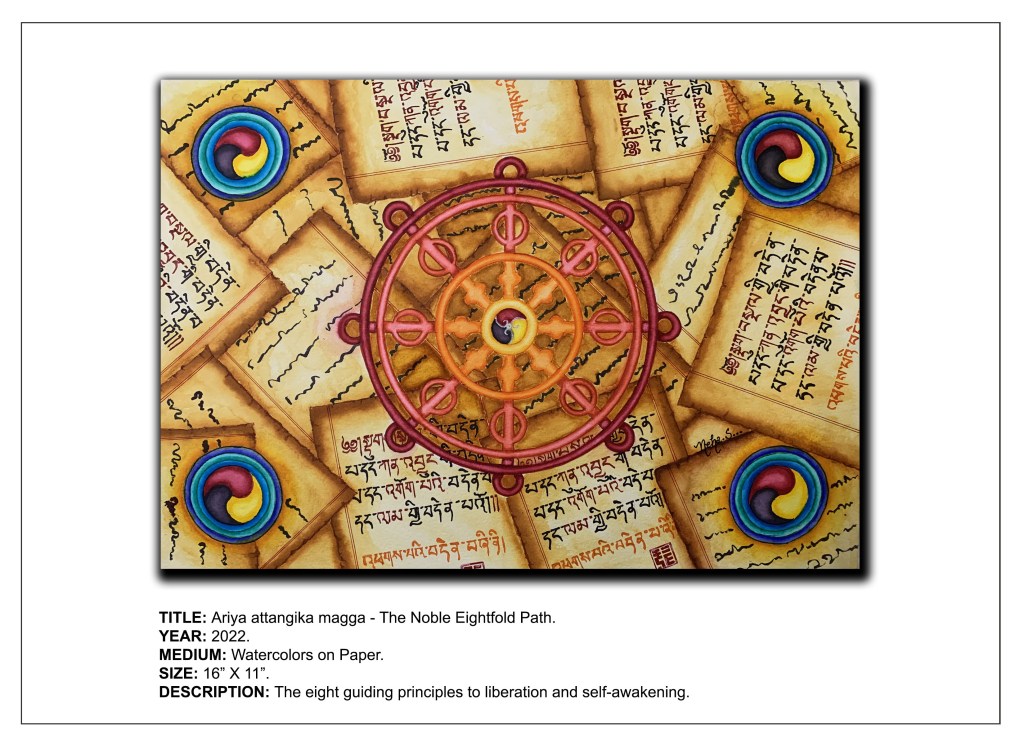
It is these fundamental doctrines of Buddhism that have been displayed in the artwork shown below, the title of the artwork being, “Ariya atthangika magga” – The Noble Eightfold Path. The Noble Eightfold Path is one of the principal teachings of Buddhism and is the fourth truth of the Four Noble Truths and regarded by Buddha as the medium to attain Enlightenment.

This artwork depicts the Noble Eightfold Path through the Dharma Wheel (Dharma Chakra), with its eight spokes representing the eight elements of the path, namely – right view, right resolve, right speech, right conduct, right livelihood, right effort, right mindfulness, and right concentration (or “samadhi”).

The four circles in the corners represent the Four Noble Truths, namely – The existence of suffering, its cause, its cessation and the path leading to its end. The path alluded to in the fourth truth is the Eightfold Path, which ultimately leads to enlightenment or Nirvana. This path is also depicted textually in the form of Tibetan manuscripts in the background of the artwork.

The Noble Eightfold Path is all about ending the suffering of life and achievement of self-awakening.  It enables us to overcome the “I” and attain harmony with the world around us. Being always awake and aware, is fundamental to a good life.

Featured

Panchamahabhuta – The Five Great Elements

AIR moves us

FIRE transforms us

WATER shapes us

EARTH heals us

SPACE awakens us

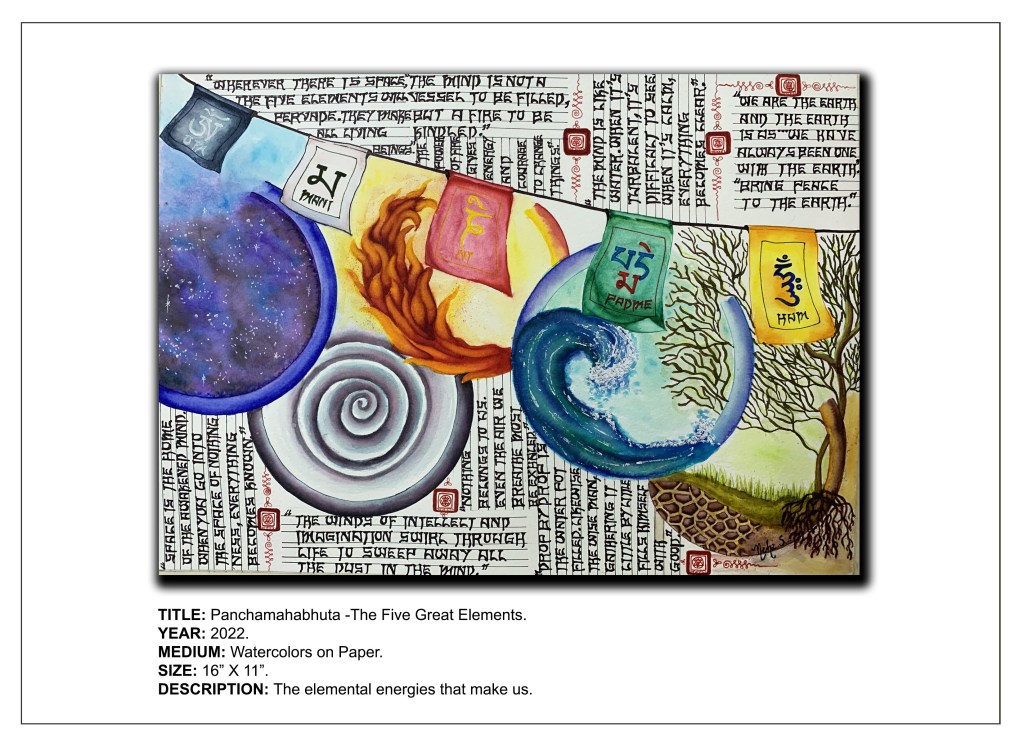
Earth, water, fire, air, and space are the five elemental energies that reside inside each one of us. It is these five elements that form the basis of this week’s watercolor artwork called Panchamahabhuta – The Five Great Elements. As in the title, these five elements are called “Panchamahabhuta” in Sanskrit and compose not only the universe, but the human body and mind.

The artwork

Each element represents a force of nature as well as a potential and quality of the human mind. The mind’s ability to serve as the ground for all experience is the quality of earth; its continuity and adaptability is water; its clarity and capacity to perceive is fire; its continuous movement is air and its unlimited emptiness is space.

These elements have been visually illustrated in the artwork along with corresponding text written in stylized calligraphy. Each element has also been represented as a Sanskrit syllable on prayer flags in synonymous colors.

We can discover our true potential by exploring and navigating through the terrain of these five elements that we are composed of. We can heal ourselves by acknowledging, aligning and connecting with these fundamental energies, thereby leading our lives with wisdom and grace.

Featured

Buddha Charita – The Life of Buddha

“It is better to conquer yourself than to win a thousand battles. Then the victory is yours. It cannot be taken from you, not by angels or by demons, heaven or hell.”

The Buddha introduced into the world a philosophy which helped mankind navigate through his suffering. The life he led and the experiences that made him confront suffering also guided him to his final destination – the attainment of enlightenment. Buddha symbolizes a path to liberation and detachment from the triviality of the material world.

The most well-known historical account about the Buddha is the story of his life. It is this divine narrative that has become the inspiration for my latest artwork titled “Buddha Charita”, which is also the culmination of my new series – “Buddha Sutra”. Here’s an image of the artwork I have created:

Buddha Charita

Link to a video clipping of the painting – https://www.instagram.com/p/CdSddp6JL2k/

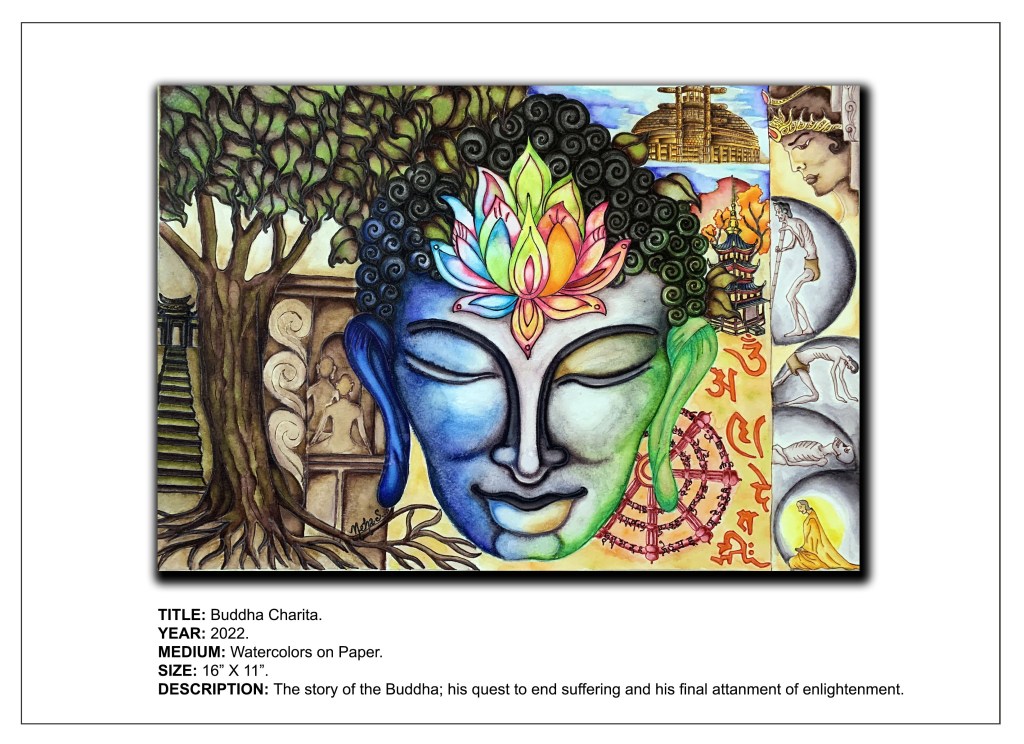
This watercolor artwork is a visual narrative linking several events in the life of the Buddha from his days as Prince Siddhartha Gautama, his confrontation with suffering, his quest for a path towards the cessation of this suffering and his final liberation in the form of his “awakening”.

The first embodiment of the Buddha as the royal Prince Siddhartha has been represented in the right-hand corner of the artwork by an image of him, resplendent with royalty. This is followed by the next stage in his life, where he comes across the sight of a decrepit old man, a sick man, and a corpse which have all been portrayed one below the other in the artwork. These sights changed the perspective of the prince and opened his eyes to all the suffering that accompanies life. Also depicted in the painting, is the image of an ascetic that Gautama encountered, who had learned to seek out spiritual solace in the midst of these worldly miseries and sorrows. Determined to find the same enlightenment, Gautama turned towards the path of renunciation.

After exploring asceticism, or restraint from all physical needs and desires, he discovered meditation and used the practice as a path toward enlightenment. This led to the third stage in the life of Siddhartha, which is displayed in the artwork as the central image of the Buddha, “the awakened one”. The tree on the extreme left of the painting represents the sacred Bodhi tree or the fig tree (Ficus religiosa) under which the Buddha meditated and finally reached the highest state of enlightenment or “nirvana,” which simply means “awakening”.

In addition to the figurative representation of the Buddha himself, his teachings have also been represented in the artwork through iconographic symbols of the likes of the Lotus flower and the Dharma Wheel. Other icons displayed in the artwork include various Buddhist monuments like pagodas and stupas, specifically the Sanchi Stupa, which is considered to be the most sacred monument of Buddhism, as it represents and displays various Buddhist ideals.  

Through this artwork, I wish to honour Buddha’s life, for it is a reminder of the basic Buddhist principles that form the stepping stones to a higher spiritual level.  It is these principles that serve as a source of strength in the grief-stricken world. It is my attempt to convey the philosophy of Buddha by reflecting on his life’s experiences and pledging to practice inward reflection to overcome sorrows, just as he did.  

Featured

“Moksha” – The Moral Compass

Hey all! I know I have been MIA for quite some time but I’m back now with a new post about my most recent artwork. This too has been long overdue, as I allowed procrastination to get the better of me, but finally, I have succeeded in completing it!

In one of my previous posts, I had talked about how a book can become the source of inspiration for my art, in particular the third book of the Ram Chandra Series – Raavan: Enemy of Aryavarta, by the Indian author Amish Tripathi. This work of fiction chronicles the life of Ravan and portrays him as an artist among other things. One of the excerpts from the book describes a painting made by him that is not only a character sketch of himself but also a logically befitting description of the concept of “dharma” or the “righteous path”. (Click on the following link to read this post – https://theartdungeon.blog/2021/06/06/inspiration-calling/).

The beautiful artwork created by Ravan and described in this excerpt was not just a vivid description of Ravan’s psyche, but also a profound portrayal of his struggle to attain the right direction through the “moral compass” called dharma.

This one-of-a-kind piece of art became my muse purely because of the distinctive way in which it brings out the true essence of Ravan. I was so enamored by his narrative that I couldn’t wait to interpret it in my own way and create my very own version onto my canvas. Finally, I managed to do that and here I present to you, my acrylic painting titled “Moksha”.

In the book, Ravan describes a painting created by him that depicts his struggle to attain enlightenment. I have attempted to depict his mental turmoil and his desperate attempts to scale the wall of the Nine emotions or the Navrasas that hold him down. The ten heads in my artwork correspond to the ten heads of Ravan himself. Out of these, 9 represent the Navrasas, one for each emotion, whereas the tenth head is the state of spiritual awakening that Ravan is striving to achieve.

I have further attempted to add on to the concept by depicting the 7 chakras or the main energy centers that control our body. My endeavor is to reaffirm that one can only transcend the wall of emotions by opening up all the chakras, allowing energy to flow freely, thereby harmonizing the body, mind as well as the spirit.  It is only this equilibrium that can help one attain physical, emotional and spiritual “moksha” – which was not just the “righteous path” being pursued by Ravan, but also the “dharma” attained by the Buddha.

Hope you all like my approach towards Ravan and his “moksha!”

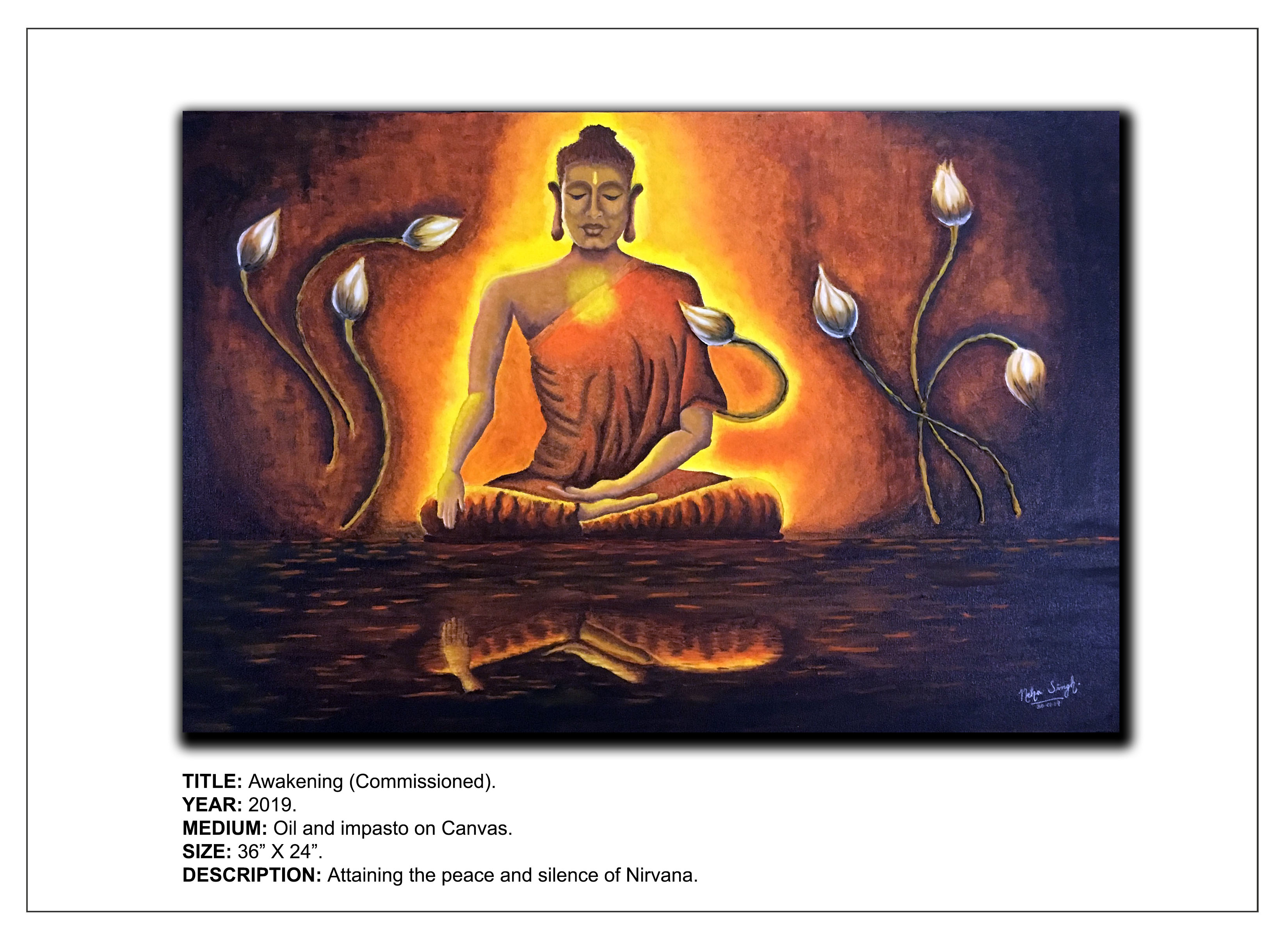
Awakening(Commissioned)

The second and final installment of the Buddha series is a painting titled Awakening, which was made to order for an office space. The brief was to create an image of the Buddha in the highest state of consciousness, that is, Nirvana.

I had been specifically asked to use muted colors, hence I restricted my palette to earthy tones, comprising of warm hues like yellow, orange and brown, with just a hint of red.

Nirvana is a place of perfect peace and happiness and the realization of this state is the awakening. The path to attaining nirvana is meditation, which was practiced by the Buddha himself. Hence, in my painting as well, I have depicted him in a meditative pose.

The look of serenity on the Buddha’s face in this composition symbolizes the joy and contentment he experienced after he awakened to nirvana. I have attempted to highlight the two important aspects of Buddha’s Awakening here, namely, the “what” and the “how”. The former is what the Buddha awakened to, which is the fact that immortal happiness does exists. The latter refers to the means of achieving this eternal happiness, which is human effort.

While painting this piece, the biggest challenge for me was to portray not only the tranquil expression of the meditating Buddha, but also  a vision of the ultimate reality that he was able to see once he awakened to nirvana. I have tried to illustrate this vision in the form of the Buddha’s reflection in the flowing stream. This image of the Buddha himself in the water is symbolic of the eternal happiness that was within him. In order to realize it, all he needed was the right perspective.

In other words, you don’t need to see different things, but rather see things differently and the undying happiness that we are looking for in worldly delights can be found within ourselves.

I have also attempted to capture some of the other important aspects of nirvana in my painting. One of these is mindfulness, that is, an awareness of reality around us. The background of the painting, specifically the negative space and the flower buds around the Buddha, represent this reality.

Another factor is concentration, which is evident through the calmness in the face of the Buddha, thus displaying that one pointed state of awareness.

Yet another facet that I have tried to bring out is tranquility of both body as well as soul, by rendering an aura around the body of the Buddha and a warm glow in the center of the torso. The former denotes calmness of the bodily form and the latter, serenity of the mind and soul.

The Buddha’s look of contentment personifies equanimity, wherein the body, mind and soul are in equilibrium and accept reality as it is, without any craving or aversion.

I have once again used my favorite medium to create this composition. Yes! Oil paints!! But, to bring about a tactile feel to my work, I have also combined it with the technique of impasto, which I have discussed in detail in one of my earlier posts (Dragon-Resurrection, dated, July 6, 2019).

I have applied the impasto in the flower buds and their stems in order to give them a 3D effect.  Previously, I had used it in combination with acrylics but this time, I have taken the conventional approach with oil paints.

One thing that I realized is that the end result obtained with both mediums is entirely different. While acrylic impasto gives a matte effect, impasto with oil paints has a glossy sheen to it.

Now I am not saying that one is better than the other…that is a matter of personal choice. So try both and take your pick!