“Veer” – The Unsung Heroes

Bravery, Courage and Strength come to those who invoke the Warrior that dwells within. A hero doesn’t need weapons to show his valor. Gallantry is strong and vibrant when it emerges from the soul.

In today’s blog post, which is a continuation of my long pending “Navrasa Series”, I will be touching upon a very powerful emotion that we all experience at some time in our lives, either in body, or soul or maybe even both.  I am talking about Heroism, or Veer Rasa.

Veer means Bravery. It represents courage, confidence, grit and determination. Strength and guts are the virtues of a brave heart. When a soldier goes to war, he is fearless and the valor with which he undauntingly and selflessly lays down his life for others is also a facet of heroism. This noblest of all emotions is aptly interpreted and represented by self confidence. The never give up attitude, defending the tormented and standing tall in the face of death without backing out like a coward are all aspects of heroism.

The word Hero in English came from the Sanskrit word Vira (veer). Veer is our boldness to do the right thing at the right time, without worrying about the consequences or the obstacles we may encounter. This boldness makes us fearless and allows us to speak the truth anytime and every time.  A person who is bold and fearless is a good leader and is idealized by one and all.

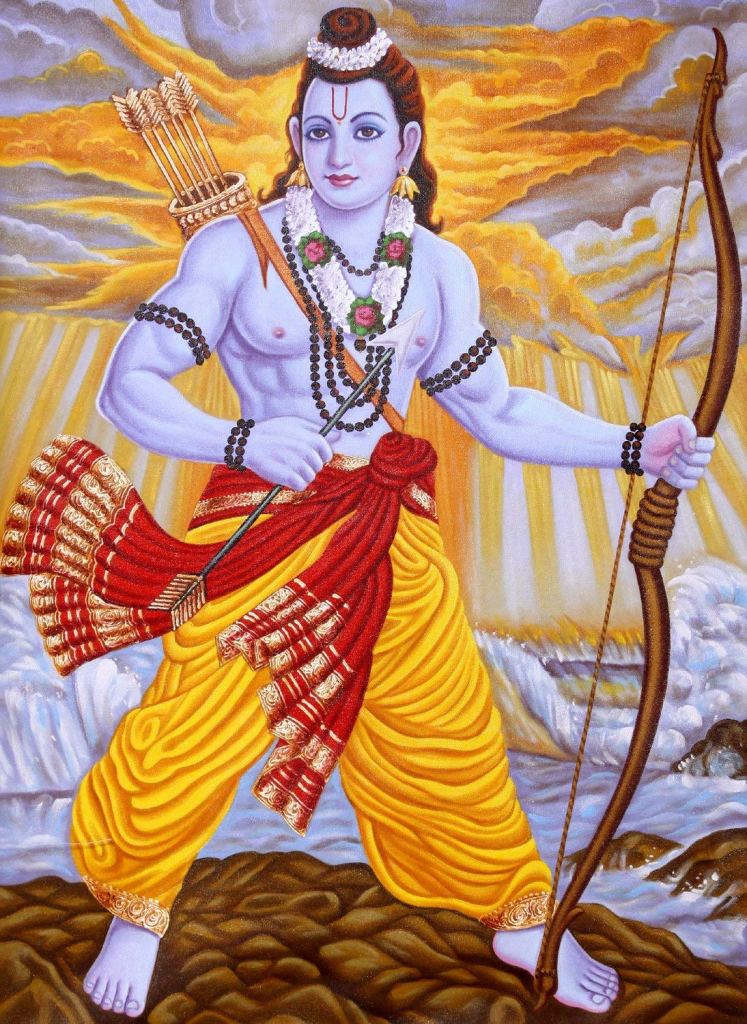
There are several examples of brave and heroic personalities in Hindu mythology. In India, two holy men were called Maha Veer, i.e. Great heroes. They are Maruti or Hanuman and Mahavira, the 24th Tirthangara of the Jains. Many others including Lord Ram and Arjuna also bear this title. Lord Ram is known for his five ‘heroic qualities’, namely, sacrifice, compassion, wisdom, valor and righteousness.  

You must be wondering how the word hero/Veer is associated with virtues like compassion, righteousness and sacrifice. Hindus believe that it is easy to kill anyone but to uphold these virtues while doing so is the most difficult task to achieve. One can easily deviate from his or her principles for selfish gains, but Lord Ram never did violate any of the rules set down by the scriptures, thus showing that one can always follow the right path. This true inner strength is the mark of the quintessential hero. Lord Ram’s valor and sacrifice is a befitting example for us mere mortals to be just and upright no matter what. 

 Another veer from Hindu mythology was Abhimanyu, who displayed a different type of heroism when he went to war knowing fully well that he would be severely outnumbered and almost certainly die. Yet he fought bravely till his last breath.  Veer rasa is depicted by the color orange and is the bedrock of defense.

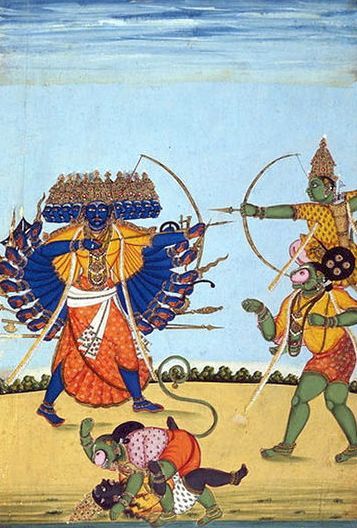
Veer rasa has also been depicted by artists with the help of mythological characters of the likes of Lord Ram and Hanuman, both being personifications of heroism in their own right. Apart from these, Lord Ram’s brother, Lakshman and the monkey king, Sugriv have also been used as subjects representing gallantry and valor.

Here are a few images of artworks depicting Veer rasa. (Click on the thumbnail to view the full image).
Aesthetic application of Veer rasa has been found in the art of woodcraft of Saharanpur in symbolic form. The motifs of Saharanpur woodcraft filled with courage and power enhance the aesthetic sense of fearlessness.It is a feeling of freedom and independence and the motifs like Sun, Lotus and Chakra are the representatives of veer rasa. Lotus represents the principal of growth and sun represents the power of the universe and great courage.

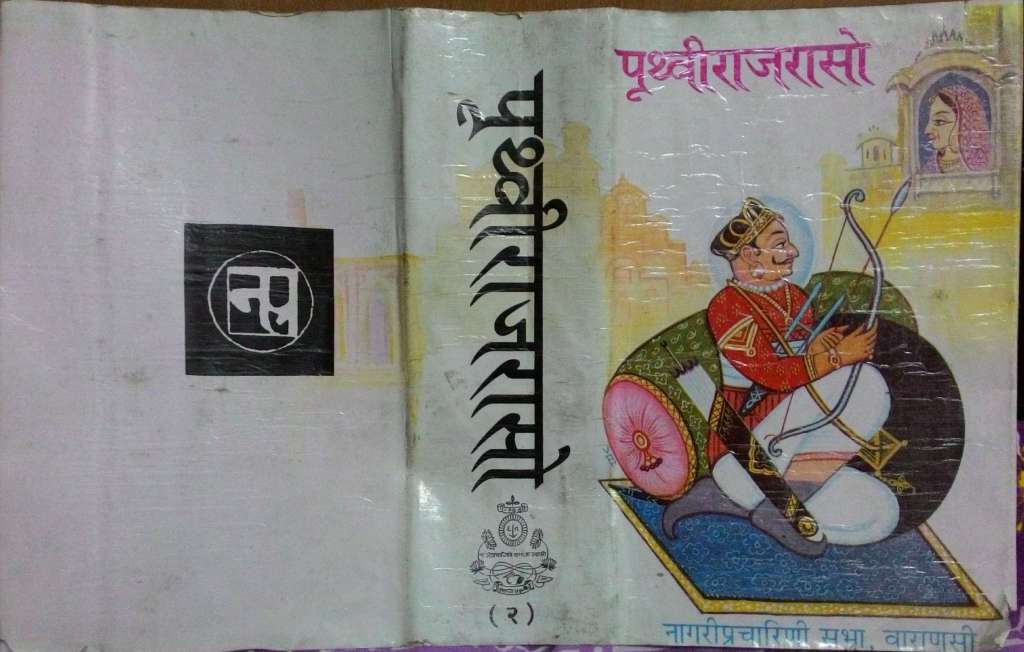
Mewar artists too have been inspired by Veer rasa and have taken inspiration from it to impart soul to their art compositions. This can be seen in the pictures of the famous book Prithviraj Raso, which was written in praise of the 12th century Indian king Prithviraj Chauhan and the holy book Bhagvad Gita, where the sentiment of chivalry has been expressed skillfully.
I too have attempted a subtle depiction of Veer rasa through my composition titled Veerangana – The Unsung Heroes. But before I charge into the battlefield of this supremely potent sentiment, here are a few lines I penned down as a tribute to the unsung hero I have portrayed in my artwork.

She wakes up wearily with listless eyes,

That cried a torrent of tears all night.

Her lonely heart is brimming with sorrow,

For her precious love won’t return tomorrow.

Yet she forces herself out of bed

And willfully pull her body up,

She holds back another silent cry

 And takes a deep breath….

SHE HAS TO TRY.

 She cooks and cleans, goes on with the day,

His thoughts will never come in her way.

 His memories, she ever so proudly holds on,

They are her strength, they make her strong.

Her little ones have had it the hard way,

Their darling daddy has gone away.

They must go on and live their lives,

Their mother’s valor is their drive.

Time flew by, we all forgot,

But they live on, not all is lost.

The martyred souls have left behind,

Beloved ones, still strong in mind.

While we go on with our daily lives,  

They brave it all, they still survive.

The sacrifice they all have made

Is a debt that cannot be repaid.

A tribute to these unsung heroes,

The ones who still have to live on,

They give us strength, they inspire us on,

To never give up and forever be strong.

My version of Veer Rasa

Who is this ‘unsung hero’ you ask? I’m sure you all must be aware of the #Pulwama Attack.  On 14 February 2019, a convoy of vehicles carrying security personnel on the Jammu Srinagar National Highway was attacked by a vehicle-borne suicide bomber in the Pulwama district of Jammu and Kashmir in India. The attack resulted in the deaths of 40 Central Reserve Police Force personnel.

 It has been a little more than nine months since that ghastly display of terror at Pulwama. The heinous attack witnessed these brave hearts fighting till their very last breath until they made the supreme sacrifice for their motherland. Despite being seriously injured, the “jawans” who initially survived the suicide bombing continued firing in retaliation and served the county with unparalled valor. While we all moved on with our lives as usual, those left behind by the slain soldiers are braving every passing moment every single day.

This artwork is not just homage to those martyred souls but also a tribute to the bereaved kith and kin they have left behind. These are the unsung heroes, who still have to be strong and live on. This piece of art is very close to my heart as it is my way of expressing not just gratitude towards our valiant warriors but also solidarity with their grief stricken, yet unyielding families, for they are no less heroic.

The word “Veerangana” in the title means heroine but in the context of my painting it encompasses much more. It represents all the loved ones of our lost serviceman, in particular his soul mate and offspring. They are no less heroic than the martyrs who laid down their lives, for even in the face of this tragedy they stand tall and continue to persevere  as they hang on to the memories of their beloved. I have represented these memories in the form of the military attire that adorned the fallen soldier before he walked into the arms of death. They have been lovingly encased in a wooden frame and preserved for posterity.

It has been my endeavor to bring out the steel and mettle that these heroic women and children are made of. Even though their expression gives away the sorrow and pain they are experiencing day in and day out, it does not bring down their resolve to prevail. The memorable moments they spent with their cherished one have become their strength and keep them going. The camouflage backdrop I have depicted in the composition is an inspiration to be brave and courageous no matter what, just like our fearless “jawans.”

The medium I have used for this artwork is mainly oil paints as I felt it is the best medium to depict a subject as profound as this. I also wanted to highlight the importance of the khakhi greens and other personal belongings of the fallen soldier in the lives of his near and dear ones. These will always have a special place in their hearts as they have remnants of his existence. It is for this reason that I have enhanced the picture frame in which they have been preserved. I did this by imparting it a 3D effect and the textural quality of wood using a hot glue gun. Then I gessoed it and once the gesso dried, I painted it in the natural colors of wood. The other shades used in the color palette comprise of earthy tones and military greens. In a way, I have deviated from using the conventional orange that is associated with Veer rasa.

So this was my interpretation of Veer rasa, a slightly different take for that matter. This artwork is not just my way of honoring the memory of the deceased but also paying my respects to the heroic souls who survive after them.  I wish to invoke this intense emotion inside the viewers of my art as well.  If I have succeeded in doing so, then it is a befitting tribute.

Sources and Photo Credits –

https://www.exoticindiaart.com/paintings/SouthIndian/

https://www.speakingtree.in/blog/five-heroic-qualities-of-lord-rama

Click to access AIJRHASS15-105.pdf

http://drvidyahattangadi.com/the-navrasa-of-life/

https://www.speakingtree.in/blog/9rasas-as-9-emotions-in-human-beings

https://www.amazon.in/Exotic-India-Veer-Hanuman-Painting/dp/B01N59S4C1

https://www.amazon.in/Lord-Rama-Canvas-Artist-Gomay/dp/B00B0E263Y

https://www.exoticindiaart.com/product/paintings/rama-in-battle-with-ravana-PC88/
“Shanta” – Peace begins with You

Greetings from The Art Dungeon!

Before I embark on today’s blog post, I want you all to sit back and relax your bodies, minds as well as souls. When you become absolutely still and quiet, you will be at peace. When you are at peace, you become so full that you are empty.

Didn’t quite make sense? Let me explain. I am referring to the second rasa in my Navrasa Series, namely, “Shanta” Rasa, which will take you into a world of deep calm and tranquility. So let’s get the ball rolling and commence our journey!

“Shanta” means to be peaceful, tranquil or contented. It represents a state of calm and untroubled steadiness. Shanta exhibits complete harmony between the mind, body and universe. It is what Buddha felt when he was enlightened, thus leading him to salvation or nirvana which freed him from the cycle of life and death. It does not require an absence of activity or emotion; rather it is the stability that comes with the true experience of peace, which can be carried anywhere, while doing anything. It holds in itself non-violence, as well as equanimity (balanced peace).

Equanimity is the ground for wisdom and freedom and is the protector of compassion and love. While some may think of equanimity as neutrality or aloofness, mature equanimity produces a radiance and warmth of being. The Buddha described a mind filled with equanimity as “abundant, exalted, and immeasurable, without hostility and without ill-will”.

Shanta is a rasa that is simple in its physicality but profound in the feelings it can evokes. All of these feelings together constitute Shanta. Buddha centralized the role of suffering in transformation. For Him Shanta represented the space of Enlightenment and He is one of the most beautiful archetypes of this rasa. Vishnu’s archetypal physicality of reclining on the ocean nuances surrender a bit differently as a restful but aware observer of the universe. For Him ‘suffering’ does not exist because He has no expectations.

Acting in surrender is central to Shanta and all other feelings go towards creating this state of submission. Surrender is an active, committed and empowered feeling where one has the ultimate realization about life being transitory and impermanent.

Shanta is the state of freedom from everything, be it worldly desires or actions. Its foundation is patience, service-mindedness, philosophical knowledge, self-control, pure spirits and freedom from all kinds of bondage. Its key note is non-violence or “Ahimsa”. If Shanta rasa has to be depicted through facial expressions, it is expressed by keeping the face in a peaceful expression or with the eyes turned upside as if doing penance and also by half closing the eyes.

The purpose of recreating this rasa is to depict the attainment of detachment from everything (or “Moksha”) and salvation. This is the representation of contentment or aesthetic bliss. It is experienced through the attainment of knowledge or the realization of truth, practiced through self-control & meditation and generates feelings of calmness, purity etc.

As this rasa represents serenity and peace, it is a state of calm and unruffled repose that is marked simply by the lack of all emotion. Sages in India meditate for entire lifetimes to attain this state of being. Shanta rasa is symbolic of the clearest form of aesthetic bliss and has been described as “as-good-as but never-equal-to the bliss of Self-realization experienced by yogis”. In music, it is often represented through a steady and slow tempo.

Shanta is a clear and cloudless state.
Shanta is untroubled steadiness.
Shanta is the key to eternity.

As mentioned in my earlier blog post, Indian art is based on the ancient aesthetic theory of rasa which, by extension, refers to   the ‘essence’ and emotional qualities crafted into a work of art (or a performance) by the maker and to the response the contemplation or perception of the artwork evokes in the viewer, in other words, it is a viewer-response theory. That is the reason why in Indian paintings and sculpture a narrative mode predominates – a narrative gradually unfolds over the area of a painting or the length of a wall or even building.

The aesthetic application of Shanta rasa has been caught in the woodcraft of Saharanpur, a city situated at the Ganga Yamuna doab region of Western Uttar Pradesh, one of the famous Indian states for craft. The significance of this rasa is based on the visual perceptions of the individuals. Some motifs found in nature are eye-pleasing such as when a person sees the moon at night, he or she feels calm and peaceful. Shanta rasa is a reflection of the still mood so the application of auspicious and sacred motifs in woodcraft conveys the message of calmness and softness. These motifs create a spiritual atmosphere in nature. Auspicious motifs and geometrical structures also increase a calm and peaceful environment for the spectators such as Kalasha, Swastika and jali work with different geometrical shapes and forms.

In Indian art, the rasas become apparent, for example in the colour in which a certain deity is depicted which hints at the predominant character trait associated with this deity, or in the colour of the aura of a person. For instance, a black aura indicates a frightened person, and a red aura indicates that the character is angry. The god Krishna, who is the archetypal lover and hero, is always depicted with a blue-black complexion and yellow garments.  The color of Shanta rasa is white.

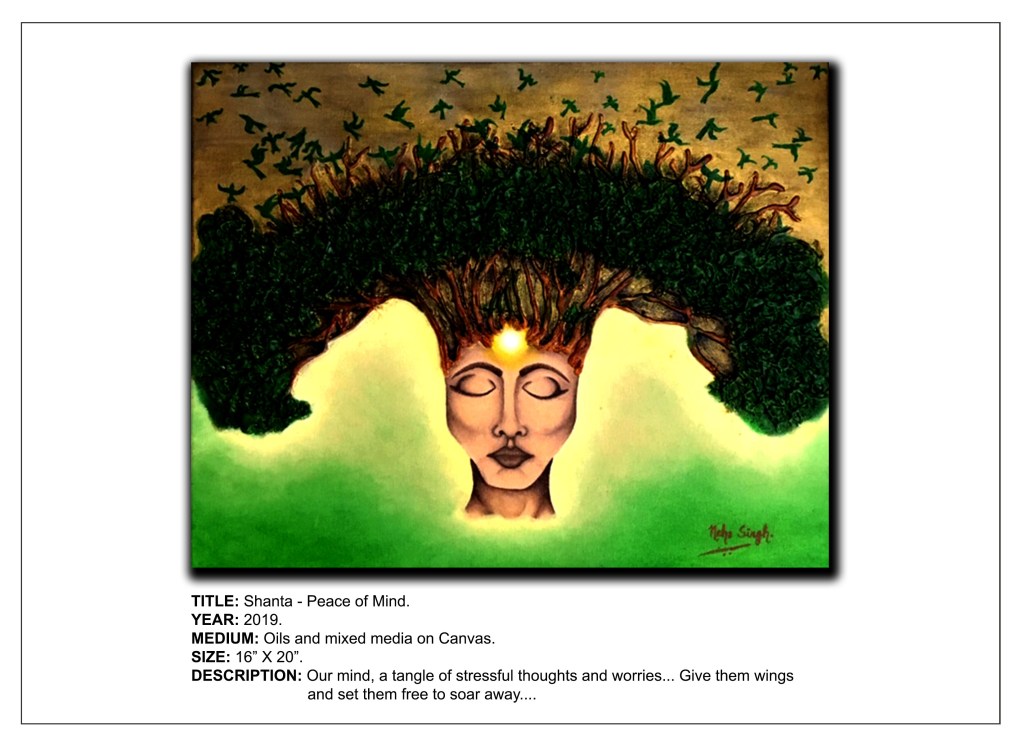
So how did I depict Shanta rasa? For me, this rasa defines the ultimate desire that we all are striving for and that is the desire to attain Peace of Mind, which is also the title of my second painting of this series.

As I had mentioned earlier, one of the core elements of Shanta rasa is non-violence. But like peace, violence also takes shape in the mind. As our mind jumps from one thought to another, its gets lost in the chaos created by doubt and fear emerging from continuous speculation and contemplation on these thoughts. Our narcissistic nature (believe me, we all are to some extent!) and our ego cannot accept any suggestions or situations that go against us and the fearful demons of ambiguity and worry  give birth to some very violent ideas.

These ideas that happen unconsciously and against our will, are facets that we dislike in ourselves as well as in others. Thoughts spill over into words and actions and lead to stresses and strains both physically as well as emotionally. The random comings and goings of stressful thoughts wreak havoc in our consciousness.  Our thoughts and impulses are the result of impersonal conditions but by taking them personally, we become uneasy which leads to upheaval in our minds.

 Another cause for mental turmoil is our tendency to judge people by their actions and not for who they really are. This particularly applies to our loved ones. If their actions do not agree with us, we overlook their true nature which eventually takes a toll on our relationship with them. Consequently, it strains our emotional faculties further, thus adding on to the stress. There comes a time when our mind becomes a mangled array of stressful thoughts and worries. That is when we start to yearn for peace and order.

With all the advancement of science, no remedy has yet been found for lack of inner peace and tranquility. Often, even when we are in good financial condition or good health, we lack peace of mind, which only proves that peace of mind does not depend on external conditions or on any scientific or technical progress.

But how does one attain this Inner peace? How do we acquire that peace of mind that we are desperately looking for all around us? The solution to this dilemma lies within us, not in external means.

 “There is nothing permanent but change.” This famous quote by Heraclitus holds good in this context as well. We need to realize that everything changes and we can’t hold on to anything, so the mind needs to stop clinging on to its emotional baggage and learn to let go. Letting go brings equanimity; greater the letting go, deeper the equanimity. Once equanimity is achieved, peace and tranquility follow.

To depict the mental commotion, I have personified them in the form of the branches of a tree that keep growing and spreading until they start encroaching on our intellect. I found the perfect medium in the form of a hot glue gun to execute this effect. The thermoplastic property of the molten adhesive worked like magic! I went on to personify the thoughts as well with….you guessed it! Birds!! This being a mixed media artwork, I have used a combination of acrylics as well as oil paints, the former for the branches, birds and sky and latter for the face and its backdrop. Once again, I chose to break the norm and opt for a color palette of greens instead of the conventional white that is used to portray Shanta rasa.

So remember, worries are like flightless birds entrapped in the cage of the mind….give them wings, set them free to soar away and find that inner peace you have been searching for far and wide.

“Shringar” – The Rasa of Beauty

In my previous post, I had introduced the concept of emotions, in particular the Navrasas, or the nine emotions in the performing as well as fine arts. I had discussed in great detail how these rasas are depicted aesthetically through art as well. I had also provided a brief synopsis of how I have attempted to interpret them in my own artworks, with the promise that I would elaborate on each one of them in upcoming posts. 

So here I am, to fulfill my promise with the first Rasa – “Shringar.”

The word Shringara in Sanskrit means love, romance, decoration and beauty, attractive and aesthetic sense. Shringar can give rise to all kinds of love, be it romantic love, the love between siblings or the affection towards a pet. Devotional love and parental love are also forms of this rasa.

Songs about the childhood of Krishna and Rama tell us that little Krishna was playful and sometimes naughty, whereas Rama was more serious. By seeing Krishna and Rama as children, we think of God every time we see a child, and that increases our devotional love.


Shringar takes shape as a rasa at the onset of puberty. It is the predominant rasa during adolescence. Teenagers go through changes in their bodies, physically, emotionally as well as chemically. They want more attention, more love and more care. They feel something is missing and may feel uneasy or depressed if the one they love does not notice them. To gain this love and affection, they want to look beautiful and that’s where Shringar fits in as a means of adornment or beautification to please and attract the beloved.  

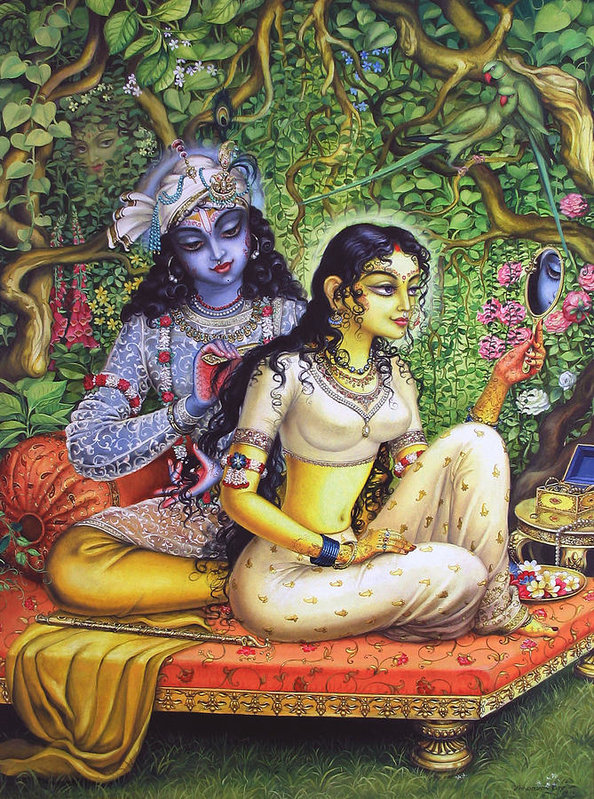
In Indian mythology, Lord Krishna’s Raas Leela is full of Shringar Rasa. The Raas Leela or Raas dance is part of the traditional story of Krishna where he dances with Radha and her friends. The term, raas, which stands for rasa, means “aesthetics” and leela means “act,” “play” or “dance, thus can be broadly defined as“Dance of Divine Love”.

Shringar also implies that there is inherent beauty everywhere and that everything can be loved. It denotes love and attraction. It is the ultimate Rasa, the king or queen of emotions, so to speak that possesses the power to heal anything.  It helps us let go of ego and connects us to the divine. Flowers, fragrances, perfumes, colors add Shringar to life.  Sringar rasa is depicted by light green color.

Shringar basically is superficial, but when we fall in love, our body becomes overwhelmed and Shringar gets a deeper meaning on a more emotional and spiritual level. Not just our mind and spirit, but our body also becomes overwhelmed with this feeling of infinite affection towards that which we find beautiful or attractive.

When we see an attractive person but our ego comes in the way, then the mind steals small glances and the emotion is short lived. On the other hand, when we let go of ego, our mind becomes flirtatious and indulges in fantasizing about our beloved’s beauty, so much so that nobody else in the world seems as beautiful. To maintain this illusion, the mind makes many small changes in the perceived appearance of the person, but, when the effect fades, it sees the person more realistically.


If we see our beloved as an object of desire and the scent of our dear one excites us, then lust takes over and love becomes more physical. On the other hand, when the beauty of our beloved and his or her eyes intoxicate us, we forget about ourselves and our love becomes spiritual or divine. Shringar rasa in its divine form can sustain the feelings of love for many years, even more than a lifetime. In India when partners are profoundly pleased with each other, they may promise to marry again in their next life.

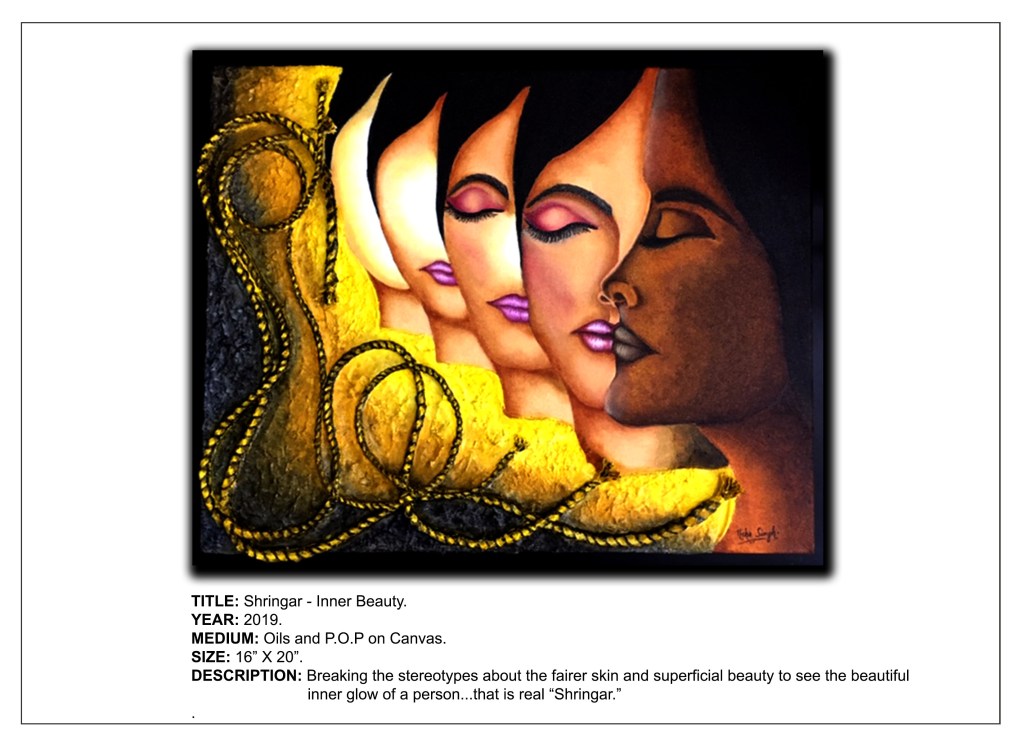
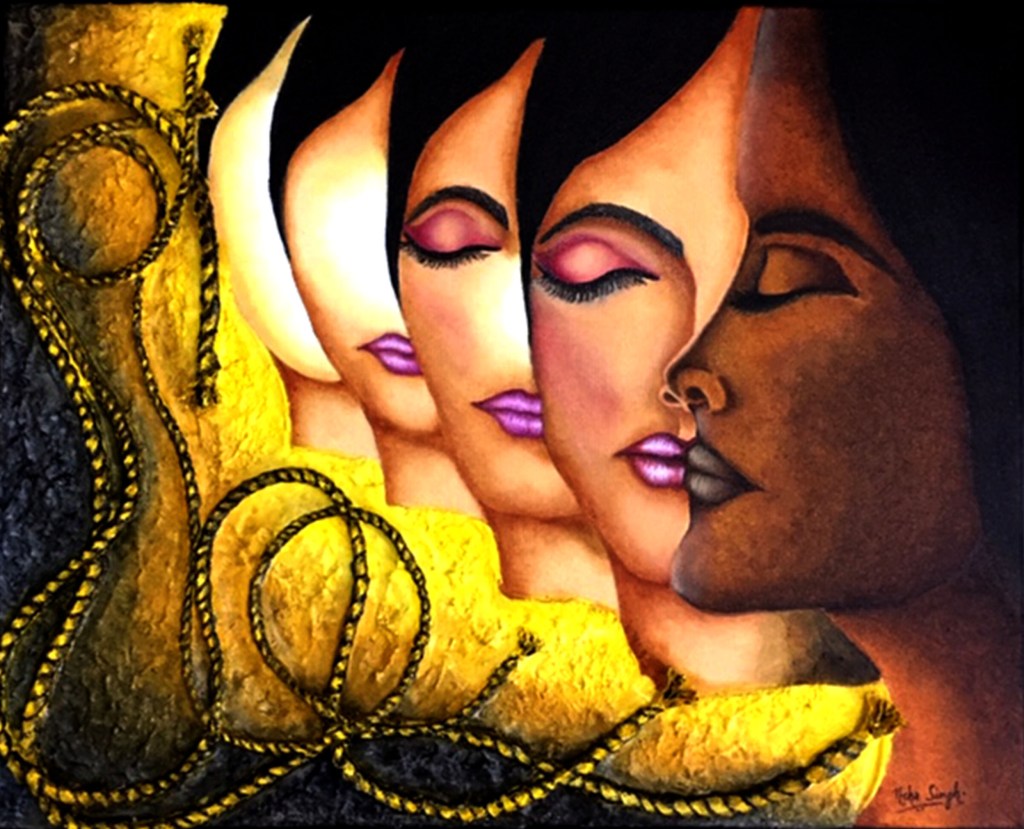
It is this emotion of beauty and love that I have tried to illustrate in the first artwork of the Navrasa Series, titled, Shringar – Inner Beauty. You all must have heard of the saying “beauty lies in the eyes of the beholder”. But the sad irony is that in today’s so called modern society, almost everyone believes in the conventional ideas of external beauty. The entire concept has been endorsed by the flourishing fashion and cosmetics industries to such an extent, that we can no longer see beauty beyond the face of a person. This also applies to skin color, specifically in India, where fairer skin is considered more attractive than its darker, or for that matter, even duskier counterparts.

Another proverb that further contradicts the idea of true beauty is, “beauty is only skin deep.” This phrase can be interpreted in several ways, the most widely accepted one being that external beauty has no effect on the internal qualities of a person.  This can mean that while someone may be beautiful on the outside, their character need not necessarily be attractive. It can also be interpreted in the opposite sense, that is, just because a person is not beautiful on the outside, it doesn’t mean he or she doesn’t have a heart of gold. In other words, it is not superficial looks, but the intrinsic goodness of one’s soul that make him or her attractive.

I strongly believe in the second interpretation. Being compassionate and having a good character are more important than good looks. Not only speaking of doing good things but having your actions match your words is beauty. Having a gentle and kind heart is beauty. In other words, Inner beauty is true beauty.

To express this belief of mine onto the canvas, I have taken the help of a woman’s face, which has been the epitome of external beauty for centuries. However, I have rendered the first face in a darker tone. By doing so, my attempt is to convey the message that not being fair skinned doesn’t make her any less attractive physically as well as intrinsically. One needs to look beyond her looks and skin tone, deep down into her soul and find that inherent goodness, which is the real essence of her beauty.  For all you know, she may have such a beautiful soul that its beauty radiates outwards from within in the form of the most resplendent glow. This beautiful, radiant essence is true inner beauty.

I have gradually eliminated the facial features in each of the faces to convey that we need to surpass these mortal physical features. Simultaneously I have lightened the skin tone, thereby trying to bring out that inner glow which is visible only when one learns to disregard the superficial visage. When we begin to appreciate the real beauty within, we experience the feeling called love.  

I have also attempted to convey the message that physical beauty fades with age, but the glow of good character and kindheartedness lasts eternally.

It is becoming clearer and clearer with each passing day that the socially construed notion of physical attractiveness, is something all women strive to achieve and maintain. In fact, they are so obsessed with looking beautiful that the fashion and makeup industries are thriving at their expense. Women give so much importance to looking good with the help of clothes, makeup and other accessories that these have become the stereotypes defining beauty today. To add to it all, the obsession with the fairer skin makes them resort to using fairness creams with the hope of lightening their complexion a shade or two.

The entwined ropes in the artwork symbolize these stereotypical bonds of superficial beauty and “fairer skin” that most women are entangled in. We need to break these shackles as they are mere illusions that prevent us from seeing the real picture. As long as we continue to live in this make believe world of “cosmetic charm”, we will not be able to see beyond the physical attributes of people who are truly beautiful deep down. After all, Shringar transforms into a divine feeling only when we let go of the ego that makes us worry about how we look instead of what kind of a people we are.

Coming to the medium and techniques….apart from my beloved oil paints, I have experimented with Plaster of Paris (POP) in order to impart texture to the background. I prepared a paste of POP and PVA glue in a ratio of 1:1 as I intended embedding strands of rope within the paste while it was still semi dry. Yes, I used real rope, which I gessoed and painted over later! While the POP provided the requisite coarseness to the texture, the PVA glue helped bind the ropes to the surface of the canvas. But it did have its disadvantages…the ropes lost their realism as they got covered with the POP paste in several places and I had to painstakingly repaint the twists in the cords to make it look like real rope again. On hindsight, the better option would have been to just stick the rope on top of the POP background after it had dried completely. It would have saved me a lot of work!

I had mentioned before that Shringar rasa is typically represented with light green color. But then, I did not want to restrict myself to one hue. Also, since my entire artwork was based on skin color, I had to vary my color palette and explore the more earthy tones. In a way, I too broke a stereotype!

Shringar rasa is generally depicted in Indian poetry, dance and music, so it was quite a challenge for me to portray it unconventionally in my art.  I have tried my level best to make it as simple and comprehensible as possible, so that anyone viewing it would easily understand what this “king of rasas” is all about. Would love to know if I was successful in invoking any emotions in you through this painting!

Sources and Photo Credits –

https://www.speakingtree.in/blog/9rasas-as-9-emotions-in-human-beings

http://drvidyahattangadi.com/the-navrasa-of-life/

https://en.wikipedia.org/wiki/Rasa_lila

https://pixels.com/featured/sringara-lila-satchitananda-das-saccidananda-das.html

https://pixels.com/featured/rasa-lila-satchitananda-das-saccidananda-das.html

https://fineartamerica.com/featured/shringar-lila-vrindavan-das.html?product=art-print

The Art of Emotions

Ever wonder what evokes feelings inside us? Feelings of love surprise, anger, sadness, fear, courage, aversion or peace? These feelings, that are born deep down inside the core of our bodies, namely our soul, are what we call Emotions. They are the ways we express our reactions towards various activities and happenings in our lives. They make life lively, rich, colorful and interesting, even though some of those colors may be bright and others darker.

The artist in me would describe emotions as the light and dark hues, shades and colors that paint the ultimate mortal canvas that is life.  As a designer, I would say they form the warp and weft of the fabric called life. Infact, I believe life and emotions have a symbiotic relationship and one cannot exist without the other. Can you imagine life without emotions? If they didn’t exist, how different would we be from robots and machines?

Emotions can be both positive as well as negative depending upon our perspective towards life and how we perceive situations. They are also displayed in varying degrees from person to person, depending upon his or her intensity of reaction to a particular situation. In psychology and philosophy, emotion is defined as a metaphysical experience displayed in the form of a psychological expression of our mental state as well as the biological reactions of our body.

Emotions form the foundation of Indian classical dance and music, theatre, art and literature and are recognized as the 9 Rasas among these traditional Indian performing arts. Popularly known as the Navrasa, they are translated into the nine emotions, moods or sentiments that figure in the daily lives of every human being. However, Rasa, a Sanskrit word, has multiple meanings as it can denote emotions as well as taste or flavor. The word Navrasa is also of Sanskrit origin, where Nav means nine and Rasa means taste or essence.

Not just the performing arts, the fine arts too (specifically drawing, painting and sculpting), have been a medium of expression for the Rasas.  Evoking the rasas in the audience through their art work is the primary objective of every artist, hence artworks are created solely with this aim.

 Come to think of it, every artist’s work evokes a certain emotion or a combination of emotions.  Rasa exists in each and every object, event or action. Not just that, everything that we do has Rasa. Depending on the individualistic nature of an object or person, some rasas hold a place of higher importance than others and at the same time may be extrinsic or innate. Rasa is the true “essence” of life itself.  

The nine emotions included in Navarasa are Shringara (love/beauty), Hasya(laughter), Karuna (sorrow), Raudra (anger), Veera ( heroism/courage), Bhayanaka (terror/fear), Vibhatsya (disgust),  Adbutha (surprise/wonder), and Shantha (peace or tranquility).

The “Color Spectrum” of Emotions

In the performing arts, specifically Indian classical dance forms, the “emotional color spectrum” consists of seven colors, just like the rainbow. Each emotion is designated a different color – rage(red), greed(orange), fear(yellow), will power(green), hope (blue), compassion(indigo), and love(violet). However, it also represents the absence of color (black), which is death, and the combination of colors (white) which is life. Similarly each rasa is also depicted with a different color, as listed below:

  1. Shringara – Green.
  2. Hasya – White.
  3. Karuna – Grey.
  4. Rudra – Red.
  5. Veera – Orange.
  6. Bhayanaka – Black.
  7. Vibhatsya – Blue.
  8. Adbhuta – yellow.
  9. Shanta – White.

These guidelines are being followed as a general rule to portray the rasas in Indian classical dance forms, but for us artists, the sky is the limit. So, don’t let it stop you from thinking out of the box and innovating!

Depiction of Navrasas in Art

The early 20th Century saw the rise of an art movement called “Expressionism,” in which the artist wanted to express an emotional experience rather than depict a scene realistically. Some artists would attempt to capture what they were feeling at the time of making the artwork and it would eventually reflect in their final finished piece. Others would create an image with the hope of awakening an emotional response in the viewer. 

One of the best ways to depict an emotion is through facial expressions. And this is the element most artists have adopted while illustrating emotions in their art. Some artists have used eyes to achieve the same goal. As they say, eyes are the mirror to the soul! Apart from these, several other approaches have been taken by artists in order to depict emotion in their art, for instance hands and even the entire body. Infact, the subject’s hands have become a fundamental element for expressing emotion. Some of the greatest masters of modern art like Matisse, Picasso, Lichtenstein and Chagall have displayed emotion in their art.

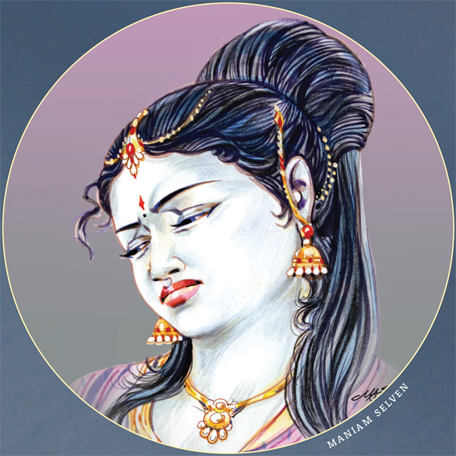
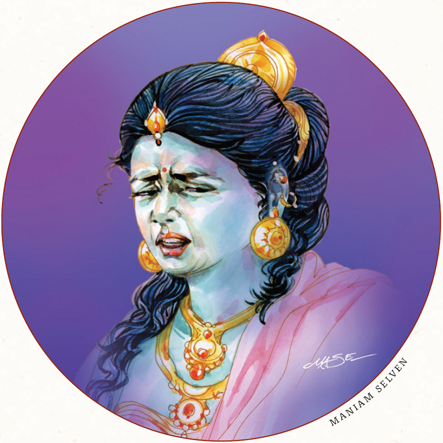
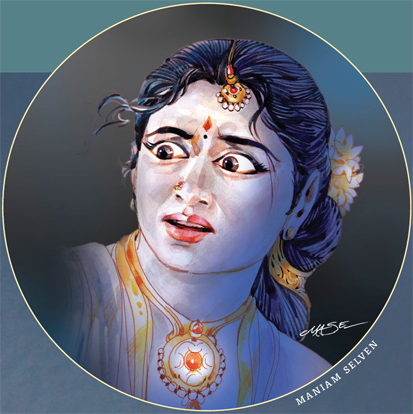
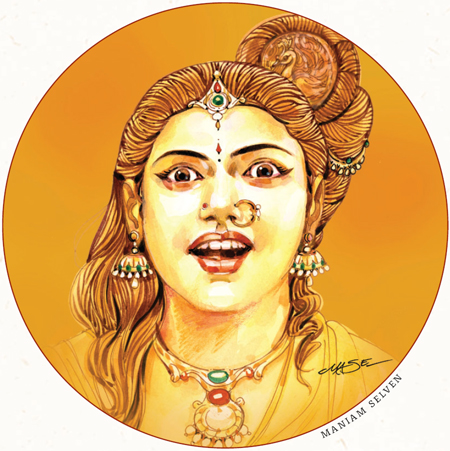
But how do artists illustrate the Navrasas in their art? The most common way is through facial expressions, as is seen in the work of an Indian artist and a leading illustrator in Tamil magazines, Maniam Selvan. In one of his paintings, he depicts the rasas with joy at the centre, surrounded by love, sorrow, anger, courage, fear, disgust, wonder and peace.

The Navrasas by Maniam Selvan

He has also rendered the rasas individually in the form of facial expressions on a woman’s face.

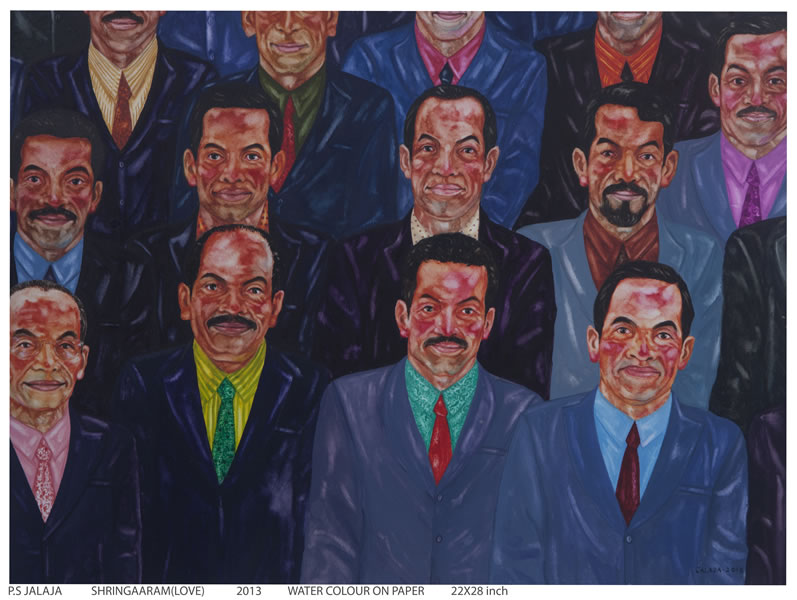
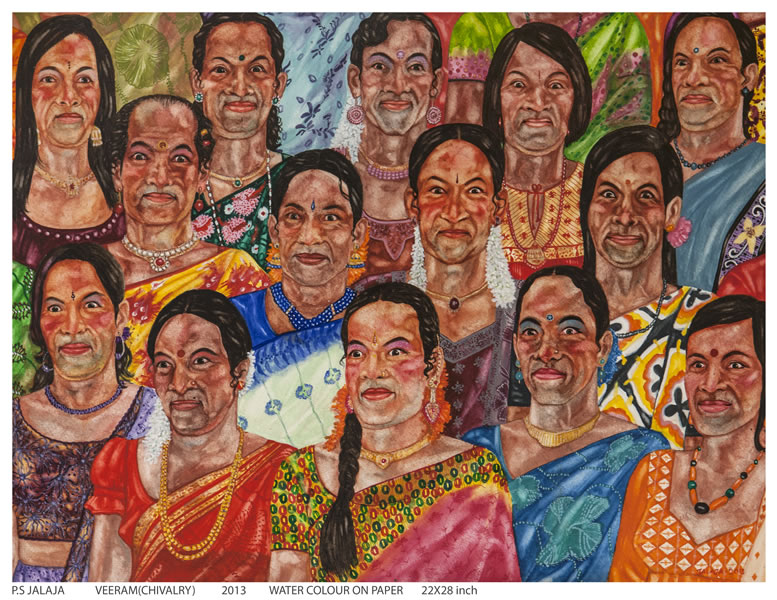
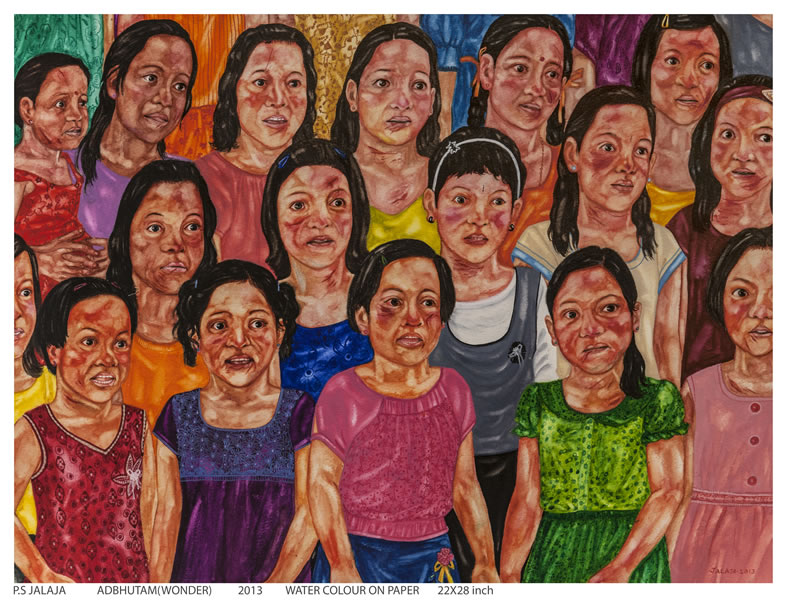
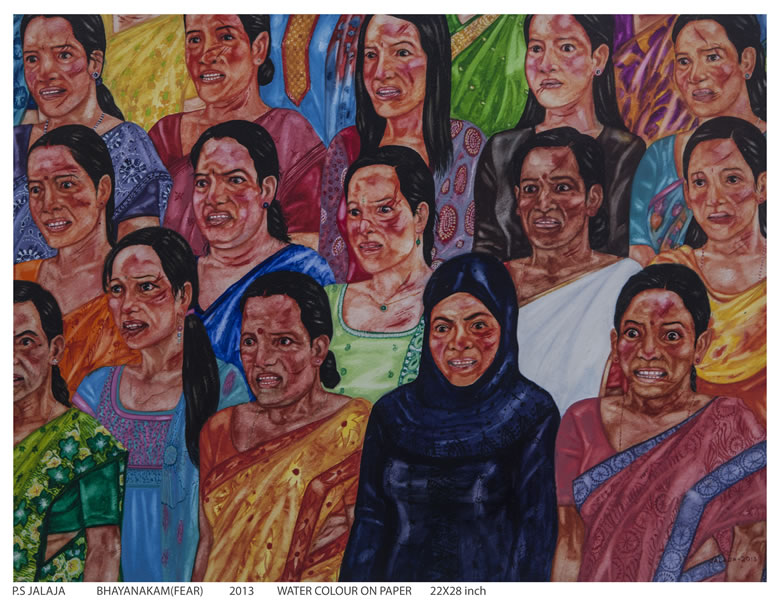
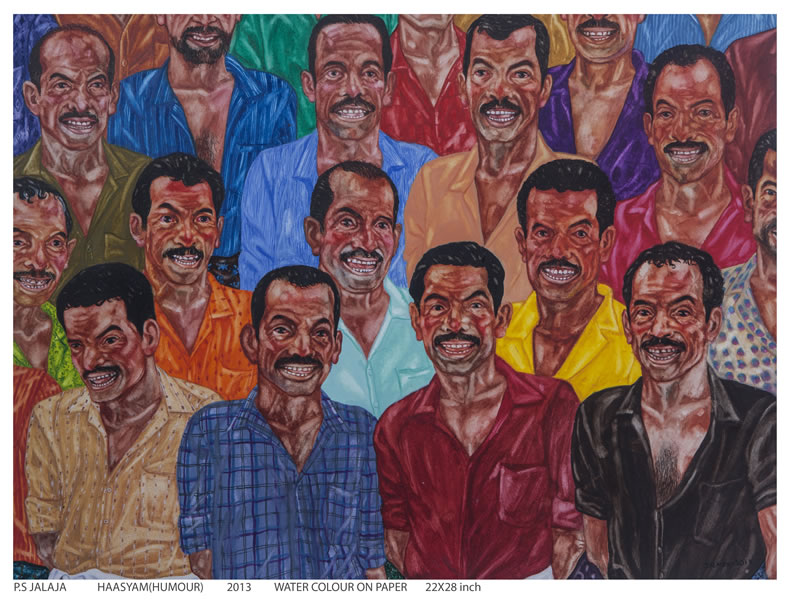
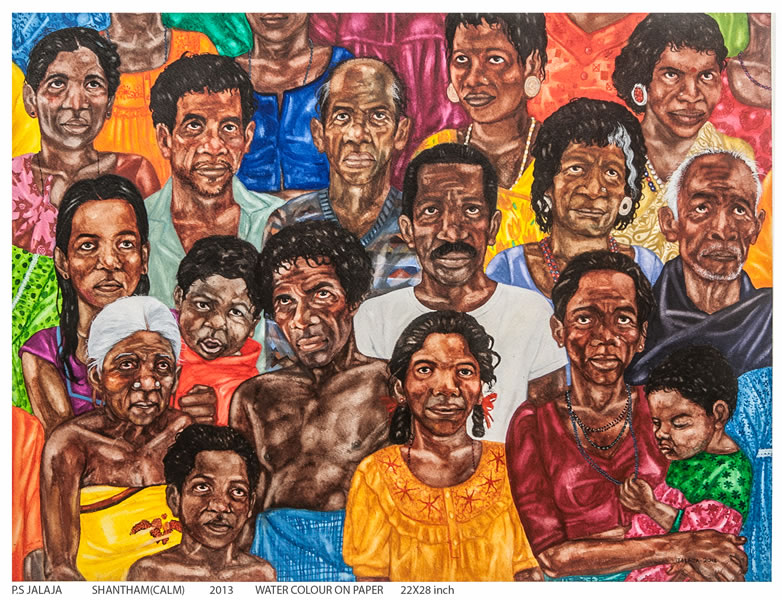
Artist P.S. Jalaja’s work titled “Shringaram”, which is part of her ‘Navarasa’ series of works, is a close-up of a homogenous crowd in the grip of a telling emotion, rasa. Working further on her favorite motif of crowd, she has transformed her canvas into a cauldron of intensely individual emotions transferred to a think-alike mob. These personally political ‘navarasa’ series of paintings are remarkable for their social currency, satirical undertone and tremendous local appeal and are not easily conceivable.

Artist Annie Ravi has depicted the rasas in the form of a self-portrait, inspired by the nine Indian sutras of dramatics, the colors of pop art and expressions from Japanese manga characters.

Navrasa by Annie Ravi

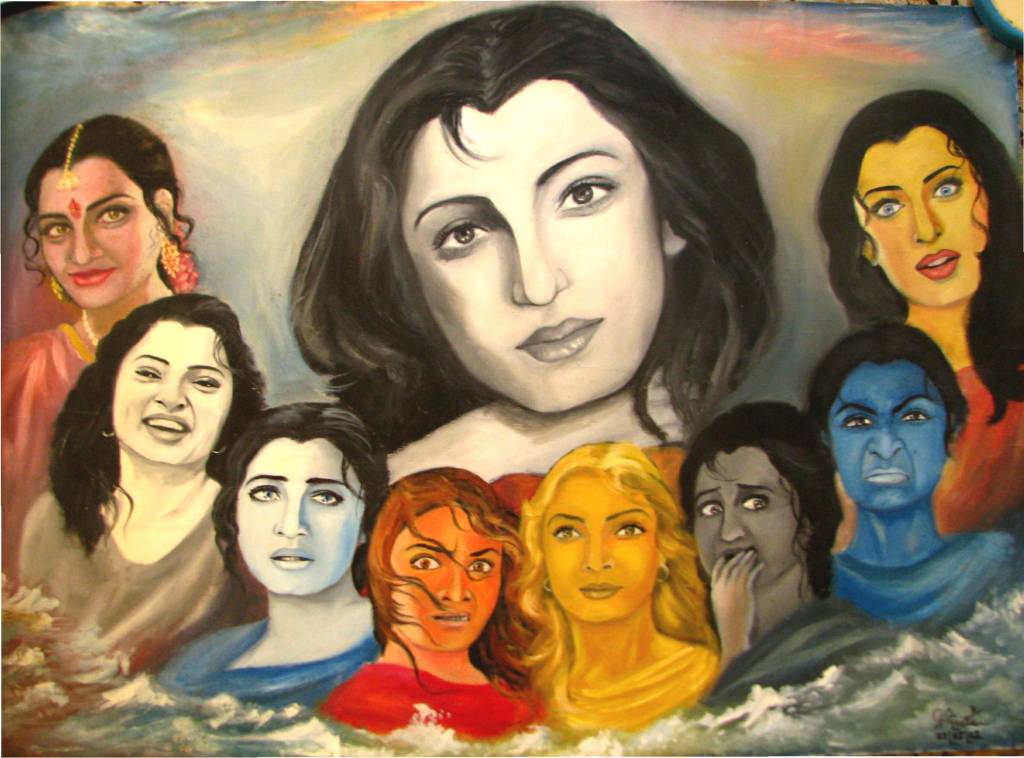
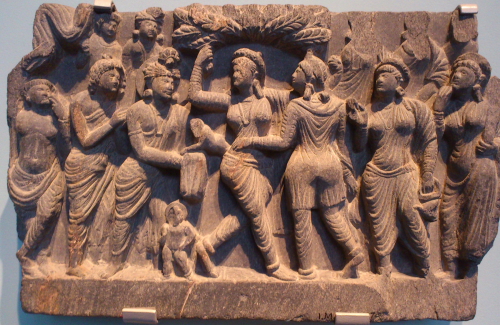
Apart from this, Navrasas have also been displayed as facial expressions in Kerala murals paintings and Indian sculptures.Here’s some more imagery depicting the rasas in art.

Now that we have talked about direct portrayal of the Navrasas through art, how do you think artists expressing emotions indirectly in their work?

Let’s consider some examples:

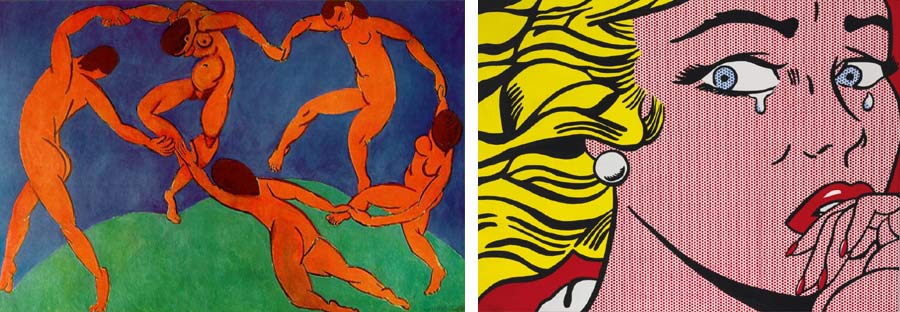
  • Henri Matisse’s famous artwork “Dance II” can be interpreted as a display of joy.
  • Roy Lichtenstein’s “Frighten Girl”, is suggestive in itself owing to the title, for the look of fear in the subject’s eyes speaks volumes.
  • “The Weeping Woman” by Pablo Picasso seems to be an attempt to express sadness.
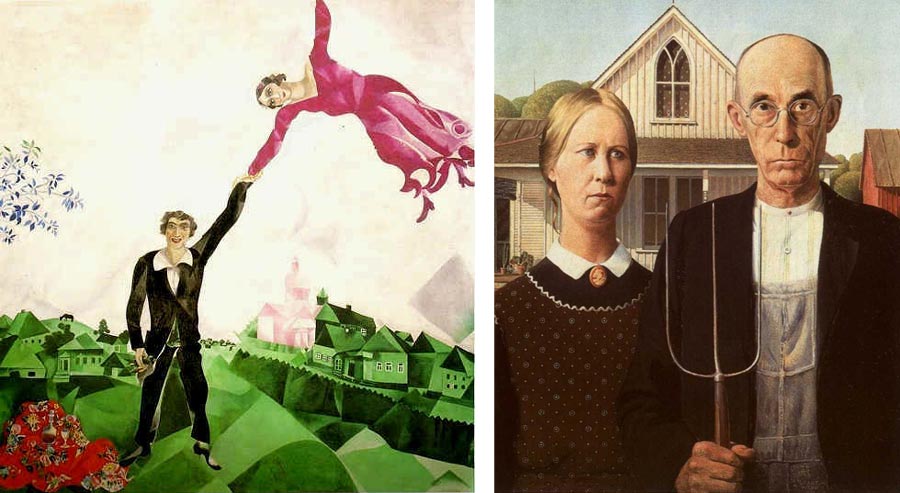
  • Marc Chagall’s “Birthday”, expresses love, which is seemingly evident in the gait and stance of the couple.
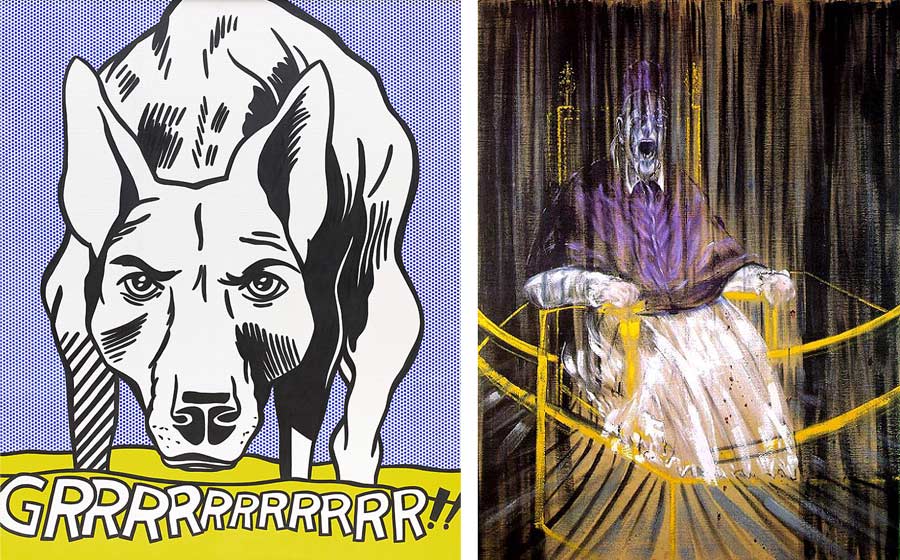
  • “Grrrrrrrrrrr!!”  by Roy Lichtenstein, is evidently displaying anger, but then again, it could also generate a feeling of fear in the viewer.
  • Francis Bacon’s, “Study after Velazquez’s Portrait of Pope Innocent X”, can be interpreted as anger as well pain.
  •  “The Promenade” is also a creation by Marc Chagall that depicts happiness.
  • Grant Wood’s, “American Gothic”, is a painting that I personally find difficult to interpret owing to the grim and serious looks on the faces of the subjects. But these two are expressions and thus emotions, in themselves.

These are the most universally accepted interpretations of the emotions portrayed in the above paintings, but then again, there is no hard and fast rule. For all you know, your emotional response to any of these paintings can be totally different from mine, so, to each his own!

My Interpretation of Navrasas

In the next few posts, I will take you on a journey into the world of these nine emotions or rasas that not only govern Indian performing arts and fine arts, but also constitute the very cosmos of human expression. So, join me as I plunge into the fascinating world of Navrasas! 

I will introduce you to each rasa individually and describe how I have interpreted it in my art. My approach to every rasa has been a combination of direct as well as indirect portrayal. In some of my pieces, I have used the conventional elements in terms of the face and eyes, but I have attempted to use them symbolically to either convey or to evoke an emotion with a moral or social message attached to it. At the same time, I have also tried to depict certain emotions indirectly without the aid of these elements.I have also not followed the conventional norms of the emotional color spectrum alone. Instead, I have chosen to use other colors as well, in combination with these.

Just to give you a sneak peak into my world of Navrasas, here are some of the artworks from my upcoming Navrasa series:

Want to know more about them? Then, keep following my blog and read the upcoming posts!

Sources and Photo Credits

https://www.thehindu.com/news/cities/Kochi/keralas-decadence-in-jalajas-navarasa-series/article5617231.ece

https://dpstinkyfinga.wordpress.com/2014/09/09/the-navarasa-of-indian-sculpture/

https://artsology.com/artemotion.php

https://www.hinduismtoday.com/modules/smartsection/item.php?itemid=5938

http://drvidyahattangadi.com/the-navrasa-of-life/

https://thinkrasa.wordpress.com/

https://www.gallerist.in/pop-art-paintings/navrasa

http://archive.kashiartgallery.com/gallery/currentExhibition.htm