“There are no enlightened beings, only enlightened actions.”
Buddhism revolves around the principle of Dharma and encompasses various traditions, beliefs and practices of Lord Buddha. Buddha gave his first sermon in Sarnath to Kaundinya and four other scholars. In Isipatana of Sarnath, he preached about Dhammacakkappavattana Sutta, which includes Four Noble Truths and Noble Eightfold Path.
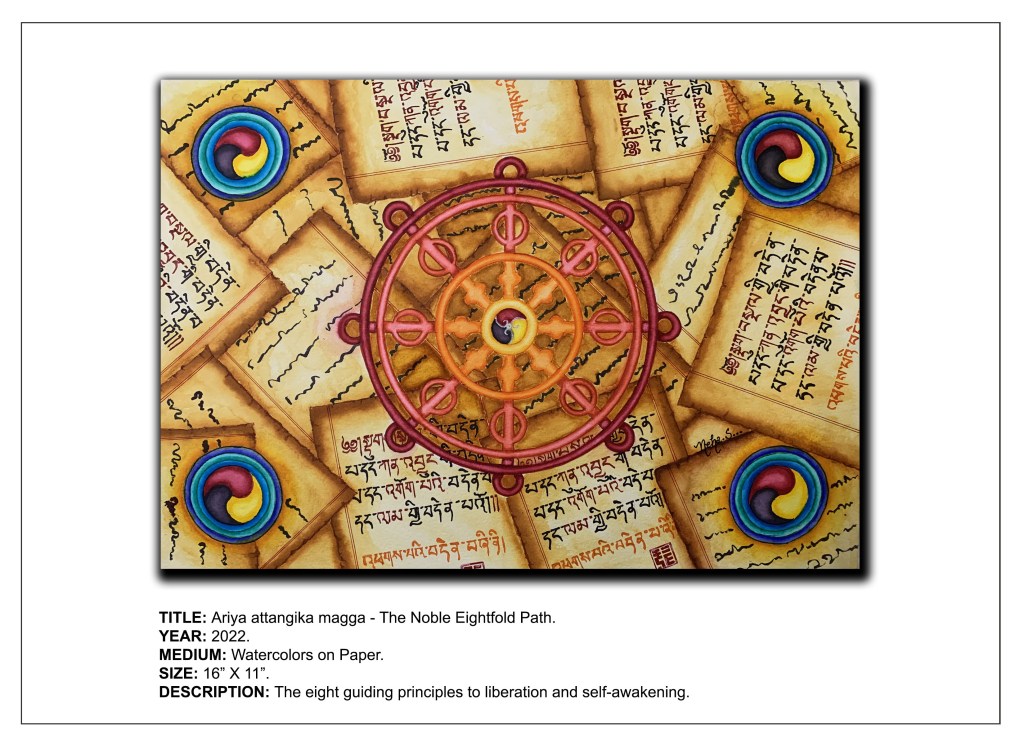
It is these fundamental doctrines of Buddhism that have been displayed in the artwork shown below, the title of the artwork being, “Ariya atthangika magga” – The Noble Eightfold Path. The Noble Eightfold Path is one of the principal teachings of Buddhism and is the fourth truth of the Four Noble Truths and regarded by Buddha as the medium to attain Enlightenment.
This artwork depicts the Noble Eightfold Path through the Dharma Wheel (Dharma Chakra), with its eight spokes representing the eight elements of the path, namely – right view, right resolve, right speech, right conduct, right livelihood, right effort, right mindfulness, and right concentration (or “samadhi”).
The four circles in the corners represent the Four Noble Truths, namely – The existence of suffering, its cause, its cessation and the path leading to its end. The path alluded to in the fourth truth is the Eightfold Path, which ultimately leads to enlightenment or Nirvana. This path is also depicted textually in the form of Tibetan manuscripts in the background of the artwork.
The Noble Eightfold Path is all about ending the suffering of life and achievement of self-awakening. It enables us to overcome the “I” and attain harmony with the world around us. Being always awake and aware, is fundamental to a good life.
“A disciplined mind brings happiness.” – Gautam Buddha.
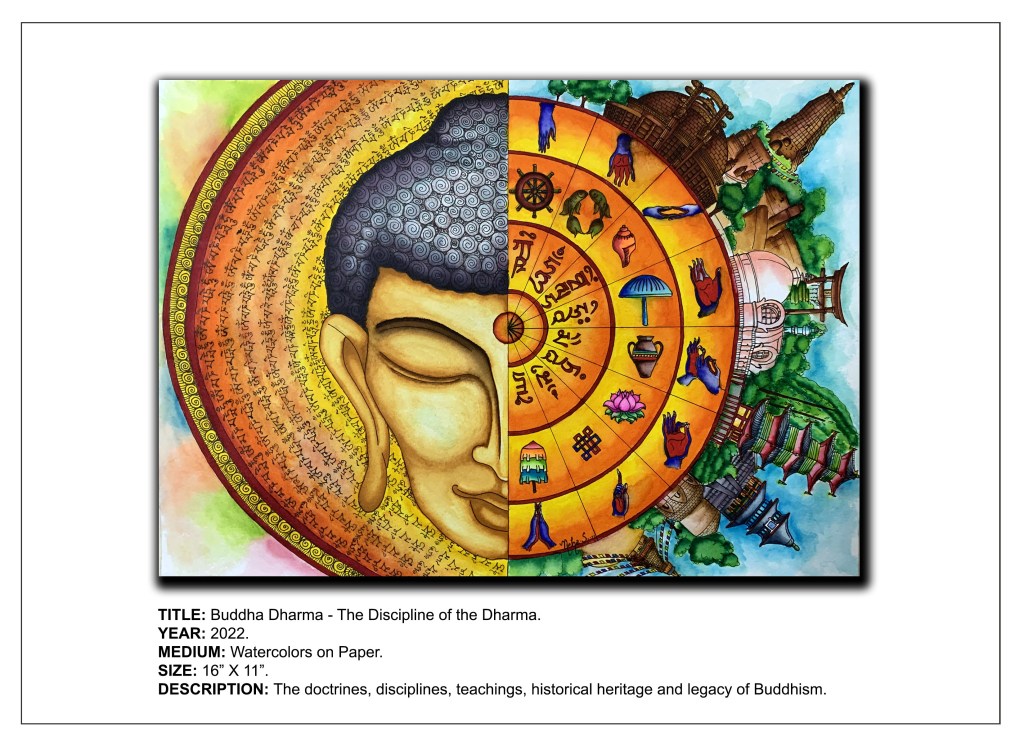
Reviving my blog and my art after a prolonged creative block. Today’s post is about my artwork titled Buddha Dharma – The Discipline of the Buddha, which is a sequel to the story of the Buddha and a continuation of my “Buddha Sutra” Series. Here’s an image of the artwork I have created:
Over his lifetime, the Buddha preached a wide range of teachings that were collectively known as the Dharma or Buddhadharma. This watercolor artwork depicts not only the doctrines, disciplines, and teachings of Dharma but also the historical heritage and legacy associated with it.Dharma has been symbolized in the painting by the powerful Sanskrit mantra – “Om Mani Padme Hum.” This mantra,within whichevery one of the Buddha’s teachings is believed to reside, has been illustrated in the halo surrounding the Buddha’s face on the left as well as inside the “Dharma Chakra” or Dharma Wheel on the right. Also depicted within the Dharma wheel is the “Ashtamangala” or the Eight Auspicious Symbols in Buddhism. These symbols, which are also teaching tools, include: the conch, endless knot, pair of golden fish, lotus, parasol, vase of jewels, Dharmachakra and victory banner. The various hand mudras associated with Buddhism have also been depicted within the Dharma Wheel.
The historical heritage of Buddhism has been illustrated in the form of Buddhist monuments of the likes of the Sanchi Stupa, the Mahaparinirvana Temple, the Mahabodhi temple, the Dhamekh Stupa, the Vishwa Shanti Stupa and some other monestaries and temples.
The Buddha’s teachings encompass the nature of the mind, the true nature of reality in the form of the existence and acknowledgement of suffering, the path to ending suffering, and finally the possibility of achieving nirvana through meditation and detachment.
“It is better to conquer yourself than to win a thousand battles. Then the victory is yours. It cannot be taken from you, not by angels or by demons, heaven or hell.”
The Buddha introduced into the world a philosophy which helped mankind navigate through his suffering. The life he led and the experiences that made him confront suffering also guided him to his final destination – the attainment of enlightenment. Buddha symbolizes a path to liberation and detachment from the triviality of the material world.
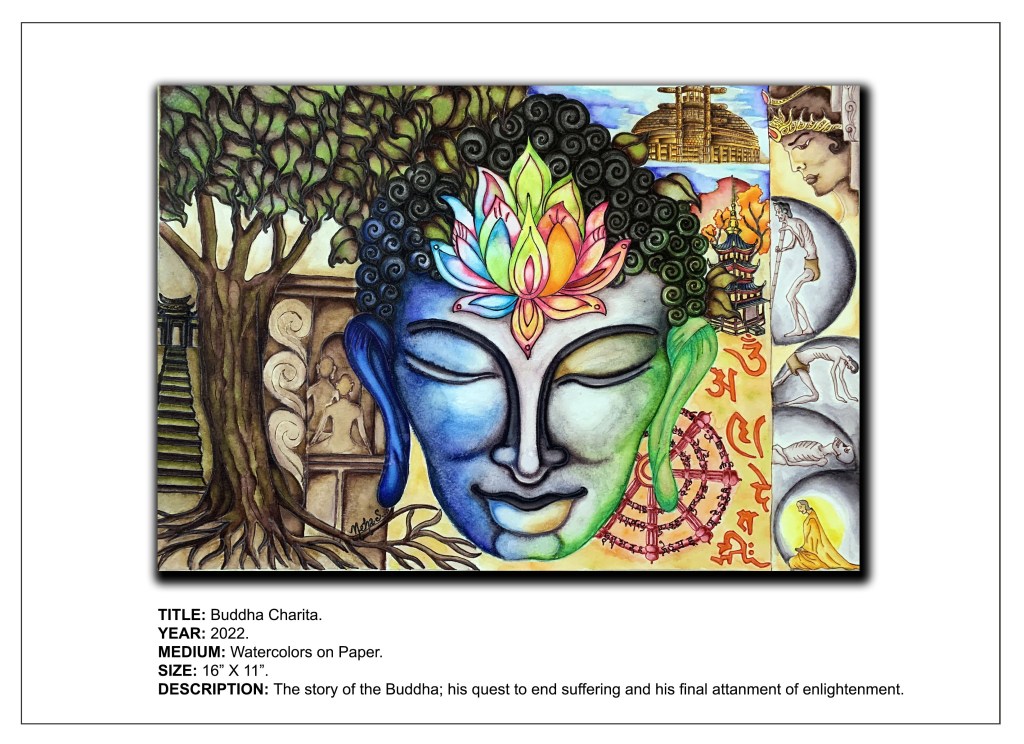
The most well-known historical account about the Buddha is the story of his life. It is this divine narrative that has become the inspiration for my latest artwork titled “Buddha Charita”, which is also the culmination of my new series – “Buddha Sutra”. Here’s an image of the artwork I have created:
This watercolor artwork is a visual narrative linking several events in the life of the Buddha from his days as Prince Siddhartha Gautama, his confrontation with suffering, his quest for a path towards the cessation of this suffering and his final liberation in the form of his “awakening”.
The first embodiment of the Buddha as the royal Prince Siddhartha has been represented in the right-hand corner of the artwork by an image of him, resplendent with royalty. This is followed by the next stage in his life, where he comes across the sight of a decrepit old man, a sick man, and a corpse which have all been portrayed one below the other in the artwork. These sights changed the perspective of the prince and opened his eyes to all the suffering that accompanies life. Also depicted in the painting, is the image of an ascetic that Gautama encountered, who had learned to seek out spiritual solace in the midst of these worldly miseries and sorrows. Determined to find the same enlightenment, Gautama turned towards the path of renunciation.
After exploring asceticism, or restraint from all physical needs and desires, he discovered meditation and used the practice as a path toward enlightenment. This led to the third stage in the life of Siddhartha, which is displayed in the artwork as the central image of the Buddha, “the awakened one”. The tree on the extreme left of the painting represents the sacredBodhi tree or the fig tree (Ficus religiosa) under which the Buddha meditated and finally reached the highest state of enlightenment or “nirvana,” which simply means “awakening”.
In addition to the figurative representation of the Buddha himself, his teachings have also been represented in the artwork through iconographic symbols of the likes of the Lotus flower and the Dharma Wheel. Other icons displayed in the artwork include various Buddhist monuments like pagodas and stupas, specifically the Sanchi Stupa, which is considered to be the most sacred monument of Buddhism, as it represents and displays various Buddhist ideals.
Through this artwork, I wish to honour Buddha’s life, for it is a reminder of the basic Buddhist principles that form the stepping stones to a higher spiritual level.It is these principles that serve as a source of strength in the grief-stricken world. It is my attempt to convey the philosophy of Buddha by reflecting on his life’s experiences and pledging to practice inward reflection to overcome sorrows, just as he did.


 The Art Dungeon