Hey folks! This week it’s going to be a short and sweet post. Working on a new project, albeit part of my ongoing “Buddha Sutra” series. Here’s a small snippet of what I am working on currently. Take a guess as to what it could be!
Do share what you think it is in the comments section below. Would love to hear your ideas. And yes! Look out for the final artwork which will be up soon!!
“Just like the lotus we too have the ability to rise from the mud, bloom out of the darkness and radiate into the world.”
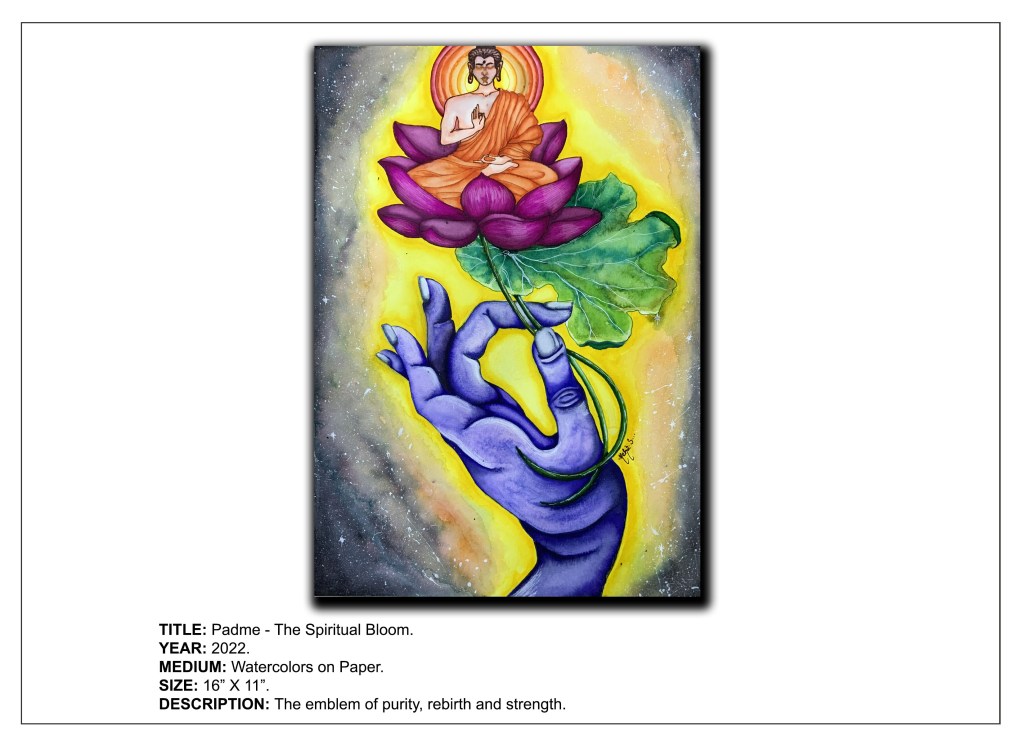
The lotus is one of the most revered and sacred symbols of Buddhism. It is this holy symbol that is the subject of today’s artwork tilted, “Padme – The Spiritual Bloom.”
The lotus represents spiritual awakening, purity, and rebirth as the act of emerging from muddy water symbolizes rising above the challenges and adversities of life and moving towards the light of wisdom. It also represents nonattachment, as it is rooted in mud (attachment and desire) but its flowers blossom on long stalks untarnished by the mud below (detachment).
Another important aspect of the lotus is that when it blossoms, it simultaneously plants a seed, representing the Buddhist concept of cause and effect, whereby the flower is symbolic of the cause and the seed-pod the effect.
The lotus serves as a reminder that all beings can attain enlightenment. Just as the blossom rises from the depths of murky ponds and lakes to bloom immaculately above the water’s surface, so can the human mind develop the virtues of the Buddha and transcend desire and attachment to reveal its essentially pure nature. It symbolizes the blooming of the soul from the filth of the physical world, eventually flourishing in the bright sunshine of enlightenment and attaining nirvana.
There are a variety of colors of the lotus associated with Buddhism. The pink lotus is the supreme one and is the true lotus of Buddha. It is for this reason that the Buddha in this artwork is depicted seated on a pink lotus, which indicates His enlightened and divine status.
All symbolism associated with the lotus points towards finding spiritual meaning in life. We all are like lotus blooms in the universal pond, striving to realize our true potential.
“There are no enlightened beings, only enlightened actions.”
Buddhism revolves around the principle of Dharma and encompasses various traditions, beliefs and practices of Lord Buddha. Buddha gave his first sermon in Sarnath to Kaundinya and four other scholars. In Isipatana of Sarnath, he preached about Dhammacakkappavattana Sutta, which includes Four Noble Truths and Noble Eightfold Path.
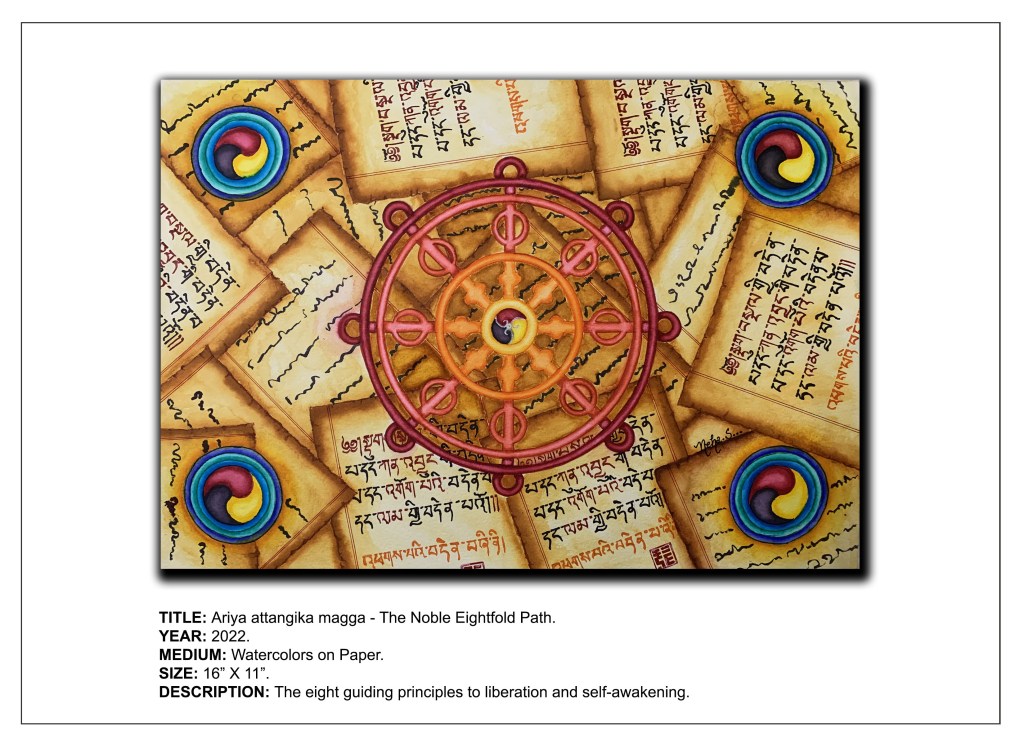
It is these fundamental doctrines of Buddhism that have been displayed in the artwork shown below, the title of the artwork being, “Ariya atthangika magga” – The Noble Eightfold Path. The Noble Eightfold Path is one of the principal teachings of Buddhism and is the fourth truth of the Four Noble Truths and regarded by Buddha as the medium to attain Enlightenment.
This artwork depicts the Noble Eightfold Path through the Dharma Wheel (Dharma Chakra), with its eight spokes representing the eight elements of the path, namely – right view, right resolve, right speech, right conduct, right livelihood, right effort, right mindfulness, and right concentration (or “samadhi”).
The four circles in the corners represent the Four Noble Truths, namely – The existence of suffering, its cause, its cessation and the path leading to its end. The path alluded to in the fourth truth is the Eightfold Path, which ultimately leads to enlightenment or Nirvana. This path is also depicted textually in the form of Tibetan manuscripts in the background of the artwork.
The Noble Eightfold Path is all about ending the suffering of life and achievement of self-awakening. It enables us to overcome the “I” and attain harmony with the world around us. Being always awake and aware, is fundamental to a good life.
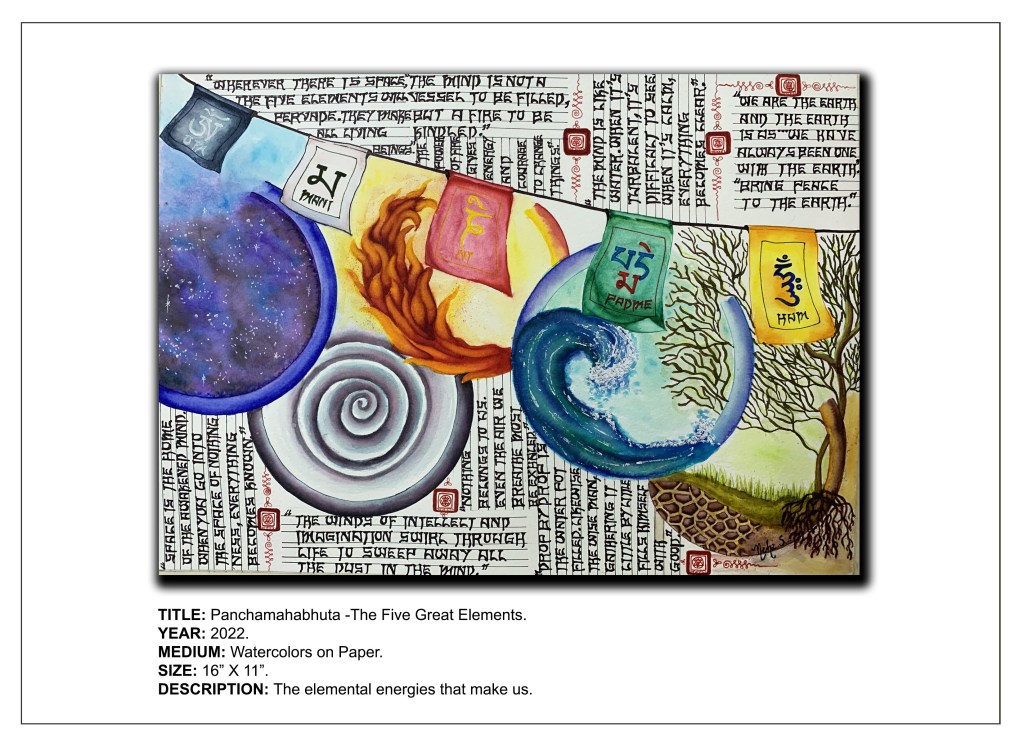
Earth, water, fire, air, and space are the five elemental energies that reside inside each one of us. It is these five elements that form the basis of this week’s watercolor artwork called Panchamahabhuta – The Five Great Elements. As in the title, these five elements are called “Panchamahabhuta” in Sanskrit and compose not only the universe, but the human body and mind.
The artwork
Each element represents a force of nature as well as a potential and quality of the human mind. The mind’s ability to serve as the ground for all experience is the quality of earth; its continuity and adaptability is water; its clarity and capacity to perceive is fire; its continuous movement is air and its unlimited emptiness is space.
These elements have been visually illustrated in the artwork along with corresponding text written in stylized calligraphy. Each element has also been represented as a Sanskrit syllable on prayer flags in synonymous colors.
We can discover our true potential by exploring and navigating through the terrain of these five elements that we are composed of. We can heal ourselves by acknowledging, aligning and connecting with these fundamental energies, thereby leading our lives with wisdom and grace.
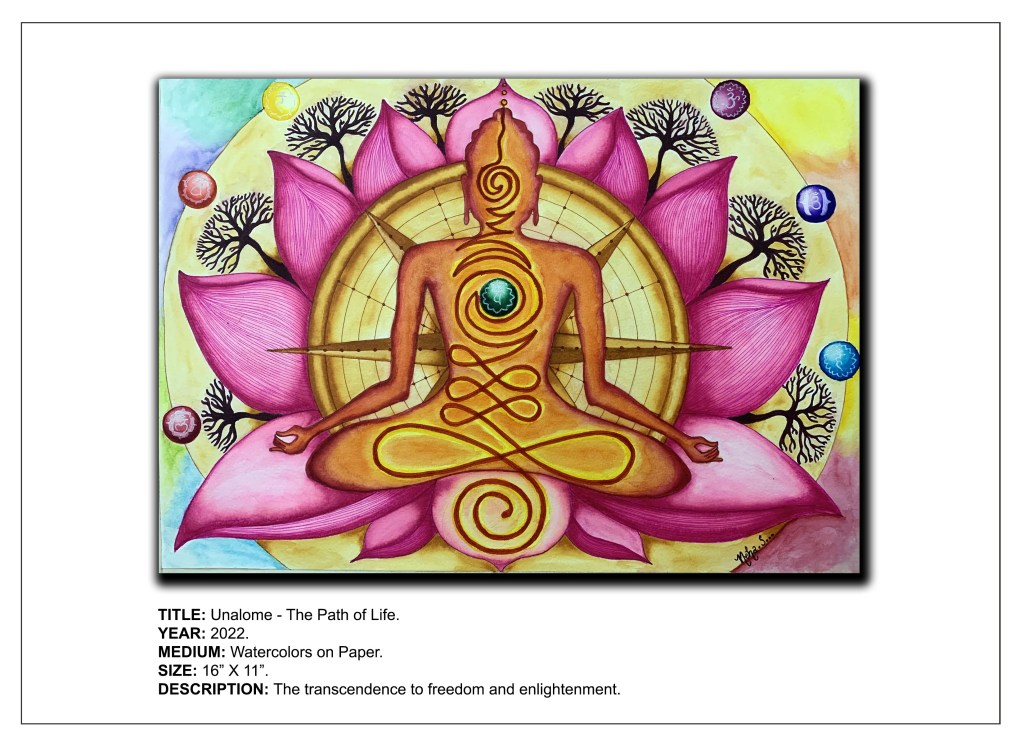
The Unalome is both a Buddhist and a Hindu spiritual symbol. It represents the path to freedom or enlightenment, or in simpler terms, your life’s path. The sign consists of three parts: the spiral, the swirl, and the dots at the end.
The spirals represent the twists and turns in life.With these ups and downs and unexpected encounters, one becomes more and more aware. The spiral represents the state before one spiritually awakens. After the spiral comes the swirl, which gets smaller and smaller and turns into a straight line. When you are aware of your thoughts, you have more focus and clarity and the road becomes less winding. The straight line is the moment of enlightenment or peace and harmony. When one gets out of the swirl, he or she suddenly see everything very clearly. Like a straight line. The road is pure, that’s where one is free and reaches enlightenment. The dots represent death, or the moment we fade into nothing. They also represent the uncertainty of life.
The lotus flower symbolizes how we can overcome all the obstacles on our journey to enlightenment and flourish. The Buddha is shown seated on a Lotus flower with a compass forming His halo. This symbolizes the path navigated by the compass of meditation towards freedom and enlightenment which can be achieved by harmonizing the 7 chakras depicted in the artwork. The trees represent growth and progress thereafter.
The Buddhist Unalome is a visual metaphor for the journey towards enlightenment. It inspires us to carve out our own path, which is unique to each one of us. Even though the journey as well as the path is uniquely different for each one of us, ultimately, the destination is the same – liberation.
“A disciplined mind brings happiness.” – Gautam Buddha.
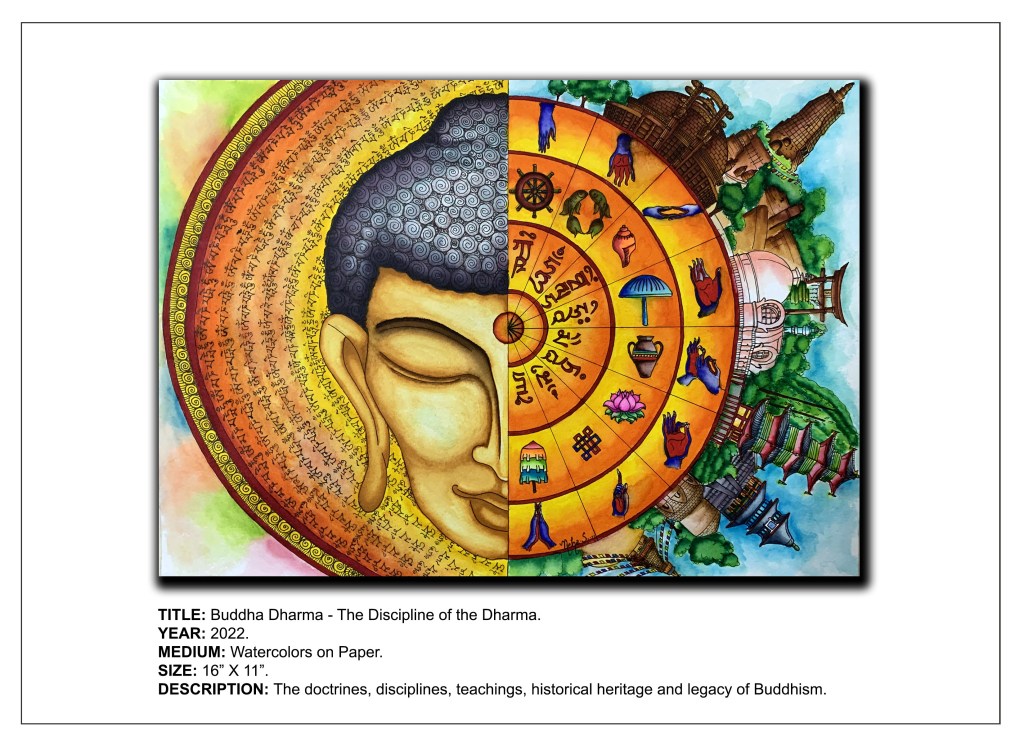
Reviving my blog and my art after a prolonged creative block. Today’s post is about my artwork titled Buddha Dharma – The Discipline of the Buddha, which is a sequel to the story of the Buddha and a continuation of my “Buddha Sutra” Series. Here’s an image of the artwork I have created:
Over his lifetime, the Buddha preached a wide range of teachings that were collectively known as the Dharma or Buddhadharma. This watercolor artwork depicts not only the doctrines, disciplines, and teachings of Dharma but also the historical heritage and legacy associated with it.Dharma has been symbolized in the painting by the powerful Sanskrit mantra – “Om Mani Padme Hum.” This mantra,within whichevery one of the Buddha’s teachings is believed to reside, has been illustrated in the halo surrounding the Buddha’s face on the left as well as inside the “Dharma Chakra” or Dharma Wheel on the right. Also depicted within the Dharma wheel is the “Ashtamangala” or the Eight Auspicious Symbols in Buddhism. These symbols, which are also teaching tools, include: the conch, endless knot, pair of golden fish, lotus, parasol, vase of jewels, Dharmachakra and victory banner. The various hand mudras associated with Buddhism have also been depicted within the Dharma Wheel.
The historical heritage of Buddhism has been illustrated in the form of Buddhist monuments of the likes of the Sanchi Stupa, the Mahaparinirvana Temple, the Mahabodhi temple, the Dhamekh Stupa, the Vishwa Shanti Stupa and some other monestaries and temples.
The Buddha’s teachings encompass the nature of the mind, the true nature of reality in the form of the existence and acknowledgement of suffering, the path to ending suffering, and finally the possibility of achieving nirvana through meditation and detachment.
I know I have been off the radar for a long time but I have a valid reason for that! The last few months have been extremely busy and exhilarating ones for me and I am super excited to share with you all that I recently had the pleasure of holding my very first solo art exhibition!
It was an incredibly challenging yet invigorating experience for me and nothing I have ever done before can match the thrill of seeing a gallery full of my work. Seeing my pieces on display in a radiant, well-lit space gave me a feeling of elation like none other. I never imagined it would feel so out of the world!
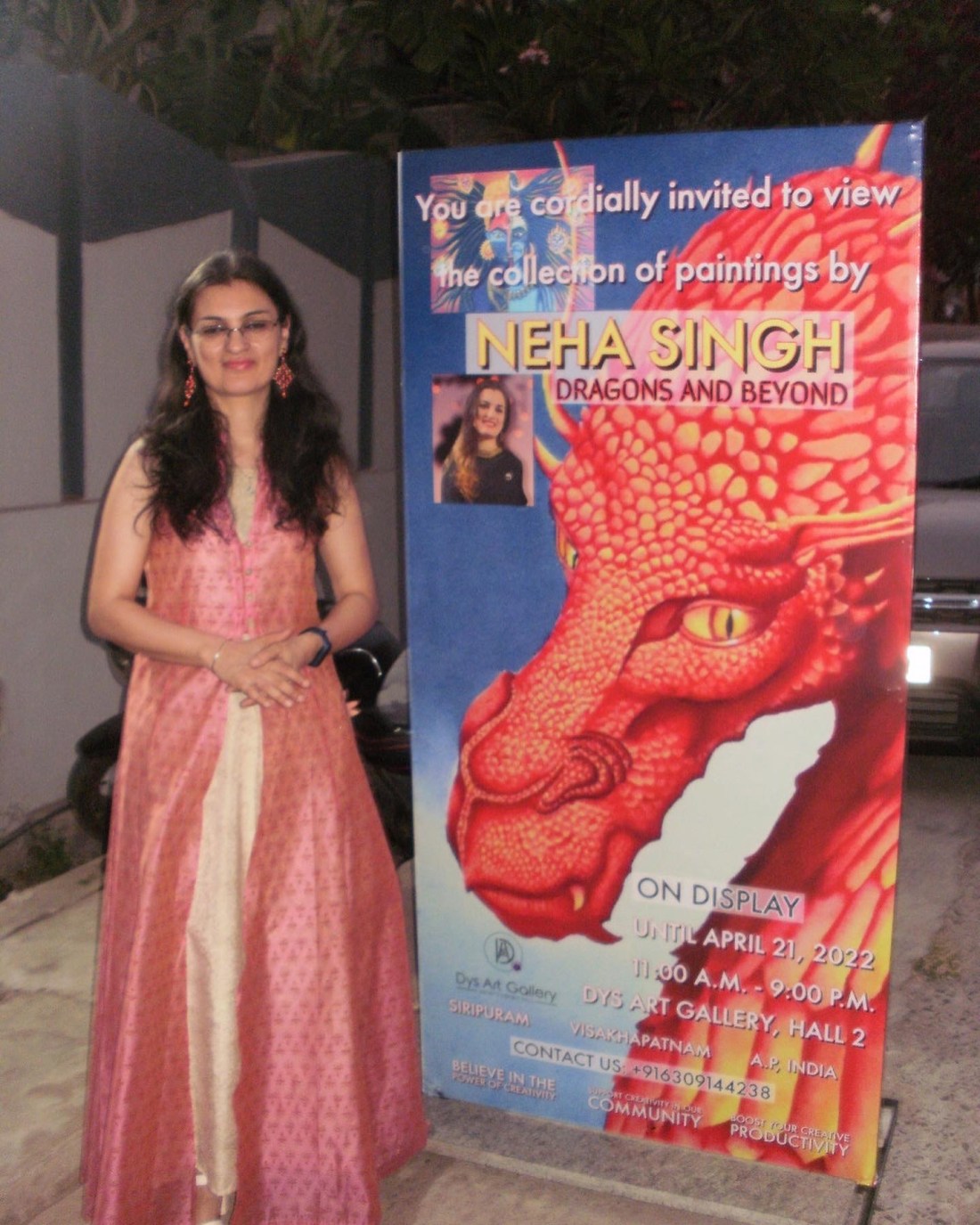
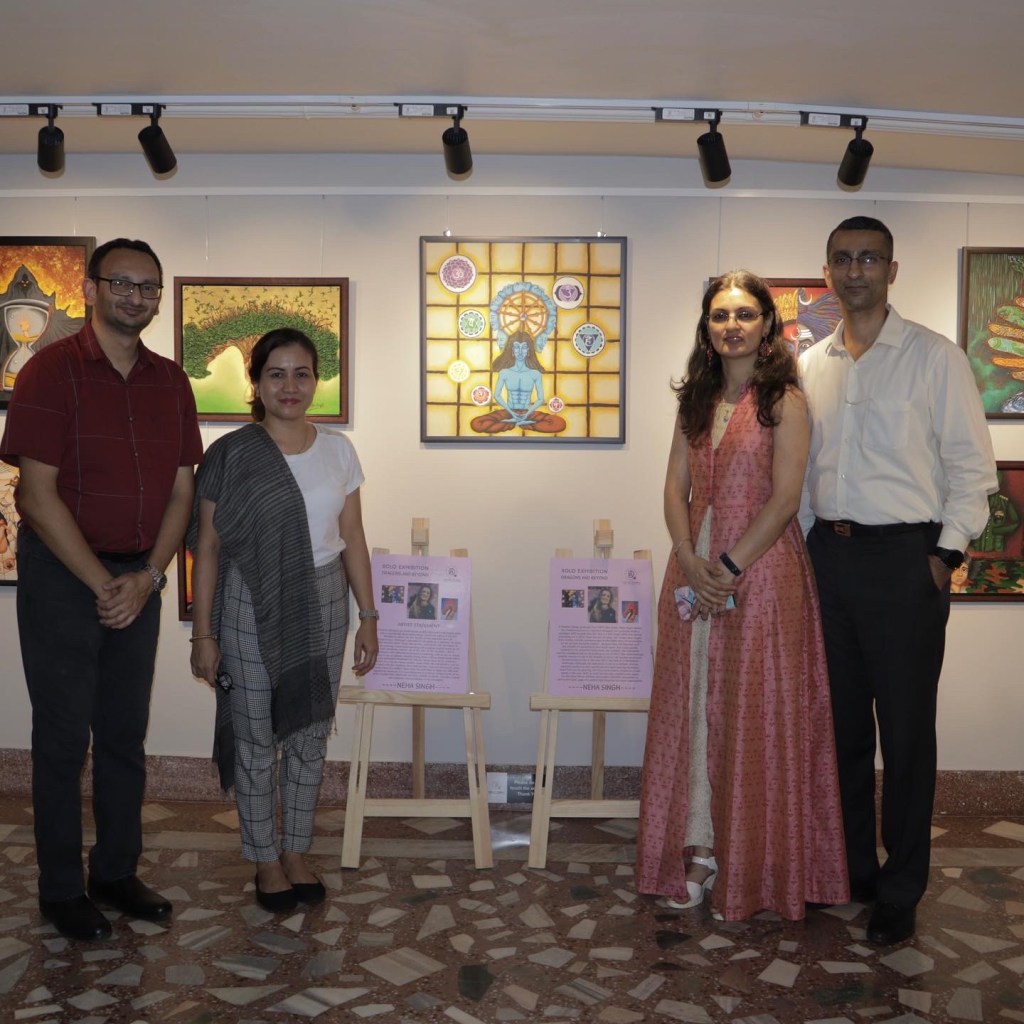
My artworks were on display at Dys Art Gallery, Siripuram Junction in Visakhapatnam from 15 April to 21 April 2022. The exhibit titled “Dragons and Beyond” was launched on the 15th of April 2022 and showcased a collection of 26 original works in all, which have been inspired by various muses, including my all-time favorite, the dragon.
Many of the artworks on display are works from earlier years while others are more recent as I wanted to put up a good mix from the past as well as the present. Most of my works belong to the genre of conceptual art and constitute my way of expressing not just what I feel and believe in, but also sharing the joy and pleasure I get from painting.
As mentioned earlier, the exhibit featured 26 original works for display as well as sale, ranging from small-scale paintings to medium sized ones. I had showcased three different series, namely the Dragon Series, the Navrasas series and the Lockdown Saga series.
Each piece in the collection has its own story to tell and a message to convey. It is my sincere endeavor and attempt not only to emote through my work, but also to send out a social message through my art. I hope my viewers can feel through my paintings what I feel and comprehend the deeper meaning behind each and every piece every time they look at one.
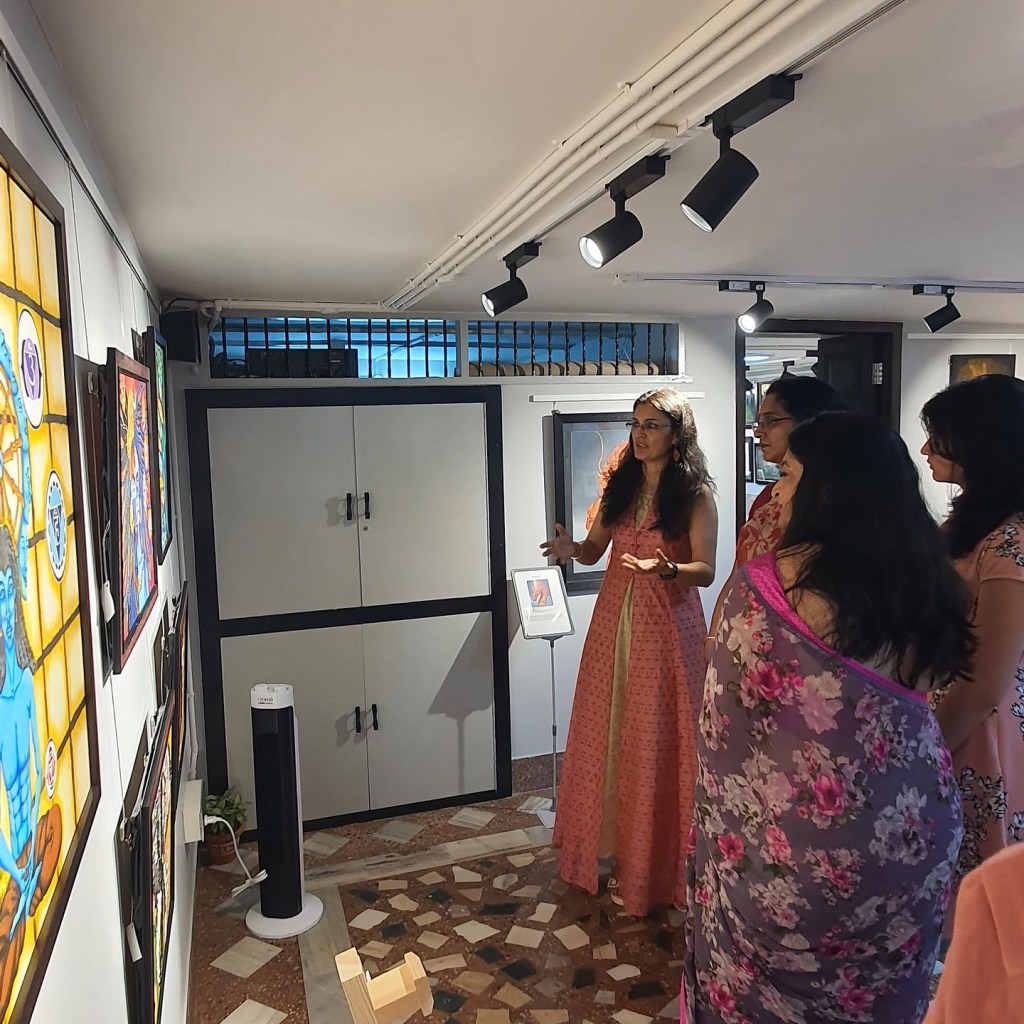
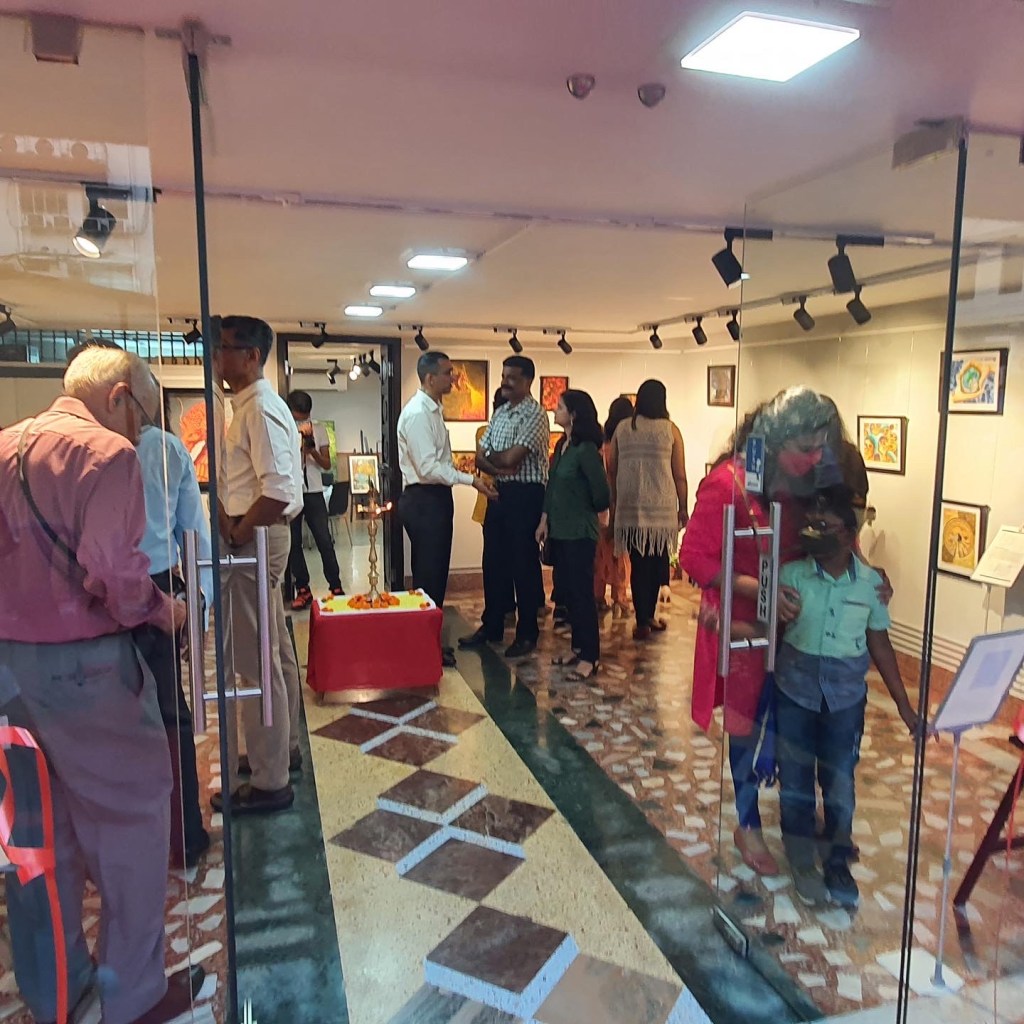
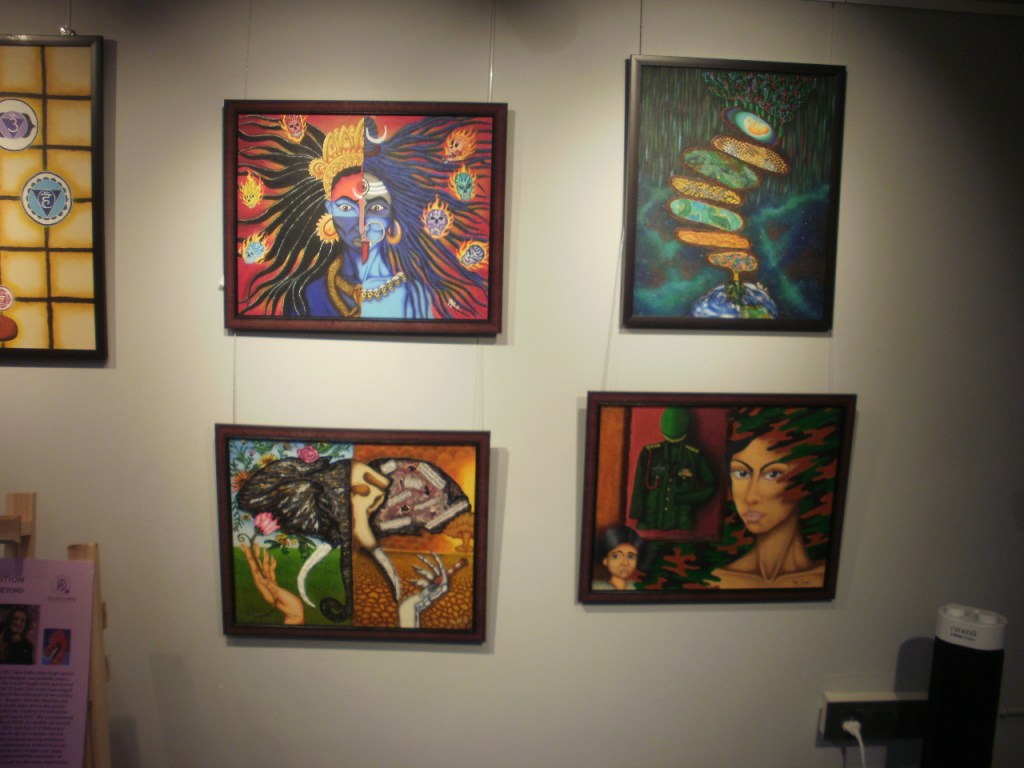
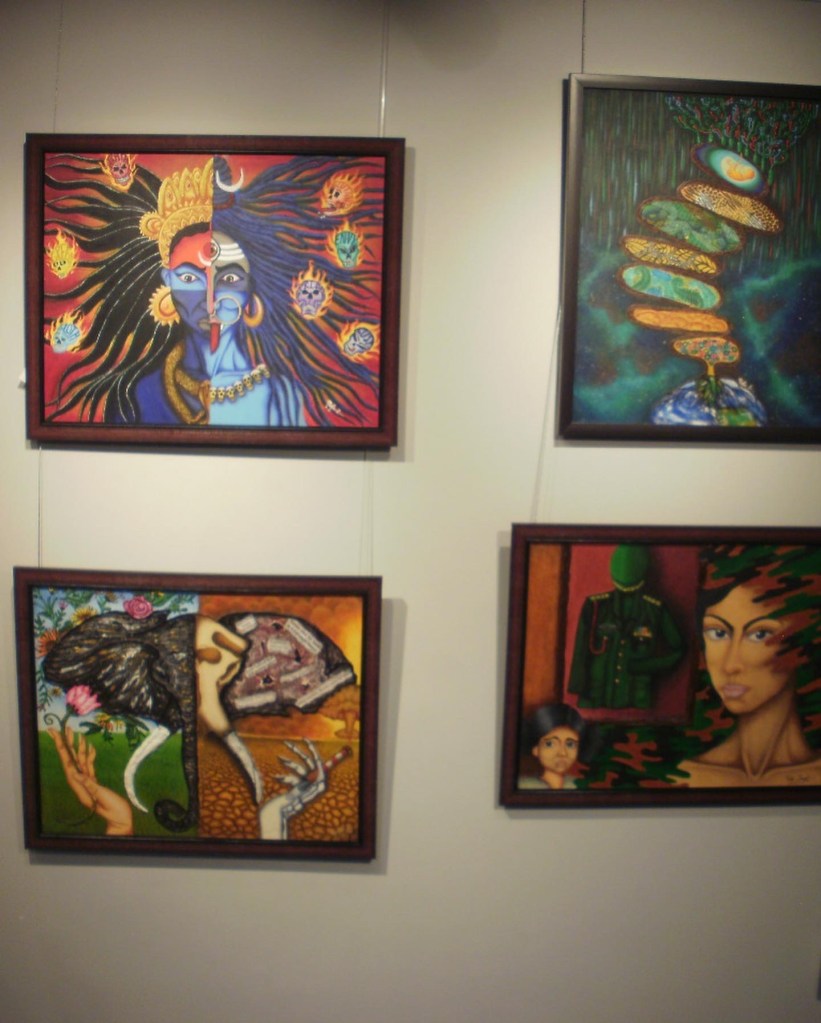
I also had the honor and privilege of being featured in the newspaper, The Hindu, along with my work. Sharing an image of the article and a few snapshots of the collection as well as the show.
The last few months leading up to this solo show have been a roller coaster ride, one full of mixed emotions and ups and downs, but in all, it has been a fabulous learning experience in terms of fine-tuning my creative process and growing as an artist. This was a life-time opportunity for me, a golden one at that and has been a long time coming. In fact, it’s been a life-long dream, and to see my dream becoming a reality is absolutely thrilling! I am grateful to the gallerists, Ms. Gladys Rathi and Mr. Krishna Rathi for providing me with this opportunity and special thanks to my dear husband for discovering this place..couldn’t have done it without you!
Hey folks! Here I am again with my next post about yet another magazine cover artwork that I have had the distinct pleasure and honor of creating. So, without further ado, let’s get started!
The artwork I am sharing today is based on the theme “Honoring the Past, Treasuring the Present and Shaping the Future.” Conceptualizing an artwork around this thought has been quite a challenge for me as not only is this subject extremely profound, but is also a challenging one in itself.
Here are a few snapshots of the original artwork that I created in accordance with the above theme as well as the magazine’s cover page showcasing it. Also including a small write up explaining the concept, that was published in the magazine.
The original artwork
The cover pageThe write up
When I started working on this concept, I was in quite a fix and it seemed like a herculean task to be able to justify a theme as complex as this one. It was my good fortune when I came across this quote – “Past is experience, Present is Experiment and Future is Expectation. Use your experience in your experiments to achieve your expectations.” This motivational mantra became the basis of my artwork and helped me in conceiving the idea behind it.
It is my belief that the past is a treasure trove of wisdom and experience that has been left behind by our ancestors and elders. I have tried to reaffirm this through the silhouette of the old woman, thereby symbolizing our ancestry. I have illustrated the legacy that they have bestowed upon us in the form of their age-old ways of simplistic and holistic living. It is this past heritage that we need to honor by imbibing it in our present-day lifestyle.
The present that we live in today is work in progress and a reservoir of everything from the past. It is this reservoir that I have portrayed in the artwork as an amalgamation of our values, customs, traditions as well as our environment and ecosystem. I have also personified the present through a younger woman’s silhouette who is seen nestling the future – our world – in her arms, at the same time honoring her forebearers by seeking their blessings. The baby in her arms symbolizes our future world which will be shaped by our coming generations.
So this is how I have approached the theme and tried to express it as best as I could through my artwork. I believe that what we have today is what we need to cherish and conserve as it is as valuable as our past. For it is this past and the present working hand in hand that will mold the future for the world to come.
Hey all! I know I have been MIA for quite some time but I’m back now with a new post about my most recent artwork. This too has been long overdue, as I allowed procrastination to get the better of me, but finally, I have succeeded in completing it!
In one of my previous posts, I had talked about how a book can become the source of inspiration for my art, in particular the third book of the Ram Chandra Series – Raavan: Enemy of Aryavarta, by the Indian author Amish Tripathi. This work of fiction chronicles the life of Ravan and portrays him as an artist among other things. One of the excerpts from the book describes a painting made by him that is not only a character sketch of himself but also a logically befitting description of the concept of “dharma” or the “righteous path”. (Click on the following link to read this post – https://theartdungeon.blog/2021/06/06/inspiration-calling/).
The beautiful artwork created by Ravan and described in this excerpt was not just a vivid description of Ravan’s psyche, but also a profound portrayal of his struggle to attain the right direction through the “moral compass” called dharma.
This one-of-a-kind piece of art became my muse purely because of the distinctive way in which it brings out the true essence of Ravan. I was so enamored by his narrative that I couldn’t wait to interpret it in my own way and create my very own version onto my canvas. Finally, I managed to do that and here I present to you, my acrylic painting titled “Moksha”.
In the book, Ravan describes a painting created by him that depicts his struggle to attain enlightenment. I have attempted to depict his mental turmoil and his desperate attempts to scale the wall of the Nine emotions or the Navrasas that hold him down. The ten heads in my artwork correspond to the ten heads of Ravan himself. Out of these, 9 represent the Navrasas, one for each emotion, whereas the tenth head is the state of spiritual awakening that Ravan is striving to achieve.
I have further attempted to add on to the concept by depicting the 7 chakras or the main energy centers that control our body. My endeavor is to reaffirm that one can only transcend the wall of emotions by opening up all the chakras, allowing energy to flow freely, thereby harmonizing the body, mind as well as the spirit. It is only this equilibrium that can help one attain physical, emotional and spiritual “moksha” – which was not just the “righteous path” being pursued by Ravan, but also the “dharma” attained by the Buddha.
Hope you all like my approach towards Ravan and his “moksha!”
Hello everyone! This post is extremely special as the artwork I am sharing today is the culmination of my Navrasa Series of works. For the uninitiated, Navrasas are the 9 emotions that form the foundation of Indian classical dance and music, theatre, art and literature, essentially the traditional Indian performing arts. These are the basic emotions, moods or sentiments that figure in the daily lives of every human being. (Click on the following link to learn more about these 9 emotions and the concept of Navrasas – https://theartdungeon.blog/2019/09/21/the-art-of-emotions/)
Coming to the emotion I am covering today, that is, Vibhatsa Rasa. The word “Vibhatsa” is a Sanskrit word that means “disgust” and is traditionally represented by the color blue in Indian art and literature. It is a feeling of Disgust or dissatisfaction with oneself and others. Vulgar, uncivilized, and perverted actions, using bad words and manners, and showing bad intentions to others are all manifestations of the Vibhatsa Rasa. All creative arts, dance and theatre to fine arts and literature and poetry are replete with imagery that pertains to Vibhatsa.
In today’s post, I am sharing my depiction of the Vibhatsa rasa through my artwork titled Vibhatsa – The Web of Disgust. This painting is an expression of how much a woman detests being considered as an object of gratification by the society and is disgusted by its countless atrocities. She loathes the unending discrimination and is sickened by the web of deceit and immorality that has been spun around her by the social order. She is so outraged by the incessant delinquency of the world around her that she is absolutely repulsed by it, just like the spindly gossamer of a spider that clings to the skin until it evokes a feeling if disgust. The medium I have used to create this artwork is oil paints and the color palette mainly consists of warm earthy tones of the likes of cream, off-white, browns etc. This of course is a deviation from the traditional color of blue that has been designated to the emotion in question, but I have always been one to break the norm. Here’s an image of the artwork followed by links to a couple of videos displaying the making of the artwork and some behind the scenes snippets:
As is visible in the painting, it depicts disgust through the lacy spindles of a spider’s web which portrays within itself the various atrocities and injustices that the feminine gender endures. Apart from this, I have also used symbolism in the form of the eye and the eye ball to represent the objectification of the fairer sex and the claw-like hands to signify the society preying on her.
When it comes to a subject like emotions, their portrayal and in turn their interpretation becomes a matter of perspective, not just for the artist but for the viewers as well. What may seem positive to the artist may be perceived as negative by his audience or vice versa. Moreover, it also depends on the mindset of the person, hence emotions in art are a totally subjective prospect.
Vibhatsa being a negative emotion in itself ideally comes across negatively in art but it has been my sincere attempt to bring it out as positively as possible through this painting. I intend it to be thought provoking and serve as an eye opener to the society with an aim to bring in the winds of change. I hope that this message emanates loud and clear through this artwork and is interpreted positively rather than negatively.
DISCLAIMER – All the information, data and imagery in this blog post is for informational and educational purpose only. Some images and data may have been taken from the links included below and I give full credit to these websites/pages, thereby in no way claiming them to be my own. Other data is based on my personal experiences and opinions.