Featured

The Big Reveal!!

Hey fellow art enthusiasts! As promised, here I am with the outcome of the little snippet I shared in last week’s post!! So, are you all ready for the big reveal? Here it is!

This is it!
The final artwork

This watercolor artwork is called Bo Tree – The Emblem of Enlightenment. It is a representation of the Bodhi Tree (Ficus religiosa), under which Siddharth Gautam, who later became known as the Buddha, is said to have attained enlightenment or Buddhahood.

The Bodhi Tree is a principal religious symbol in Buddhism due to its prominence in the Buddha’s discovery of enlightenment, or total peace and happiness in the form of Nirvana, or the greater reality. “Bodhi” means awareness and Bodhi tree means the tree under which Buddha becomes fully aware of the noble truth of the universe.

Essentially the ‘tree of awakening,’ also known as the Bo Tree, in Pali it is known as the “bodhirukkha,” in Sanskrit the “bodhivka” and to botanists as Ficus religiosa. Given its close association with the attainment of Buddhahood, the tree has great symbolic significance.

This tree as depicted in the artwork represents the supreme knowledge acquired by the Buddha during his tireless meditation. It conveys the teachings and sermons he preached and passed on to his disciples and followers. These teachings are illustrated in the artwork in the Pali script and represented as scribbles in the canopy of the tree.  The tree reflects the capacity of every human being to follow in the footsteps of the Buddha in achieving the ultimate spiritual goal by letting go of the finite self through meditation and self-discipline. The heart-shaped leaves of the Bodhi tree symbolize peace and happiness developing in one’s heart during the journey towards Nirvana.

The Bodhi tree is the DNA of Buddha’s teachings, an emblem of peace and a reminder of the eventual prospect of enlightenment that lies within us all.  

Featured

Guess What’s On My Easel?

Hey folks! This week it’s going to be a short and sweet post. Working on a new project, albeit part of my ongoing “Buddha Sutra” series. Here’s a small snippet of what I am working on currently. Take a guess as to what it could be!

Do share what you think it is in the comments section below. Would love to hear your ideas. And yes! Look out for the final artwork which will be up soon!!

Featured

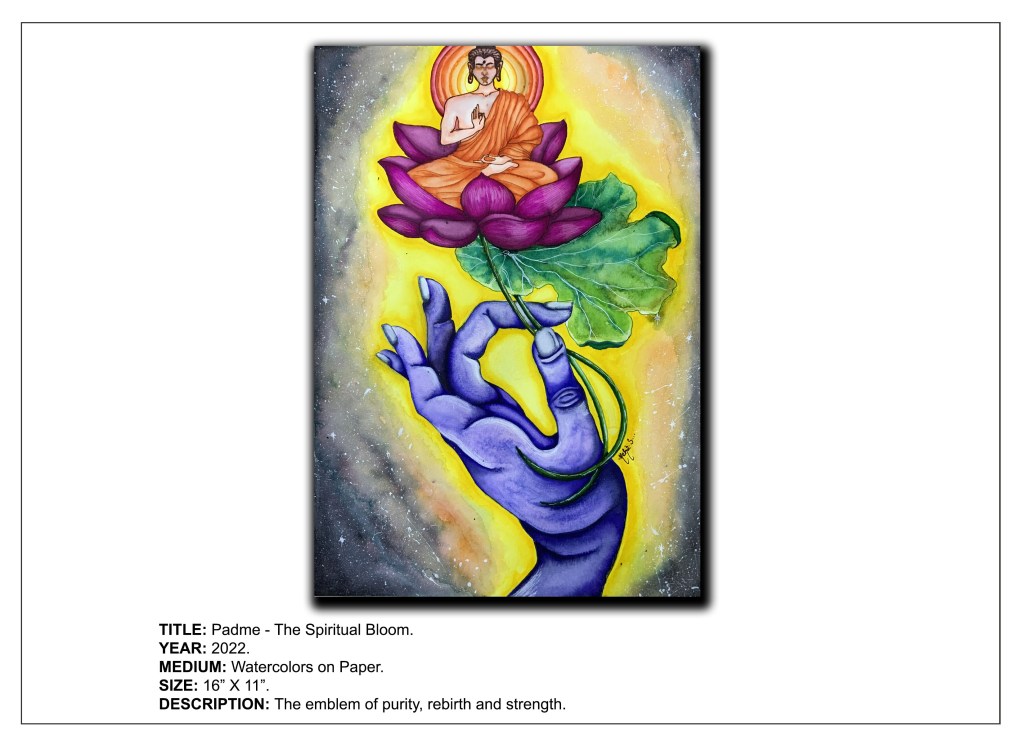
Padme – The Spiritual Bloom

Padme – The Spiritual Bloom

“Just like the lotus we too have the ability to rise from the mud, bloom out of the darkness and radiate into the world.”

The lotus is one of the most revered and sacred symbols of Buddhism. It is this holy symbol that is the subject of today’s artwork tilted, “Padme – The Spiritual Bloom.”

The lotus represents spiritual awakening, purity, and rebirth as the act of emerging from muddy water symbolizes rising above the challenges and adversities of life and moving towards the light of wisdom. It also represents nonattachment, as it is rooted in mud (attachment and desire) but its flowers blossom on long stalks untarnished by the mud below (detachment).

Another important aspect of the lotus is that when it blossoms, it simultaneously plants a seed, representing the Buddhist concept of cause and effect, whereby the flower is symbolic of the cause and the seed-pod the effect.

The lotus serves as a reminder that all beings can attain enlightenment. Just as the blossom rises from the depths of murky ponds and lakes to bloom immaculately above the water’s surface, so can the human mind develop the virtues of the Buddha and transcend desire and attachment to reveal its essentially pure nature. It symbolizes the blooming of the soul from the filth of the physical world, eventually flourishing in the bright sunshine of enlightenment and attaining nirvana.

There are a variety of colors of the lotus associated with Buddhism. The pink lotus is the supreme one and is the true lotus of Buddha. It is for this reason that the Buddha in this artwork is depicted seated on a pink lotus, which indicates His enlightened and divine status.

 All symbolism associated with the lotus points towards finding spiritual meaning in life. We all are like lotus blooms in the universal pond, striving to realize our true potential.

Featured

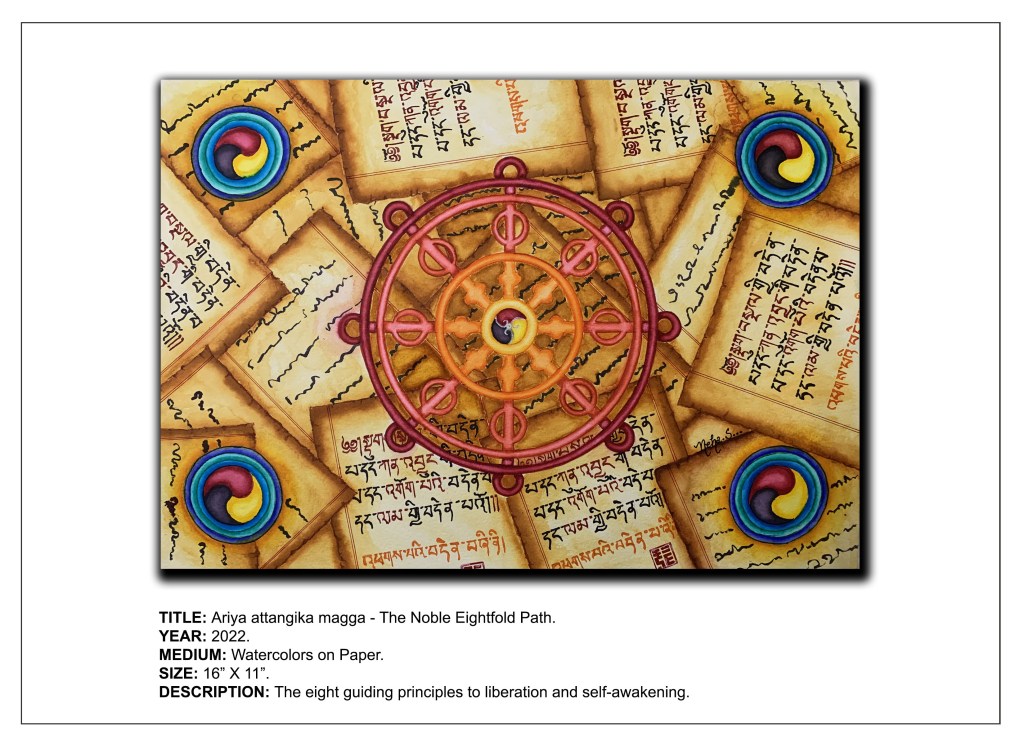
“Ariya atthangika magga” – The Noble Eightfold Path

“There are no enlightened beings, only enlightened actions.”

Buddhism revolves around the principle of Dharma and encompasses various traditions, beliefs and practices of Lord Buddha. Buddha gave his first sermon in Sarnath to Kaundinya and four other scholars. In Isipatana of Sarnath, he preached about Dhammacakkappavattana Sutta, which includes Four Noble Truths and Noble Eightfold Path.

It is these fundamental doctrines of Buddhism that have been displayed in the artwork shown below, the title of the artwork being, “Ariya atthangika magga” – The Noble Eightfold Path. The Noble Eightfold Path is one of the principal teachings of Buddhism and is the fourth truth of the Four Noble Truths and regarded by Buddha as the medium to attain Enlightenment.

This artwork depicts the Noble Eightfold Path through the Dharma Wheel (Dharma Chakra), with its eight spokes representing the eight elements of the path, namely – right view, right resolve, right speech, right conduct, right livelihood, right effort, right mindfulness, and right concentration (or “samadhi”).

The four circles in the corners represent the Four Noble Truths, namely – The existence of suffering, its cause, its cessation and the path leading to its end. The path alluded to in the fourth truth is the Eightfold Path, which ultimately leads to enlightenment or Nirvana. This path is also depicted textually in the form of Tibetan manuscripts in the background of the artwork.

The Noble Eightfold Path is all about ending the suffering of life and achievement of self-awakening.  It enables us to overcome the “I” and attain harmony with the world around us. Being always awake and aware, is fundamental to a good life.