Featured

Panchamahabhuta – The Five Great Elements

AIR moves us

FIRE transforms us

WATER shapes us

EARTH heals us

SPACE awakens us

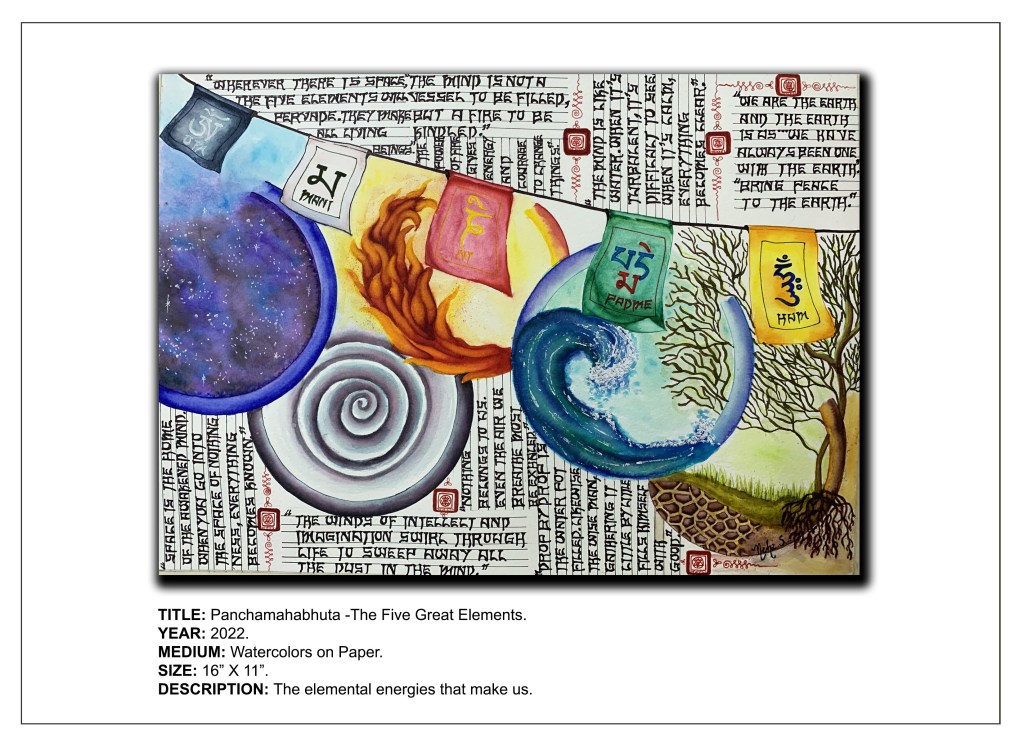
Earth, water, fire, air, and space are the five elemental energies that reside inside each one of us. It is these five elements that form the basis of this week’s watercolor artwork called Panchamahabhuta – The Five Great Elements. As in the title, these five elements are called “Panchamahabhuta” in Sanskrit and compose not only the universe, but the human body and mind.
The artwork

Each element represents a force of nature as well as a potential and quality of the human mind. The mind’s ability to serve as the ground for all experience is the quality of earth; its continuity and adaptability is water; its clarity and capacity to perceive is fire; its continuous movement is air and its unlimited emptiness is space.

These elements have been visually illustrated in the artwork along with corresponding text written in stylized calligraphy. Each element has also been represented as a Sanskrit syllable on prayer flags in synonymous colors.

We can discover our true potential by exploring and navigating through the terrain of these five elements that we are composed of. We can heal ourselves by acknowledging, aligning and connecting with these fundamental energies, thereby leading our lives with wisdom and grace.
Featured

Unalome – The Path of Life

Presenting the next watercolor installment in my “Buddha Sutra” Series – I call this one Unalome – The Path of Life.

Also available on instagam – https://www.instagram.com/p/Ckgd1bdP2lF/

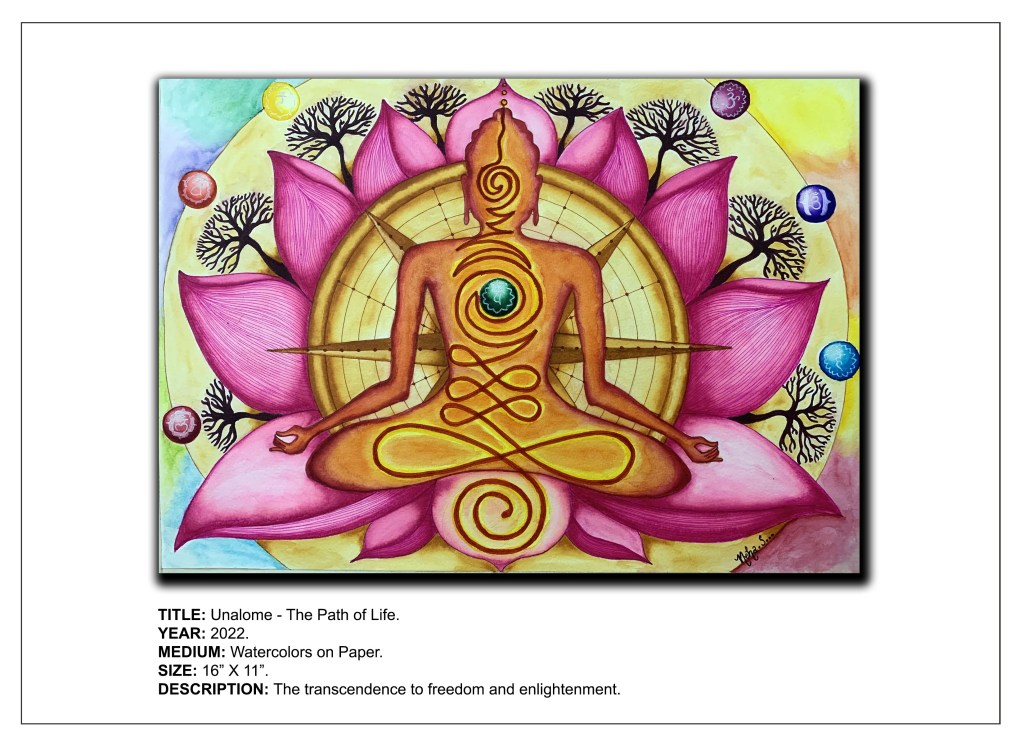
The Unalome is both a Buddhist and a Hindu spiritual symbol. It represents the path to freedom or enlightenment, or in simpler terms, your life’s path. The sign consists of three parts: the spiral, the swirl, and the dots at the end.

The spirals represent the twists and turns in life. With these ups and downs and unexpected encounters, one becomes more and more aware. The spiral represents the state before one spiritually awakens.  After the spiral comes the swirl, which gets smaller and smaller and turns into a straight line. When you are aware of your thoughts, you have more focus and clarity and the road becomes less winding. The straight line is the moment of enlightenment or peace and harmony. When one gets out of the swirl, he or she suddenly see everything very clearly. Like a straight line. The road is pure, that’s where one is free and reaches enlightenment. The dots represent death, or the moment we fade into nothing. They also represent the uncertainty of life.

The lotus flower symbolizes how we can overcome all the obstacles on our journey to enlightenment and flourish. The Buddha is shown seated on a Lotus flower with a compass forming His halo. This symbolizes the path navigated by the compass of meditation towards freedom and enlightenment which can be achieved by harmonizing the 7 chakras depicted in the artwork. The trees represent growth and progress thereafter.

The Buddhist Unalome is a visual metaphor for the journey towards enlightenment. It inspires us to carve out our own path, which is unique to each one of us. Even though the journey as well as the path is uniquely different for each one of us, ultimately, the destination is the same – liberation.

Featured

Buddha Dharma – The Discipline of the Dharma

“A disciplined mind brings happiness.” – Gautam Buddha.

Reviving my blog and my art after a prolonged creative block. Today’s post is about my artwork titled Buddha Dharma – The Discipline of the Buddha, which is a sequel to the story of the Buddha and a continuation of my “Buddha Sutra” Series.  Here’s an image of the artwork I have created:

The making of the artwork – https://www.instagram.com/p/CjaGde-rKXc/

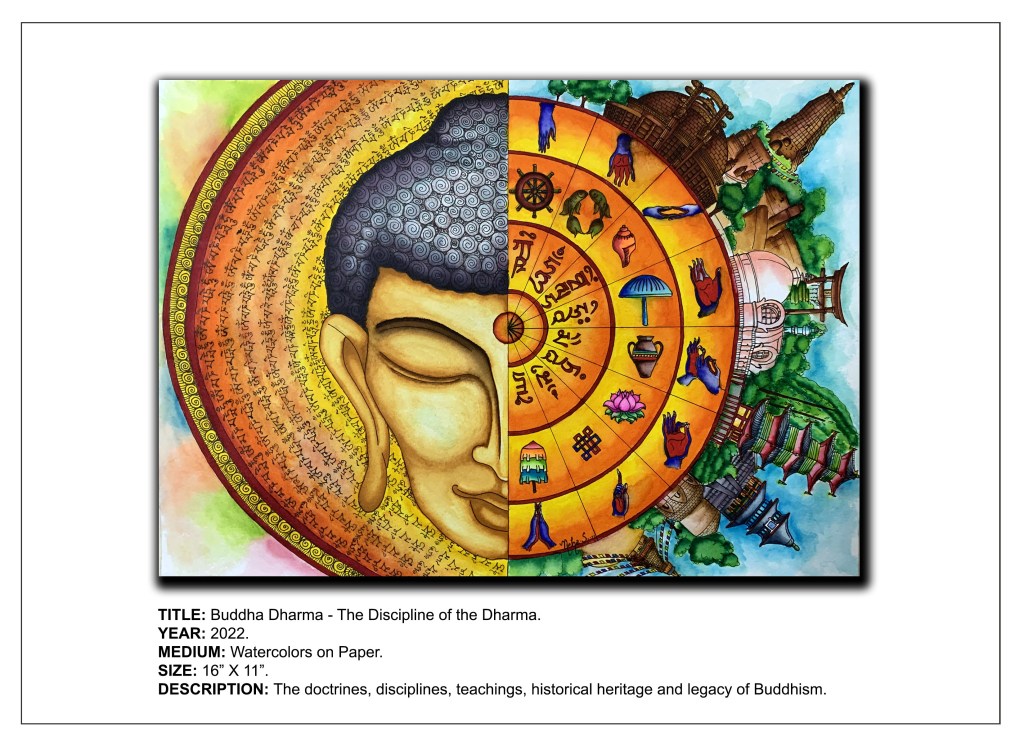
Over his lifetime, the Buddha preached a wide range of teachings that were collectively known as the Dharma or Buddhadharma. This watercolor artwork depicts not only the doctrines, disciplines, and teachings of Dharma but also the historical heritage and legacy associated with it. Dharma has been symbolized in the painting by the powerful Sanskrit mantra – “Om Mani Padme Hum.” This mantra, within which every one of the Buddha’s teachings is believed to reside, has been illustrated in the halo surrounding the Buddha’s face on the left as well as inside the “Dharma Chakra” or Dharma Wheel on the right.  Also depicted within the Dharma wheel is the “Ashtamangala” or the Eight Auspicious Symbols in Buddhism. These symbols, which are also teaching tools, include: the conch, endless knot, pair of golden fish, lotus, parasol, vase of jewels, Dharmachakra and victory banner. The various hand mudras associated with Buddhism have also been depicted within the Dharma Wheel.

The historical heritage of Buddhism has been illustrated in the form of Buddhist monuments of the likes of the Sanchi Stupa, the Mahaparinirvana Temple, the Mahabodhi temple, the Dhamekh Stupa, the Vishwa Shanti Stupa and some other monestaries and temples.

The Buddha’s teachings encompass the nature of the mind, the true nature of reality in the form of the existence and acknowledgement of suffering, the path to ending suffering, and finally the possibility of achieving nirvana through meditation and detachment.